

Anti-rights groups marched in Paraguay against the education reform
Self-proclaimed “pro-life” groups marched in Asunción in defense of the traditional family and against the “globalist agenda” and “gender ideology”.


Share

ASUNCIÓN, Paraguay. The march organized by the Citizens' Network for Children and Adolescents (Recnapy), made up of 35 parent, Catholic, and Evangelical organizations, took place on Thursday, October 20. Self-described "pro-life" and "pro-family" groups from across the country gathered in the morning at Democracy Square in Asunción. Their objective was to halt the National Educational Transformation Plan (PNTE) and prevent the inclusion of "gender ideology" in Paraguayan classrooms.
That day, the streets and social media were flooded with fake news, baseless demands, and confusion. Anti-rights signs prominently displayed the syllable "trans" (as in transformation) in the colors of sexual and gender diversity. They alluded to transgender people and a supposed hidden agenda of the Ministry of Education and Science (MEC).
“Gender ideology is pedophilia, gender ideology is sex with children. We have to be that direct,” said Gabriela Vergara, an anti-rights and anti-vaccine leader from the organization Vida y Libertad (Life and Liberty).
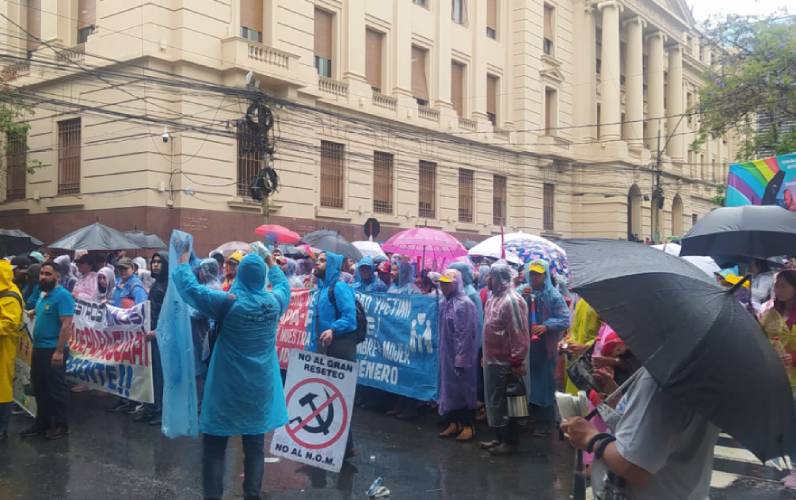
Photo: Juliana Quintana.
A project that nobody read
When the protesters were asked about the most objectionable aspects of the National Education Program (PNTE), they responded with clichés: “Not with the children,” “It has gender ideology,” or “We’re here to defend the family.” They also admitted, in every case, that they hadn’t read the Ministry of Education and Culture’s (MEC) materials. They cited the Facebook page of Somos Muchos Muchos Más (We Are Many Many More) and other “pro-life” organizations responsible for spreading misinformation as sources.
Many of the people who attended refused to answer questions about why they were there. That day, a memorandum signed by the acting head of the Cabinet Office of the Municipality of Asunción, Santiago Cabrera, was made public. It invited public officials to participate in the anti-rights march .
The governor of Alto Paraná, Roberto González Vaesken, accused in 2019 by his own wife, Darsy González Duarte, of committing acts of pedophilia , declared a holiday to participate in the march against the Educational Transformation Plan. Photos of buses full of people traveling to Asunción for the march circulated in WhatsApp groups administered by Miguel Ortigoza and Fabián Maldonado. According to the Minister of Education, Nicolás Zárate, the mobilization had political motives and blamed former president Horacio Cartes.
The reform consensus
On September 28, the Ministry of Education and Sciences (MEC) announced that the socialization of the Educational Transformation Plan would continue until April 2023. But Recnapy stated that the “ideologies imposed” in the PNTE are part of the Paraguay 2030 National Development Plan, and that the implementation of the 2030 Agenda in Paraguay “was neither discussed nor agreed upon” with the Paraguayan people.
However, in addition to the various surveys carried out by the MEC, the Strategic Committee of the PNTE is composed of Nicolás Zárate, Minister of Education; Viviana Casco, from the Technical Secretariat of Planning for Economic and Social Development (STP); Oscar Llamosas, Minister of Finance; Carmen Marín, head of the Management Unit of the Presidency of the Republic and six members of civil society, including Miguel Ortigoza.
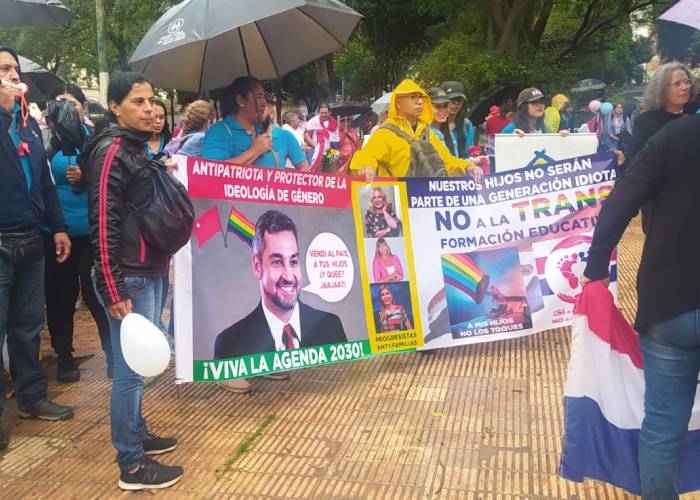
Photo: Juliana Quintana
The disinformers of the PNTE
Ortigoza is a well-known evangelical pastor at the Family Worship Center (CFA). He is also a spokesperson for the National Federation of Parents' Associations of Paraguay (Fenapep), has been active on social media for months , and participates in media debates.
While the CFA pastor denied that former president Horacio Cartes was behind the mobilization , he has publicly appeared in the past supporting events of Honor Colorado , Cartes' political movement. This also occurs in a pre-electoral context, considering that the Colorado Party primaries will be held on December 18 and the general elections on April 30.
The amplification of fake news came from organizations such as Somos Muchos Muchos Más, Frente Nacional Provida y Profamilia (Frenvifa), Federación de Asociaciones por la Vida y la Familia (Fedavifa), Padres en Acción, Federación Nacional de Asociaciones de Padres de Estudiantes del Paraguay (Fenapep), among others.
The responsibility of the media
But the misinformation didn't just circulate on social media; many mainstream media outlets also amplified these lies. In this interview , Ortigoza said that the Ministry of Education has been teaching since 2015 that children "have the right to choose from birth with whom they will have sex" and that they are taught to masturbate. Although Ortigoza is one of the biggest purveyors of misinformation regarding the content of the National Education Program (PNTE), he is not the only one.
Valeria Insfrán, president of Recnapy, said in an interview with a local media outlet : “We are demanding respect for parental rights and that there be no gender-based content that violates the integrity of our children.” However, she did not specify what, theoretically, jeopardizes parental rights and/or instills “gender ideology.” In fact, the term “gender” does not appear even once. Furthermore, parental rights can only be lost by court order, as explained on numerous occasions by the Vice Minister of Basic Education at the Ministry of Education and Science (MEC), Alcira Sosa.
Another prominent source of misinformation regarding the content of the National Education Plan (PNTE) is Lizarella Valiente, a candidate for the Senate from the Cartes faction and wife of Óscar “Nenecho” Rodríguez, the mayor of Asunción. “As a mother, I’m more concerned about what my children will be taught. We want to know the content, the curriculum, the cross-cutting themes of this plan—where the crux of the matter lies,” she said on a television program .
A plea against lies
In this context, the Ministry of Education and Science (MEC) issued an official statement highlighting the importance of parents' participation in the development of the National Education Transformation Plan (PNTE). The head of the MEC, Nicolás Zárate, asked these groups "not to lie" regarding the scope and details of the educational transformation plan.
He assured that the document does not seek to implement the controversial gender ideology, and that it is financed by the Fund for Excellence in Education and Research (FEEI).
“The plan doesn’t contain a single word about gender ideology. Correct me if I’m wrong, it doesn’t. It’s not funded by the European Union; it’s a Paraguayan plan,” he stated at the time . This was in response to false accusations made by Father Montero Tirado, one of the mentors of the reform in the 1990s. Zárate explained that the document comprises more than 1,600 pages, documented with national and international data.
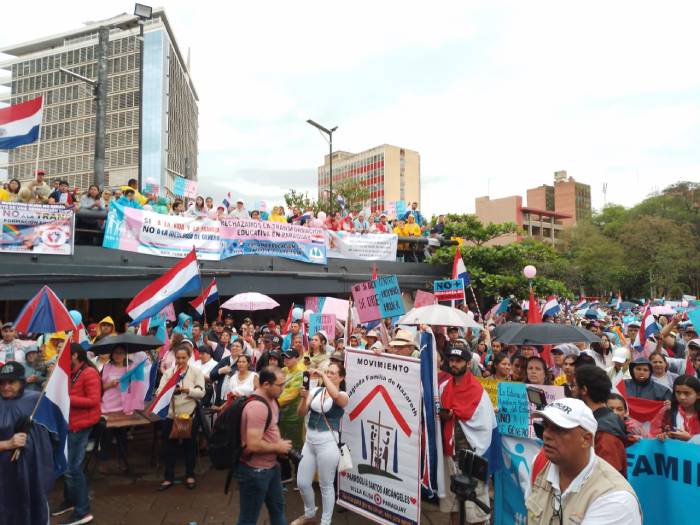
Photo: Juliana Quintana
A plan to improve education
The National Education Plan (PNTE) has three cross-cutting themes that aim to guide the national debate. These are multiculturalism, which promotes communication and interaction between groups from different cultures; inclusion, focused on non-discrimination and equal opportunities in access to education; and a rights-based approach, which is an analysis based on the rights recognized for all people in national and international legislation.
The educational reform being implemented by the government for the past two terms began at the end of Horacio Cartes's administration. It proposed the design of a "strategy and structure" aimed at addressing concrete realities evidenced by deeply troubling statistics. For example, the collapse of roofs and the fact that approximately 240,000 people over the age of 15 in Paraguay are illiterate. The proposal focuses on teacher training, investment in infrastructure, and technology.
Paraguay, anti-rights laboratory
The anti-rights movements in Paraguay were adept at creating an external enemy. This is a way of evading the real enemies, which are economic inequality, domestic violence, the concentration of land in the hands of an elite, and the lack of access to fundamental rights. According to Ana Portillo, a professor and researcher, the alliance between conservative sectors in the political, economic, and religious spheres is a regional and global phenomenon.
However, these movements in Paraguay have certain characteristics specific to them. On the one hand, according to a Pew Research study (2014), Paraguay is the most Catholic country in Latin America. Eighty-nine percent of the adults surveyed are Catholic, although, as Portillo explains, a shift toward evangelicalism is beginning. Anti-rights religious discourses are usually linked to nationalism. Thus, a supposed “gender ideology” constantly (and opportunistically) emerges, claiming to “endanger” the family, society, children, and national culture.
On the other hand, the researcher mentions Paraguay's geopolitical location in the heart of the continent. “Controlling Paraguay and its government has influence throughout the Southern Cone, especially for conflicting interests in Argentina and Brazil. Some researchers argue that Paraguay is, in fact, an anti-rights laboratory, a place where certain strategies and discourses are tested on a small scale . As these prove effective, they are then replicated on a larger scale in other countries,” Portillo explains.
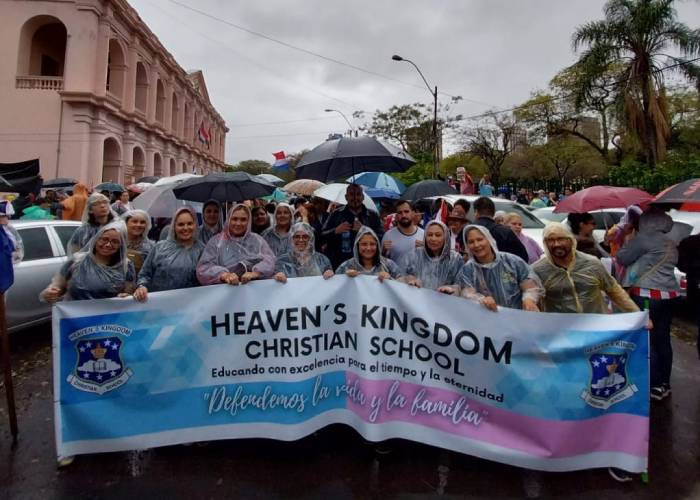
Photo: Juliana Quintana.
What it combats is the political construction.
The 2017 ban marked the climax of a campaign against “gender ideology” in educational materials spearheaded by the Catholic Church and the Paraguayan coalition Somos Muchos Muchos Más, coordinated by evangelical pastor Miguel Ortigoza.
Ortigoza is also a member of the conservative Christian group Capitol Ministries in the United States. Resolution 29664, better known as the “Riera Resolution,” achieved two key objectives: equating gender theory with an “ideology” and prohibiting gender theory in the education system.
“We have a very hostile environment for carrying out a participatory process to build this policy. This was opportunistically exploited by these anti-rights sectors who are once again constructing a threat and an enemy infiltrated within this proposal for educational transformation, using the same strategies and tactics of fake news,” the researcher reflects.
We are present
We are committed to journalism that delves into the territories and conducts thorough investigations, combined with new technologies and narrative formats. We want the protagonists, their stories, and their struggles to be present.
SUPPORT US

FOLLOW US
Related notes


We are present
This and other stories are not usually on the media agenda. Together we can bring them to light.