

Women and children were attacked during the eviction of an indigenous community in Paraguay
Communities of the Guarani people reported that during the eviction, in addition to beating women and children, they stole and slaughtered animals.


Share

ASUNCIÓN, Paraguay. A new case of violent eviction was carried out on Wednesday, October 18, against the January 15 Community, a Guarani people, under the orders of prosecutor Norma Salinas. A deployment of 250 police officers and a helicopter was used against 32 families, exactly one week after the mobilizations for the International Day of the World's Indigenous Peoples and the agreement to establish a working group between the communities and the State.
On Wednesday, October 12, representatives from 18 Indigenous communities marched through the streets of Asunción, demanding a working group with the government to discuss 35 points. One of these points called for an end to violent forced evictions and criminalization of Indigenous people, as well as a genuine response to the issue of land access for their communities. However, on the morning of October 18, the Paraguayan government once again disregarded a commitment it had previously made.
Prosecutor Norma Salinas issued the eviction order. Police forces arrived at the community with 250 officers and a helicopter that circled overhead with a machine gun. The 15 de Enero community of the Guarani people has been settled there for 18 years, almost two decades, building their tekoha (territory), with around 45 families.
An attack on women and children
Images circulating on the social media accounts of the National Indigenous Organization (ONAI) showed women physically defending their territory. Among them were women with their babies in their arms. The cries of children during the eviction, amidst the violence, were another striking image.
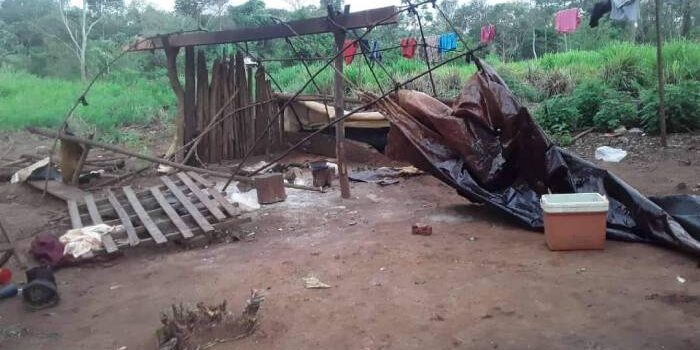
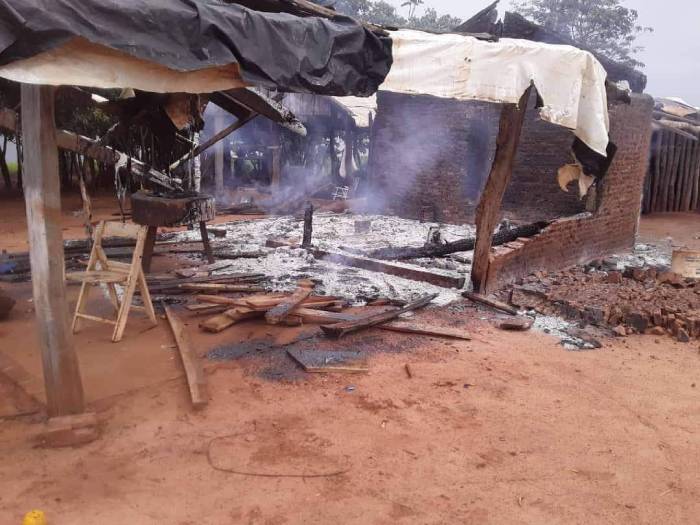
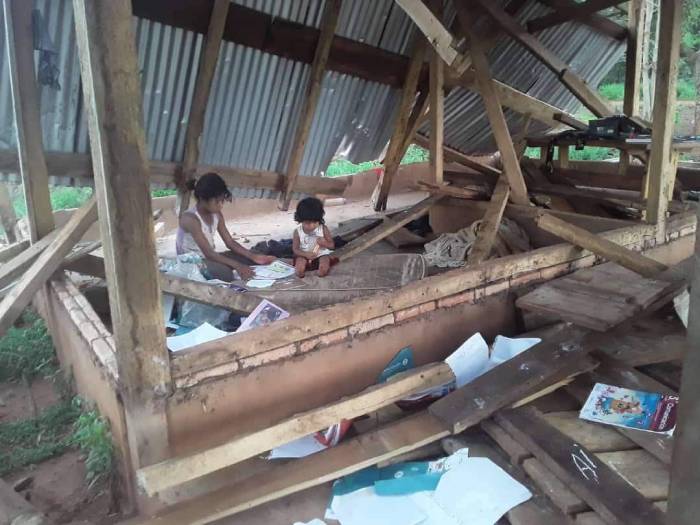
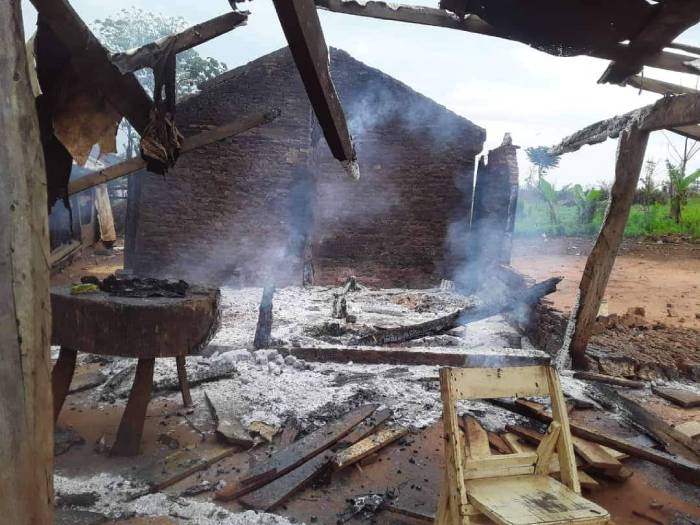
The community reports that the police destroyed all their homes, beating women, children, and men indiscriminately. They also stole cell phones from community leaders and slaughtered community animals. The families were left with virtually nothing; the women were left to care for everything because the men were arrested.
Total helplessness
The community is camped out on the side of the road under tents in the rain. They are asking the public for solidarity because they have nothing.
“They took our clothes, everything we owned, they destroyed our homes. It’s heartbreaking what we’re going through. Justice needs to be served; it’s not fair that they treat us like this. We’ve been here for a long time,” says one of the women from the community in an audio recording that circulated on social media, but she has not been identified.
Among those detained were two 14-year-old Indigenous children , who, with the help of human rights defenders, were able to return to their community. There were also people present who were not members of the community and were simply observing the situation. All of these individuals would face charges under the Zavala-Riera Law, which criminalizes land occupation. However, lawyer Fulgencio Torres of the Network of Human Rights Lawyers argued that this law is not applicable because it has only been in effect since 2021, and in this case, the community in question has been settled there for 18 years.
Land situation
The community had been settled for 18 years in Nueva Toledo, in the department of Caaguazú. They stated that their ancestors had lived in the area since 1965, and later a German citizen appeared claiming to be the owner of approximately 660 hectares.
This is how the land conflict began. In 2009, the Indigenous people returned with the goal of reclaiming some of their land. They made representations to the National Indigenous Institute (INDI) and the National Institute for Rural Development and Land (INDERT), and file 4937/10 was opened, in which they claimed 1,000 hectares.
The land survey should have begun in 2013, but it was never completed due to the authorities' inaction. After almost 10 years, the forced and violent eviction took place. Attorney Torres explained that the procedure carried out by Prosecutor Salinas was improper. It should have been a civil action, but she applied the criminal penalty. This allowed her to carry out the eviction and deploy forces that would cost the public around $1,000, since the expenses were covered by taxes.
“They beat us mercilessly, they didn’t even respect children and pregnant women. They slaughtered our animals, robbed us, and took our work tools,” said Gustavo Sosa, a community leader.
Solidarity of organizations
Several organizations and individuals denounced the excessive violence used by the State. They demanded the restitution of lands to the Mbya Guaraní indigenous community and the release of those detained.
“ This act violates the National Constitution, which in Chapter 5 recognizes the prior existence of Indigenous Peoples and guarantees their inviolable territorial rights. This repeated practice by the Paraguayan State also represents a violation of several international norms and commitments that the country has pledged to respect. We hold the President of the Republic, Mario Abdo Benítez, the Attorney General of the State, Sandra Quiñónez, and the heads of the Paraguayan Indigenous Institute and the Institute for Rural and Land Development, among other authorities who fail to fulfill their duties and disregard the law, responsible for this violation of our rights as Indigenous Peoples,” stated the National Indigenous Articulation (ANIVID).
The ONAI also issued a statement emphasizing that they will not remain silent because a forced eviction violates the fundamental rights of Indigenous peoples. “We have been resisting for 530 years, enduring dispossession and evictions from our ancestral lands, as part of the genocide, ethnocide, and ecocide that in the last two years has left 5,000 people without homes and food. Children without schools, with the destruction of our places of worship and cultural development, with no alternative but hunger and homelessness.”
"We urge the State to seek real solutions and measures."
For its part, CasaFem, a feminist cultural center, also issued a statement . “In Paraguay, where land is the greatest source of inequality in Latin America; where the State and the Justice system consistently favor the interests of a minority that controls the land and its regulations; we wish to express our condemnation of the government's actions that violate the rights of Indigenous peoples as enshrined in the National Constitution. We urge the State to seek real solutions and measures that address the needs of all, respecting human rights as defined by national and international law ,” they stated.
So far, INDI, the institution responsible for guaranteeing the rights of indigenous peoples, has not reached the community, whose residents are without clothing, food, or water. They gaze across the street at their tekoha (traditional dwelling) as the rain continues unabated.
Photos: Indigenous Organization
We are present
We are committed to journalism that delves into the territories and conducts thorough investigations, combined with new technologies and narrative formats. We want the protagonists, their stories, and their struggles to be present.
SUPPORT US

FOLLOW US
Related notes


We are present
This and other stories are not usually on the media agenda. Together we can bring them to light.