

Feminist journalists discussed media, diversity, and strategies to prevent hate speech
“Genders, diversities and dissidences” was the focus of a new day of reflection on the role of the media in hate speech.


Share

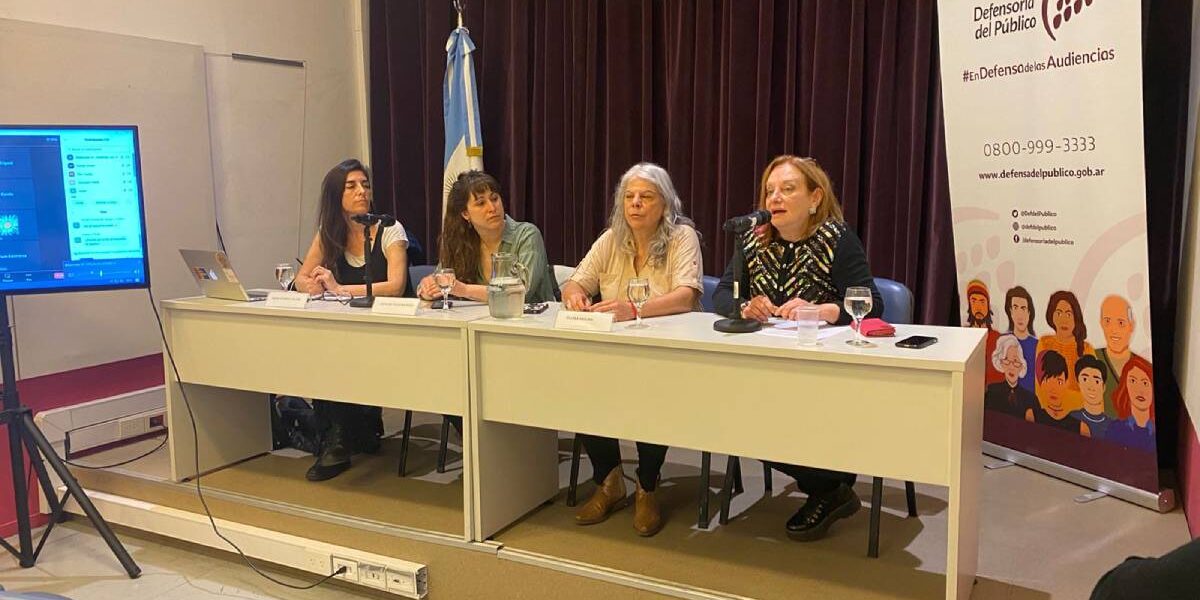
BUENOS AIRES, Argentina. Faced with the proliferation of hate speech that “constructs meaning” both offline and online, journalists from alternative and public media outlets discussed their role in communication. María Eugenia Ludueña of Presentes , Silvina Molina of Télam , and Catalina Filgueira Risso of Feminacida spoke at the Reflection Days “ The Role of the Media in Preventing Hate Speech .”
It was the second of four meetings organized by the Ombudsman's Office , the Télam news agency, and legislator and president of the Human Rights Commission, Victoria Montenegro , held at the Buenos Aires City Legislature. On this occasion, the journalists participated in the panel "Gender, Diversity, and Dissidence," moderated by Alejandra Iriarte, Director of Protection and Rights at the Ombudsman's Office. Also present was Mariana Bendahan, Deputy Manager of Télam and one of the organizers of this series of debates and reflections on hate speech.
“Diversities or dissidences are the object of operations, which we could even call disinformation, in connection with the subsequent development of hate speech and the transfer of this violence in digital or media environments to the real world,” said the head of the Public Defender's Office, Miriam Lewin, at the beginning of the meeting and as a way of presenting the panel.
In this regard, the journalists' interventions focused on understanding that hate speech is another form of violence. They also provided tools and insights on how to respond to it.
The "transodio"
Presentes co-director María Eugenia Ludueña added that the agency has been observing "a strong increase in hate speech."
“Perhaps Argentina isn’t the first country where we’ve seen them. But we do see strong anti-rights movements that appropriate language and carry out operations,” she stated. Regarding this, she recalled that “the trans-exclusionary movement generates hate speech against the trans community.”
She also focused on indigenous communities: “A characteristic of discriminatory discourse is the construction of enemies; we see this, for example, in recent news about the indigenous world. Furthermore, they only appear in the mainstream media when there is a conflict over land, with stigmatized and criminalized identities.”
Presentes also shared what happened on social media following a recent news story: the issuance of the first non-binary ID card in Chile to Shaen Cienfuegos . This development, reported through a video and an article, unleashed a massive online backlash of discriminatory and hateful rhetoric from anti-rights trolls. It was an unprecedented reaction on this media outlet's social media platforms.
The discourse that violates
“Hate speech is a form of gender violence. It is no coincidence that it targets the people it does,” said Filgueira Risso of Feminacida .
For her, they are “at the bottom of the iceberg of violence,” but that doesn't make them any less important. “They build our world where we move and find fulfillment,” she stated.
“What does hate speech want? To incite violence. And what does that violence want? To silence us,” began Silvina Molina, Gender Editor at the Télam news agency. According to the journalist, the primary target of hate “are women and gender and sexual minorities.” She also linked online gender violence to hate speech and identified female journalists and politicians as “the main victims.”
Strategies
Building networks, considering new roles such as "online security editor," and reporting on attacks against journalists were some of the proposals that emerged to address violence against journalists. Furthermore, the speakers emphasized the importance of protecting the mental health of those who cover such violence.
“That’s why we shouldn’t sign the articles with our full names. We should network with our colleagues. It shouldn’t be just one colleague covering it, but rather many media outlets should cover it together,” Filguiera Risso pointed out.
“First, we need to be aware of the post-traumatic stress that some of us journalists who cover this may suffer, opening spaces for listening to see what is happening to us and how we feel about it,” Ludueña added.
They also recommended reading self-care guides for journalists. Some of these can be accessed at Dart Center , Periodistas de a Pie , and Luchadoras .
The role of audiences
The rise of hate speech can lead to attacks and crimes against the groups targeted by these messages. However, it also sparks an active response from users. In March of this year, the Ombudsman's Office received a record number of complaints (750) against statements made by Congresswoman Amalia Granata, actress Carmen Barbieri, and television host Viviana Canosa.
In response to these forms of violence, the journalists proposed several courses of action. On the one hand, they emphasized the need for training on how to cover these issues. Thus, Presentes shared a “ Toolkit for Dealing with Transphobic Discourse, ” and Feminacida shared its school of journalism, communication, and gender studies .
“Faced with the advance of violent and hate speech, we must be able to challenge this hegemony by building more and better prevention campaigns, awareness campaigns, and respectful and responsible approaches,” Filgueira Risso stated.
Less hate, more debate
In this regard, the journalists emphasized the importance of covering cases not as a series, but within their specific contexts. They also stressed the need to "make visible all the stories that frame these events" and "not lose sight of the power and specificity of each case." Furthermore, they emphasized the importance of "seeking out those voices and identities that are never heard" and "highlighting intersectional issues."
“What does hate speech do? It doesn’t provide context. It states a truth or a half-truth without giving context,” Molina commented, emphasizing that “haters don’t debate.” In response, she advocated for journalism that fosters debate, investigation, and tools to dismantle these discourses “through nonviolence and with facts.”
Finally, in response to the arguments of those who justify hate speech, Ludueña remarked: “The right to freedom of expression is not an absolute right.”
We are present
We are committed to journalism that delves into the territories and conducts thorough investigations, combined with new technologies and narrative formats. We want the protagonists, their stories, and their struggles to be present.
SUPPORT US

FOLLOW US
Related notes

We are present
This and other stories are not usually on the media agenda. Together we can bring them to light.