

In Mexico, women displaced the statue of Columbus and founded a place to fight against violence.
The Glorieta de las Mujeres que Luchan (Roundabout of the Women Who Fight) is today a space for denunciation, memory and resistance.


Share

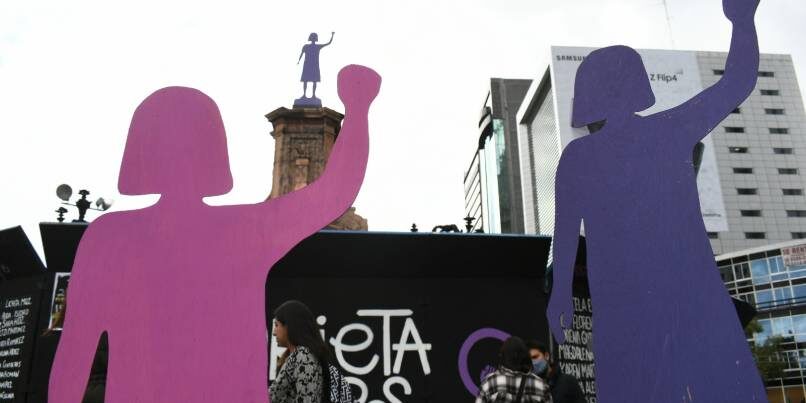
MEXICO CITY. Mexico. On September 25, 2021, resilient mothers, searching for their missing children, took over the space left by the statue of Christopher Columbus and founded the Glorieta de las Mujeres que Luchan (Roundabout of the Women Who Fight).
They did it out of rage and a desire for justice. But also out of love and remembrance. Because of the absence of the state and the support network that formed among women affected by the tragedies that plague Mexico, such as disappearances and femicides. And because more than 100,000 people are still missing.
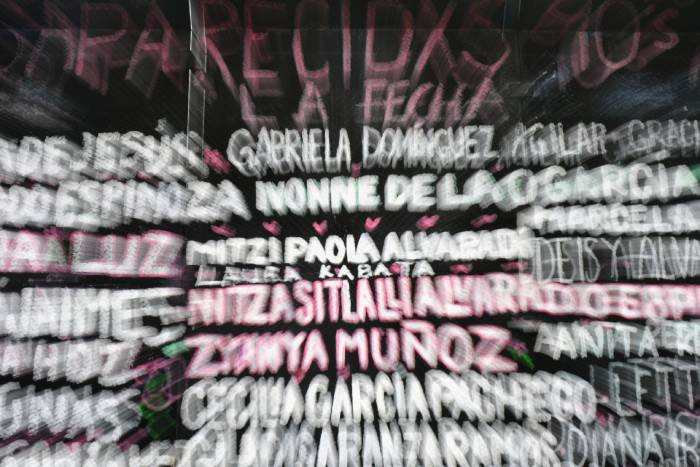
Despite the request to the capital's government, headed by the Head of Government, Claudia Sheinbaum, to respect the Glorieta, the space covered with the names of the mothers searching for their missing children who have been murdered, was under threat.
The roundabout that should never have been
The statue of Christopher Columbus arrived on the coast of Veracruz in 1875, donated by a Mexican businessman and banker, Antonio Escandón. The bronze had come from the workshop of Charles Cordier, a French sculptor, according to information from the newspaper El País .
According to The New York Times, the statue, erected in 1877 on a pedestal in a roundabout in the heart of Mexico City, had been defaced by protesters in 2020. Faced with threats of further damage, the authorities removed it.
Sofía Riojas, architect and member of the Restauradoras con Glitter explains to Presentes that, in Mexico City, the avenue known as Paseo de la Reforma is an urban space that portrays the history of Mexico from the perspective of power.
“The rebellion against the image of Columbus began with the Zapatista uprising. There were already intentions to topple the statue. Thinking about what happened in 2020, in the context of the Black Lives Matter , colonialist and slave-owning sculptures were torn down in the United States and Europe. In Latin America, it was during the social uprising in Chile. In that same vein, the need to tell the other side of history, not just from the perspective of the conquerors, was revived. As a result, the Mexico City government decided to remove the sculpture ,” he explains.
A space of reinterpretation and resistance
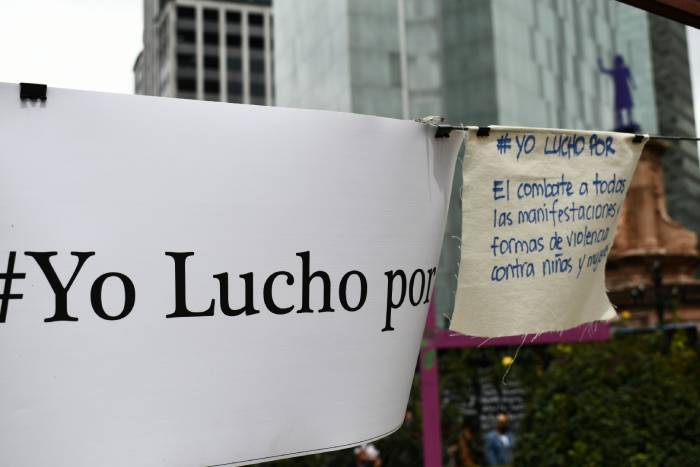
A safe place, a meeting place and a place to listen is what Teresa Villalobos found on Paseo de la Reforma when she intervened in the space in March 2022 with a clothesline of complaints.
Villalobos is a co-founder of the Network for Gender Equality (Redige) and the mother of a rape survivor. She started the clothesline protest under the hashtags: #YoDenunciéPero and #NoDenunciéPorque.
“The clothesline was meant to denounce institutional violence, as opposed to denouncing the aggressors. On November 25, 2021, we put up the first clothesline with sheets of paper so that women could post their testimonies. But the next day the government tore it down and destroyed it,” Teresa recalls.
Among the testimonies, Teresa found that women and victims of sexual abuse in Mexico do not report the crimes due to a lack of trust in the authorities. They also do so because of fear of further attacks, social pressures, and a lack of resources. Or because they don't know where to begin or who to ask for help.
“It’s a bleak scenario you face when you speak out. But here at the Glorieta, we’ve found a space where we—Indigenous women, mothers, searchers, activists, women who are survivors of violence, students, artists—raise our voices. The authorities don’t understand that this is a public space where we can stand together. A safe space in a country where speaking out can lead to being attacked or killed,” she says.
The space where we all fit
Tania Morales, director of the association for transgender children, presents herself as a woman who fights for the right to identity, against discrimination and invisibility.
For her, the Glorieta is not only a symbol of struggle and memory but also a space where everyone fits.
“During the September 28th march for Global Action to Decriminalize Abortion, our contingent emerged from there and made a difference. In previous years, we met in a secluded space. Today, having this space that recognizes all identities and struggles made us feel confident in a fight that also affects us ,” she says.
The space occupied in Reforma is, for Tania, a space of memory and activism for both women and sex-dissident people.
The roundabout is for those who were, are, and will be.
On September 25, 2021, it took between four and five hours to establish the new roundabout. Starting at 5 a.m., the organized women arrived at Paseo de la Reforma and asked for support.
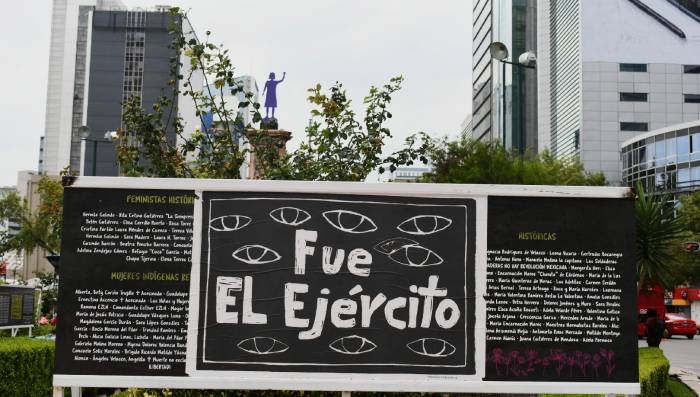
In September 2022, women inaugurated the "We Are Not All Here" Garden, where they planted a pink cross to raise awareness and remember the victims of femicide, and to denounce the authorities' inaction in these cases.
“It may not seem clear, but the Glorieta is a space dedicated to the women who search for and track the bodies that state violence has taken from us; to the mothers who fight for justice for their daughters who are victims of femicide and who are subjected to violence in doing so; to the women defenders of water and territory who are murdered, imprisoned, and assaulted for fighting for life; to the invisible Afro-Mexican women,” says one of the women who are part of the group also called the Antimonumenta, in an interview.
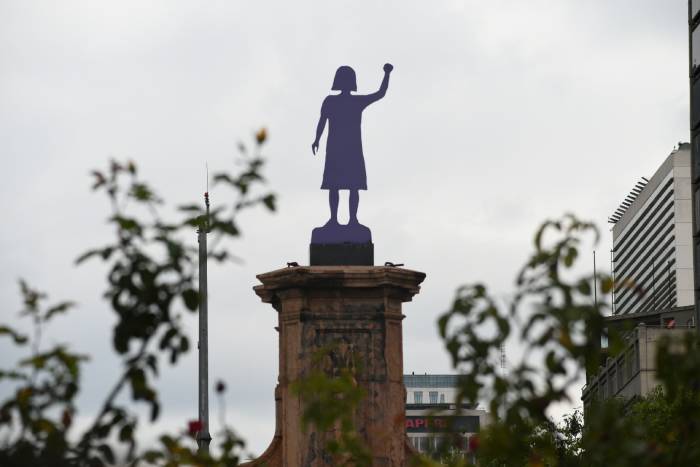
Under the slogan "we are all, we were all," the woman recalls that September 25th when the first silhouette, which was made of wood, was placed, and which was changed to a steel one last March 5th.
The roundabout, a demand of all the fighters
For the women of the Antimonument, the decision to place a woman with her fist raised symbolizes their leftist struggle. A struggle that doesn't belong to any party, but seeks truth and justice, as long as it's purple. Because it's a feminist struggle that includes the LGBTQ+ community, as this is a branch of the LGBTQ+ community that refuses to accept violence.
“Women in Mexico fight because the justice system doesn’t work. We women have to take to the streets, but let’s not forget that the institutions brought them out and made them fighters. This Glorieta de las Mujeres que Luchan (Roundabout of the Women Who Fight) is for them and for all women,” the member says loudly.
A triumph
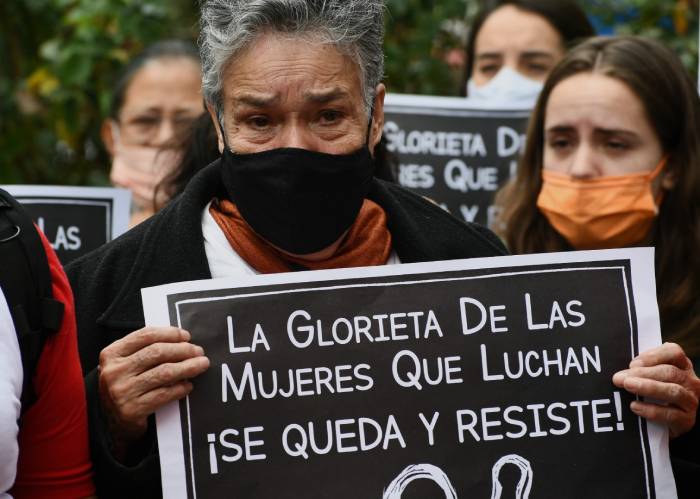
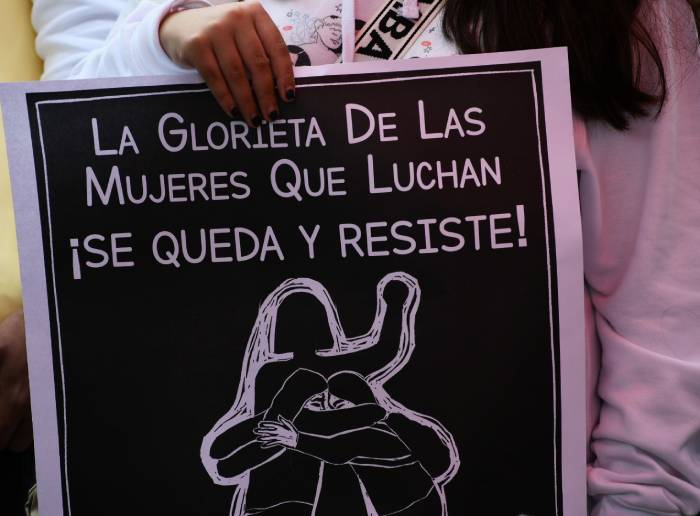
Four days after the vigil and following a dialogue between Mexico City government officials and representatives of the Glorieta de las Mujeres que Luchan (Roundabout of the Women Who Fight), an agreement was reached to prevent the roundabout's removal. It will remain on Paseo de la Reforma. According to information from Animal Político , for the moment, the women and dissidents have won a victory: the sculpture of "La Joven de Amajac" (The Young Woman of Amajac) will not be installed.
We are present
We are committed to journalism that delves into the territories and conducts thorough investigations, combined with new technologies and narrative formats. We want the protagonists, their stories, and their struggles to be present.
SUPPORT US

FOLLOW US
Related notes



We are present
This and other stories are not usually on the media agenda. Together we can bring them to light.