

Repression in Villa Mascardi: Disrespecting the Mapuche worldview of childbirth is obstetric violence
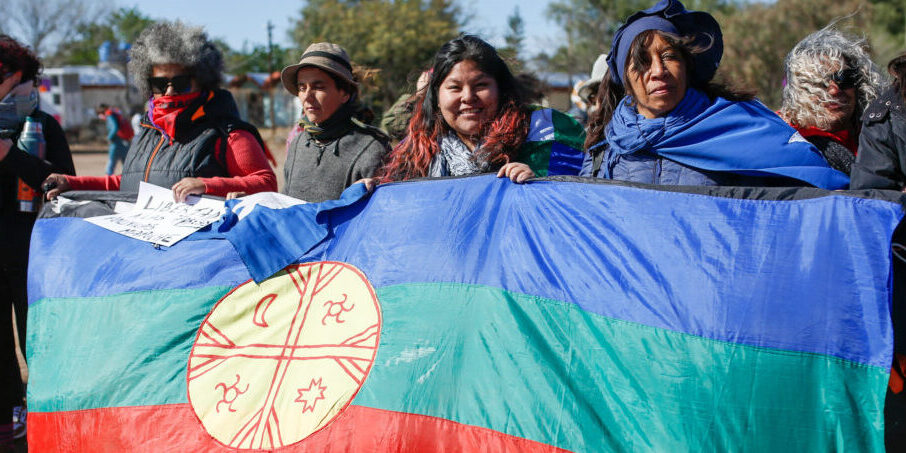
Romina Rosas was one of the Mapuche women repressed in Villa Mascardi. At 40 weeks pregnant, she was admitted to the Ramón Carrillo Hospital in Bariloche without any regard for her wishes regarding how she wanted to give birth.


Share

In the three days leading up to the 35th Plurinational Gathering of Women, Lesbians, Trans, Transvestites, Bisexuals, Intersex, and Non-Binary People (which we successfully managed to have officially recognized as such for the first time during the established dates), we learned of a massive and deliberately violent police operation in Villa Mascardi, Río Negro. The Mapuche nation has long been demanding the return of its ancestral territories, usurped by nationalist and capitalist ideologies.
This operation aimed to intimidate through eviction and uphold private property as a form of cultural control. In this context, we also learned of the deliberate detention of seven Mapuche women members of the Lof Lafken Winkul Mapu on October 5th . Following the unjustified decision (without any formal charges) to transfer four of them to the women's prison in Buenos Aires, three others were detained along with their babies and held incommunicado by the Airport Security Police in Bariloche, obstructing their right to a defense. One of them, 40 weeks pregnant, was admitted to the Ramón Carrillo Hospital in Bariloche.
¿Was any further cruelty towards the Mapuche community necessary?
From a patriarchal perspective, it seems so. In this critical scenario of violated human rights, the Mapuche midwife who had been assisting Romina Rosas during childbirth was mistreated and denied entry to the hospital. Why should Romina be forced to deny her worldview when giving birth?
To deny a worldview
After Romina was admitted to the hospital, her traditional Mapuche midwife, who had been with her since the beginning of her pregnancy, was denied entry. As a traditional Mapuche midwife, she intended to engage in dialogue with the midwives on duty in the maternity ward, a basic requirement to guarantee Romina's rights, but she was confronted by an officer from the Airport Security Police. She was asked for her identification, subjected to mistreatment and hostility by the officer, and forced to leave. Following these events, a video of Romina's traditional midwife circulated on social media. "They're not letting me in as her companion... we Mapuche people have our own worldview, our own way of giving birth, and they are violating our rights . "
Several colleagues immediately went to the hospital to ensure Romina's birthing conditions were safe and to uphold her right to have someone accompany her during labor. This right is enshrined in the Law on Respectful Childbirth 25929 (passed in 2004 and regulated 11 years later, in 2015).
Finally, after the protests, the midwife was allowed into the hospital. But it seems that, from the perspective of the police and judicial authorities, the intimidation already used against them wasn't enough: " After two hours they let me in. The Airport Security Police searched me in an excessive, abusive, and degrading manner," the midwife confirmed.
Plurinational feminisms
What perspectives can plurinational feminisms offer? For decades, feminist movements have denounced the cultural disciplining exerted through violence inflicted on the bodies of those who gestate. We point out, among other issues, the power relations involved in constructing female sexuality as an object to be medicalized and intervened upon.
These power relations demonstrate that biomedical knowledge pathologized processes—such as childbirth—that at other times belonged to the general public. Different systems of knowledge about the pregnant body, such as those associated with midwives, or the knowledge of Indigenous peoples regarding childbirth and self-care shared among women, were marginalized and subordinated as part of this pathologization process.
Medicalized childbirth became alien and external to those who, with their bodily experience, are central protagonists of the birthing process: those who are pregnant and their chosen companions.
Law on respectful childbirth
Today we have a law on respectful childbirth which, in Article 2, establishes the rights of those giving birth. Among other things, these include the right to be treated with respect and not to be discriminated against based on culture, ethnicity, preferences, or choices (subsection b); and the right to be accompanied by a person of their choosing and trust (subsection g). The presence of a chosen person during childbirth is understood as providing emotional and spiritual support, as well as ensuring the rights of the person giving birth are protected throughout the process.
However, the denial of Romina's Mapuche midwife's entry and accompaniment to the hospital violated this fundamental right.
In addition to the Law on Respectful Childbirth, many other declarations, protocols, and guidelines for childbirth in Argentina were ignored and silenced. For ten years (yes, ten years) there has been a guide, promoted by the Ministry of Health in conjunction with UNICEF Argentina, with an intercultural approach.
Previous complaints
In Buenos Aires, in 2021, the "First Forum on Respectful Indigenous Childbirth" was held, organized by the provincial Ministry of Health. The women who attended maintained that a culturally respectful birth includes, among other things, being accompanied by people and/or midwives from their community. Furthermore, Romina was involved in an unjust process of detention. Had she not been 40 weeks pregnant, she would have been deliberately transferred to a Buenos Aires prison along with her companions.
The denial of Romina's right to a birth companion is part of a very common practice against pregnant women deprived of their liberty. They cannot choose who accompanies them. Incidents like these were already denounced in 2019 by the National Penitentiary Ombudsman in its report, "I Gave Birth Like a Convicted Woman." In June of this year, the "Guide for the Implementation of Respectful Childbirth in Detention Settings in the Province of Buenos Aires" was published. While this guide does not have national standing, it establishes a precedent in the area of defending the right to a companion during childbirth for people deprived of their liberty.
A form of gender-based violence
In conclusion, Romina's experience of being denied support during childbirth is an act of obstetric violence, a form of gender-based violence. Obstetric violence, as clearly defined in Law 26485, is the antithesis of rights in childbirth. When the right to support is violated, obstetric violence exists. Furthermore, this form of violence, the most silenced of all gender-based violence, was compounded by discrimination and mistreatment in multiple forms. She was violated by the denial of the cultural context in which she carried out her pregnancy and by the erasure of her Mapuche worldview. She was violated by the reinforcement of stereotypes already imposed on people deprived of their liberty: they must remain alone and silent . This web of power reflects how the punitive logic of the prison system accommodates a hegemonic biomedical approach to health.
It is urgent that feminist movements denounce the violation of the rights of our Mapuche sisters. Through collective struggle, it is essential that we defend the plurinational character of our territory. It is possible that Romina will be able to give birth accompanied by her midwife and without being deprived of her freedom.
The author of this column is an anthropologist and feminist teacher, a doctoral candidate at the Institute of Research in Gender Studies (IIEGE), FILO/UBA.
We are present
We are committed to journalism that delves into the territories and conducts thorough investigations, combined with new technologies and narrative formats. We want the protagonists, their stories, and their struggles to be present.
SUPPORT US

FOLLOW US
Related notes
We are present
This and other stories are not usually on the media agenda. Together we can bring them to light.