

What's behind the operation against the Mapuche in Villa Mascardi
The violent eviction in the Lafken Winkul Mapu community shows a modus operandi of racist right-wing groups seeking to seize the land.


Share

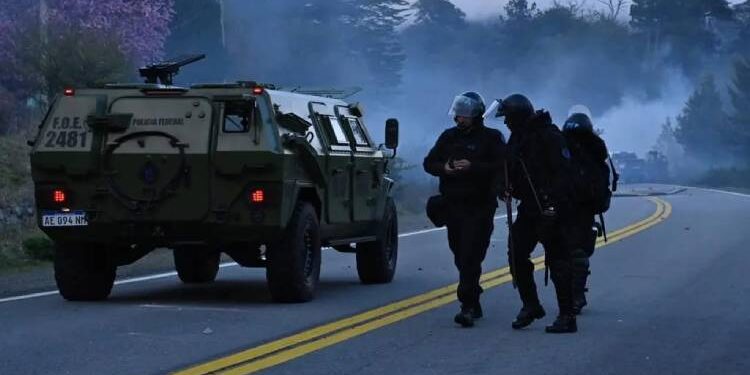
BUENOS AIRES, Argentina. The Unified Command, created by the national government to intervene in the land conflict in the Mapuche community of Villa Mascardi, 35 kilometers from Bariloche, debuted on Tuesday, October 4. It was an operation involving some 250 uniformed officers from federal and provincial forces .
The commando unit blocked National Route 40 and kept it closed for many hours after the operation. They entered the National Parks property, reclaimed in 2017 by the Mapuche community of Lof Lafken Winkul Mapu, at 6:00 a.m. It was there that the young man Rafael Nahuel was murdered.
The backdrop is a campaign against the Mapuche communities, who have once again been blamed for arson and other acts of vandalism that they deny committing. The aim is to criminalize them again, now accused of violating the Anti-Terrorism Law.
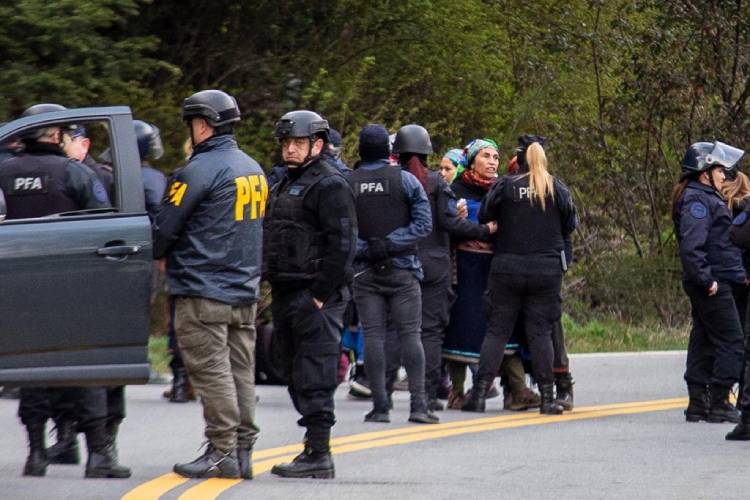
The deployment of communication vehicles, mobile checkpoints, water cannons, pickup trucks, and a riot control truck resulted in the arrest of seven Mapuche women and three minors. Three of the women were in the area because they were receiving treatment from the machi (healer) Betiana Colhuan Nahuel, and were believed to be her "patients." They came from La Pampa, Chubut, and Buenos Aires provinces.
María Nahuel, a community representative, indicated that the agents entered through the National Parks property. The first house in the settlement belongs to Betiana, a 22-year-old machi (Mapuche spiritual leader), who was with her children and was among those detained. Nahuel also reported that one of the women arrested is pregnant, and she requested that the authorities protect her health.
Without guaranteed human rights
Security Minister Aníbal Fernández stated that "it was not a repression" because no one suffered "even a scratch," and that "lethal weapons were not used.".
However, Colhuan described: “A bunch of soldiers came in shooting. They gassed us while we were holding our babies, then they detained us for hours and now they want to take our children away.”.
Last night, María Nahuel—Rafael Nahuel's aunt and Colhuan's mother—reported that her grandson and other children "were left alone in the countryside." She pleaded with them to let her "go and get them before nightfall.".
Furthermore, reporters stationed at the scene indicated that human rights organizations were unable to enter the Lof. This joint action by the national and provincial governments was condemned by other Mapuche communities in Patagonia, including those in Esquel, Trelew, and Neuquén, as well as in Buenos Aires in front of the Casa Rosada (Government House).
The fire that no one investigated
Federal Judge Silvina Domínguez issued the court order for the procedure. She did so within the framework of the case opened against members of the Villa Mascardi community as alleged perpetrators of the arson attack on a Gendarmerie post. That incident occurred a week ago.
However, no one is investigating the arson attack on June 2, 2021, that burned down the ruca (house) of Machi Colhuan in the reclaimed territory. The family, who were in Bariloche at the time, suffered total material losses.
The community condemned the events in a statement, also denouncing the presence of unknown individuals accompanied by members of the Gendarmerie and National Parks. Colhuan had already been arrested on November 23, 2017. This occurred two days before Rafael Nahuel was murdered by a gunshot from that same security force, when members of the Coast Guard threw her to the ground and forced her to eat dirt.
She plays a spiritual role among her Mapuche brothers and sisters. For this, she had to prepare herself for a long time on a difficult path of learning, accompanied by other machi. They guide the path of those whose Püllü/Nguen (machi role) awakens during the first years of life.
The demonization
The community's lawyer, Laura Taffetani (from the Lawyers' Association ), told Presentes that "last night, with great difficulty, they rescued several children who had been left alone on the property. They carried out the operation without any regard for the fact that there were children present." The lawyer asserted that "they staged the fire at the Gendarmerie post to justify the raid. It was a disguised eviction, the eviction they hadn't been able to carry out before."
This type of operation is what in Chile is called a "setup," as in the case of Operation Hurricane . On this side of the Andes, they could be called "false flag attacks": they are carried out by "them" and blamed on the enemy. This is how the group of professionals advising the Neuquén Coordinating Committee and the Río Negro Indigenous Council defines them.
These organizations view with alarm the increasing demonization of Indigenous populations because it harms them in the legal arena, particularly in their claims for recognition of their ancestral land rights.
They claim that “they” are “task forces of intelligence agents from the PRO party. The Gendarmerie itself, with the protection of Governor Anabela Carreras,” is the main weapon against the communities, defending the real estate interests of the Rural Society of the Patagonian region and extractive companies. The official also accused officials of the current government of being in collusion with the “violent Mapuche.”.
Members of the Lof community of Villa Mascardi are facing charges in dozens of legal cases for land grabbing and other crimes. Last week, Patricia Bullrich, a leader of the PRO party, asked the courts to consolidate all the cases into a single trial. She also requested that they be charged under the Anti-Terrorism Law, along with politicians, lawyers, and former officials of the current government, such as Magdalena Odarda (former president of the National Institute of Indigenous Affairs). She accuses them of financing “terrorist” activities.
The ghost of the RAM and the Bariloche Consensus
Last month, when a series of fires and leaflet distributions by the alleged RAM (Mapuche Ancestral Resistance) began, the coordinator of the Mapuche Tehuelche Parliament of Río Negro, Orlando Carriqueo, stated that "it is the right wing itself that is behind these attacks, which still has influence in the security forces."
After former Security Secretary Eugenio Burzaco, from the Macri administration, claimed that the communities reclaiming territory are "groups of violent terrorists who want to take over our lands in Patagonia," Carriqueo responded: "You destabilize democracy because you are violent and racist.".
According to Burzaco, the Mapuche of Villa Mascardi claim territorial sovereignty over Wallmapu, “which does not belong to them.” They want to keep the provinces of Río Negro, Neuquén, La Pampa, and part of the Province of Buenos Aires. Furthermore, they do not accept our national constitution or Argentine laws.”.
According to Carriqueo, the national government is responsible for this situation because it yielded “to pressure and violated human rights.” Furthermore, it is responsible for allowing these right-wing forces to “create a favorable environment to justify repression and seek deaths.”.
The passage of Juntos por el Cambio through Mapuche lands
Patricia Bullrich, president of the PRO party, led a caravan on Saturday “in defense of Mascardi.” She demanded the “immediate eviction” of the Lafken Winkul Mapu community due to a series of acts of vandalism that have never been solved. The Mapuche attribute the acts to the police and the very business owners who filed the complaint, grouped in the so-called Bariloche Consensus.
Days earlier, the former Security Minister had backed Burzaco. She had also criticized the national government: “Federal forces have orders not to act and to let things happen,” she said. According to the former official and president of the PRO party, “if the authorities don't act, we are going to lose part of our territory to extremists.”.
The former Minister of Security—who was in office when Santiago Maldonado disappeared—stated that five members of the CAM (Coordinadora Arauco Malleco) arrived from Chile, “the violent ones on the Chilean side.” She asserted that Facundo Jones Huala was in Villa Mascardi “behind the attack on the National Parks post and the takeover of Luis Dates’s house.”.
Furthermore, he demanded that "the fugitive Jones Huala be arrested," whose freedom was revoked in Chile where he was imprisoned.
“It is time to discuss a new Constitution that recognizes the plurinationality of our people.”
Similarly, the Popular Unity (UP) party of Río Negro condemned “the campaign aimed at stigmatizing the Mapuche people as 'terrorists'.” “We believe that once again, private actors with territorial interests in Patagonia are going on the offensive. They seek to influence the legal disputes that Indigenous communities have with the State for their own financial gain ,” the political group stated in a press release.
The party denounced the fact that dialogue tables are being organized, but Indigenous communities are not invited, thus failing to socially legitimize the construction of meaning. “Based on isolated incidents, they seek to create an atmosphere of violence by promoting the stigmatization of the Indigenous communities of Patagonia,” stated Rodolfo Aguiar, the party's president. For the Popular Unity (UP), there can be no dialogue or consensus without first recognizing the rights of the Mapuche people, their pre-existence as expressed in the National Constitution (Article 75, section 17), international conventions such as ILO Convention 169 ratified by Argentina, the UN Declaration on the Rights of Indigenous Peoples, and the guarantees enshrined in the Comprehensive Indigenous Law of the Province of Río Negro.
UP indicated that for this to become a reality, judges independent of political power and a political power capable of enforcing rulings and laws are necessary. “The non-compliance with the 2013 court ruling, ratified just days ago, which obliges the Río Negro Executive to improve the Tacuifí Road to Lago Escondido, sets a bad precedent in this regard. The government should not be defending Lewis or any unproductive speculative interests,” Aguiar added. “It is time to begin discussing a new Constitution, one that recognizes the plurinationality of our people and from which peace, dialogue, memory, and the promotion of rights suppressed by the Argentine Army during the Conquest of the Desert emanate,” he concluded.
Supremacism and racism
“They portray us as invaders to protect the interests of foreign businessmen,” stated Soraya Maicoño. She is a spokesperson for the Lof Quemquemtrew community, where the young man Elías Garay was murdered in November 2021 in Cuesta del Ternero . “The situation is dire. Consenso Bariloche is a supremacist and racist group made up of tourism entrepreneurs, cabin owners, hoteliers, mainstream media outlets, politicians of various stripes currently serving in Río Negro, and lawyers who have been inciting violence and portraying the Mapuche people as usurpers,” the Mapuche woman stated. “They are protecting the interests of Benetton and Lewis, who own almost 1,000 hectares and 14,000 hectares, respectively, against a recovery effort of only seven,” she added.
Maicoño denounced that “all the women’s rights are being violated. During the operation, they were beaten and dragged, and their children were taken from them.” She pointed out that in that community they have “a very important lamien (sister), the machi Betiana Colhuan Nahuel. She was arrested with her three-month-old baby. They invaded a spiritual space that is very valuable to us, not only because we live in this area but also for the Puel Mapu (Mapuche territory).”.
Along the same lines, Mauro Millán, lonko of the Lof Pillán Mahuiza, told Revista Cítrica that the conflict in Villa Mascardi with the Lof Lafken Winkul Mapu “is the result of a long process of territorial recovery by the Mapuche-Tehuelche people. Regardless of the political affiliation of the governments, the state's response is repression as a continuation of the genocide that founded the nation-state.”
We are present
We are committed to journalism that delves into the territories and conducts thorough investigations, combined with new technologies and narrative formats. We want the protagonists, their stories, and their struggles to be present.
SUPPORT US

FOLLOW US
Related notes
We are present
This and other stories are not usually on the media agenda. Together we can bring them to light.