

The Wetlands Law returns to the Chamber of Deputies amid massive mobilizations in Argentina over fires
The Wetlands Bills will be discussed this Thursday in a plenary session of committees in the Argentine Chamber of Deputies.


Share

BUENOS AIRES, Argentina. The Wetlands Bill will be discussed this Thursday in a joint committee meeting in the Argentine Chamber of Deputies. Ten years after its initial introduction in Congress, officials and activists hope it will finally be approved after receiving a favorable opinion.
Following the “environmental protests in Rosario”—as activists like to call last month’s demonstrations against the fires in the Paraná Delta—the Speaker of the House of Representatives, Cecilia Moreau, referred the bill to committee for consideration. These committees are: Natural Resources and Environment, Agriculture, and Budget.
“We owe a debt to the society that established that the Wetlands Law is the best strategy to defend these ecosystems. The debate has already been settled in society; it is we who have been delaying it. It is not a law against production but against destruction, which are very different things,” Congressman Leonardo Grosso told Presentes.
After losing its parliamentary status at the end of 2021, the legislator reintroduced the "Minimum Environmental Protection Standards Law for the Rational and Sustainable Use of Wetlands" . The Ministry of Environment and Sustainable Development told Presentes that it will support this bill.
The fires
In the islands of the Paraná River Delta, more than 300,000 hectares have burned in total since 2020, according to data from the Environmental Observatory of the National University of Rosario (UNR).
Magalí Gómez (35) is a teacher, active in XR Rosario since the end of 2019, and lives in the city of Rosario in the province of Santa Fe, which is affected by the smoke from land fires. “ Last Monday, Tuesday, and Wednesday the smoke was terrible. Everyone was coughing. We had to close the classroom windows to keep the smoke out. People had eye irritation, some had nosebleeds, and there was also difficulty breathing. The wind changed on Thursday, but you can still see the plumes of smoke in front of us,” she told Presentes.
He also pointed out that it hasn't rained in Rosario for months. "In 2020 we said that the only plan for managing fires was rain, and now we don't even have that," he added.
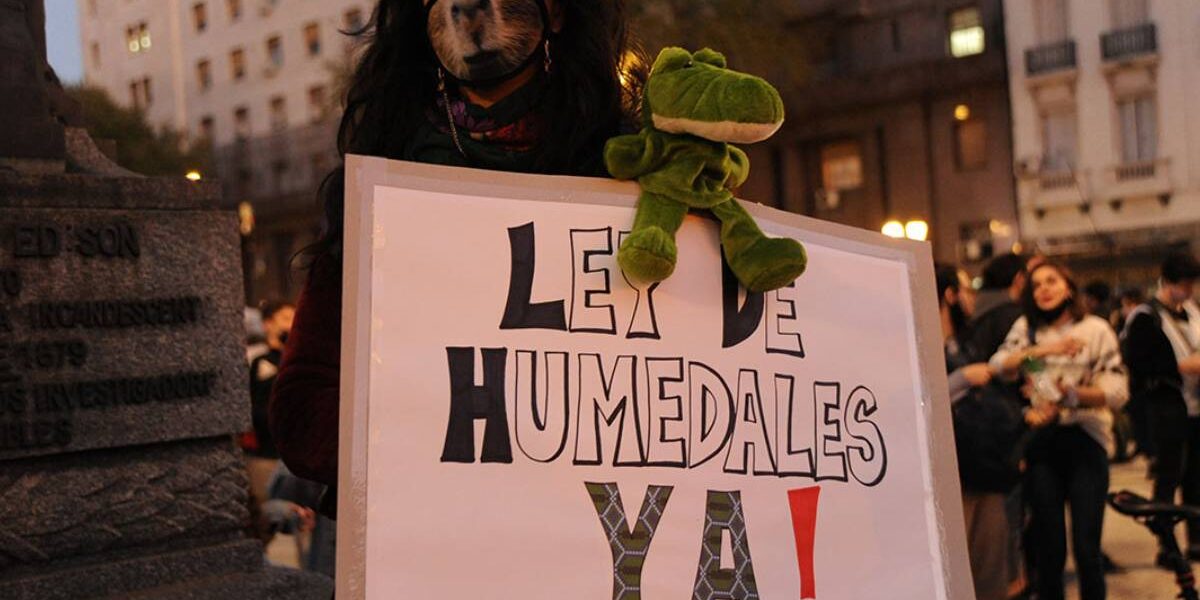
Last weekend, multinational actions were carried out across Argentina to protect wetlands . As part of these actions, activists and self-organized groups blocked and camped out on the Rosario-Victoria Bridge. They demanded the approval of the Wetlands Law and an immediate end to the burning of the rivers.
“If the law were in effect, the province of Entre Ríos would have to refuse to authorize the burning of grasslands for cattle ranching in the Paraná Delta. With a three-year drought and a historic low water level in the Paraná River for the last 40 years, coupled with a huge amount of combustible material on the Delta islands, the most likely outcome is that fires will break out and any firebreaks will be ineffective. In that context, the burning of grasslands should not be authorized during these months,” Grosso explained. He specified that the law “will contribute in the medium and long term.”
10 bills
Currently, there are at least 10 wetlands bills under consideration in Congress . Two are in the Senate: one introduced by Senator José Antonio Rodas of the Frente de Todos bloc representing the province of Chaco, and another sponsored by José Torello of the PRO party. Meanwhile, eight bills are in the Chamber of Deputies. These include those introduced by Grosso; Graciela Camaño of the Identidad Bonaerense bloc; Enrique Estévez of the Socialist bloc representing Santa Fe; Hernán Pérez Araujo of the Frente de Todos bloc representing La Pampa; and Gabriela Lena of the Unión Cívica Radical representing Entre Ríos.
The project, spearheaded by Grosso, has the support of over 400 organizations that participated in its creation. “It’s a project that involved a great deal of collaborative work between the scientific community, academia, and socio-environmental organizations. The voices of the people who live in the wetlands were also heard. It’s a project that would truly serve to protect these ecosystems,” activist Ivo Peruggino told Presentes. The 31-year-old is a member of the Multisectoral Wetlands Network NGO Mundo Aparte , which focuses on the rescue, rehabilitation, and release of wildlife
Its objective is to “establish minimum environmental protection standards for the preservation, restoration, and rational and sustainable use of wetlands throughout the nation.” It also recognizes “their intrinsic value” and seeks to safeguard “their ecological integrity, ensuring the ecosystem services they provide.”
Among its most important functions is the incorporation of wetlands into territorial environmental planning. To this end, a wetlands inventory is created.
“We are damaging the possibility of our own lives in terms of quality and health. This has to be a public policy aimed at protecting and caring for this territory. It has to do with the possibilities for the future and what kind of future for human beings, but also with the integrity of non-human beings,” said Julia Vélez (36), also a member of the Multisectoral group, in an interview with this agency.
The wetlands
In Argentina, wetlands cover approximately 21% of the territory. The country also has 23 Ramsar sites , meaning wetlands considered of international importance under the Ramsar Convention. These sites cover a total area of 5,687,651 hectares.
Globally, these ecosystems cover 12.1 million square kilometers , equivalent to 6% of the planet's surface. Forty percent of plant and animal species live or reproduce in them. Meanwhile, the annual rate of wetland loss is three times the annual rate of forest loss worldwide, according to data from the Wetlands Foundation . In fact, since 1970, their extent has decreased by 35%, as stated in the Global Wetlands Outlook .
Wetlands are essential for the development of life. “A wetland provides multiple ecosystem functions for the healthy development of life on Earth, not only ours, but also that of other species. Among these functions, they filter the water we drink and clean the air we breathe. They also retain polluting nutrients, mitigate flooding, and provide habitat and food for countless species that find refuge there. They are our main ally in combating climate change and mitigating its consequences, even if only slightly. In this sense, wetlands store carbon dioxide (CO2), preventing its release into the atmosphere,” explained Peruggino.
“The law defines wetlands. Years ago, there were discussions surrounding this definition; today, that issue has been settled. Another important point is the inventory and land-use planning. This gives provinces the ability to manage their territory and thus protect, plan for, and promote the sustainable use of these ecosystems. Furthermore, another key feature is the protection standards it establishes and the administrative sanctions that ensure compliance with this law,” explained Representative Grosso.
While an earlier version of the bill included penalties for certain actions, the current version removed that provision. “We removed the chapter on criminal legislation because it added another layer to the bill. It would have had to go to the criminal legislation committee as well. We felt that this slowed down the legislative process,” Grosso explained. He also stated that they are simultaneously working on “more comprehensive proposals for an environmental criminal code.”
Meanwhile, the legislator emphasized that the wetlands law “is not against production, but against destruction.” “It doesn't prohibit any activity. What it does is regulate based on what's happening in each territory. For this purpose, the implementing authority will be each of the provinces, which are the ones that best know the issues within their territory, with oversight from the national government,” he added.
Finally, Article 18 of the bill states that “all projects for the development and use of wetlands must recognize and respect the rights of indigenous peoples, including their right to free, prior, and informed consent.” This is in accordance with ILO Convention 169 .
We are present
We are committed to journalism that delves into the territories and conducts thorough investigations, combined with new technologies and narrative formats. We want the protagonists, their stories, and their struggles to be present.
SUPPORT US

FOLLOW US
Related notes

We are present
This and other stories are not usually on the media agenda. Together we can bring them to light.