

They marched to protest the unpunished femicides of a Qom teenager and her mother in Tigre
Lisette Fernández is demanding an investigation into the femicide of her 14-year-old sister, Micaela, in 2013, as a case of human trafficking. Their mother was murdered while seeking justice. They were members of the Qom Yecthakay community in Tigre (Buenos Aires).


Share

BUENOS AIRES, Argentina. The deaths of Micaela (14) and Nancy Fernández (36), members of the Qom Yecthakay community in Tigre (Buenos Aires province), were femicides "linked to human trafficking," denounces Lisette Fernández. She is the daughter and sister of the victims. She is seeking to expedite the investigations and is requesting that Micaela's death be reclassified from "suicide" to "homicide." She also insists that the fact that this is a crime perpetrated against Indigenous women be taken into account.
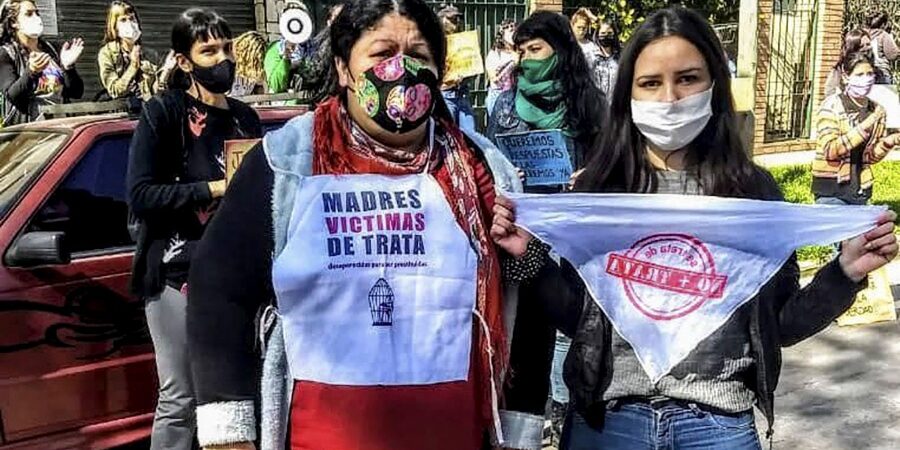
“Beyond demanding justice, I want the memory of my sister and my mother to live on: I want them to remain present in society, in the neighborhood,” Lisette, who lives in Tigre, told Presentes. This afternoon , neighbors and relatives of the victims marched to the 6th Prosecutor's Office in El Talar to demand justice for Micaela Fernández , on the anniversary of her birthday.
Both cases, Micaela's—classified as "suicide"—and Nancy's—classified as "homicide"—are being handled by the Specialized Prosecutor's Office for Illicit Drug Investigations , headed by prosecutor Marcela Semería. Prosecutors Gastón Larramendi and Lida Osores Soler are also involved.
The last meeting with Micaela
In February 2013, Micaela was found dead with a gunshot wound to the head at Dante "Pato" Cenizo's house. "The last time I saw Mica was for my birthday. I was turning 12. We had a nice day together, and then late in the evening, a car came to pick her up. That's when she said she had to leave. I asked her to stay a little longer. She told me she would be back during the week. I never saw her again," Lisette said.
She believes there is "plenty of evidence" to establish that both her death and that of her mother, Nancy, were murders linked to a human trafficking network . Furthermore, she points to Cenizo—currently in prison on drug trafficking charges—as a member of the network.
“My sister was kidnapped in 2013. I heard from her that he was prostituting her, that he was forcing her to sell drugs. I saw my mother beaten when she went to report the kidnapping. They locked her up and beat her. I also witnessed the injustice, the complicity of the police. Out of fear that something would happen to me, my mother sent me to live with an aunt,” says Lisette.
When Micaela disappeared in 2013, her mother, Nancy, went to the Sixth Police Station in El Talar to report her disappearance. “They treated her like she was crazy” and refused to take her report. Days later, Micaela reappeared, beaten, with injuries to her face, her hair brutally cut. She said she had been taken to a house where she was abused by several men. At that point, Nancy again tried to file a report. She ended up being arrested. A year after Micaela's death, on May 2, 2014, her mother was found dead in her home. A homicide case was opened.
“When we go to ask for justice, we are discriminated against.”
For Lisette, these deaths are also linked to racism . “We are more vulnerable. The traffickers know who they target: the most vulnerable girls. They know that when we go to ask for justice, they don’t listen to us, they discriminate against us ,” she said. She knows this, among other things, from her mother’s experience at the police station: “While they were beating my mother, they told her, ‘Shut your mouth, you fucking Indian.’ Racism was always present.”
For members of the community, accessing justice is difficult, Lisette pointed out. She witnessed it herself. After her grandfather, Eugenio, who had spearheaded the fight for justice for the deaths of Nancy and Micaela, passed away, she wanted to take charge. And finally, when she turned 18, she gained access to the case files.
“I had no idea what to do. I was so little, and no one prepares you for the murder of a family member. No one knows what to do afterward,” said the young woman, now 21. Along the way, she met the Punta Querandí in Dique Luján, and there she met Paula Alvarado Mamani, a Kolla lawyer, who now represents her.
“Both cases have been reopened, and Lisette is a private plaintiff. In Micaela’s case, we requested that the charge be changed from suicide to homicide-femicide . In Nancy’s case, we are asking what happened to her phone, which disappeared after her murder. It was stolen, but it continued to work . Now we have the support of the Provincial Commission for Memory ,” Alvarado Mamani summarized to Canal Abierto .
Despite Lisette's demand, judicial sources are not currently considering changing the classification of the incident involving Micaela Fernández from "suicide" to "homicide".
However, "there has been progress" in the cases, Alvarado Mamani told Presentes . He also clarified that he cannot "give specific names" because it is a "sensitive" case. "There are two witness statements, and there are new requests for DNA testing within the framework of the case. These are developments that allow us, at least in Mica's case, to change the classification from suicide to homicide," he reported.
Furthermore, he indicated that "a certain amount of evidence has been produced, both in Nancy's case and in Micaela's, which is compelling and points to the verification of the crimes committed." He also emphasized that "it involves not only those who carried out the acts directly, but also those who were not directly involved."
For Lisette, the struggles embodied by both her mother and her grandfather—founder of the Qom Yecthakay community of Tigre—are her driving force. “I feel it is my duty to continue their demand for justice, to carry on their voice.”
We are present
We are committed to journalism that delves into the territories and conducts thorough investigations, combined with new technologies and narrative formats. We want the protagonists, their stories, and their struggles to be present.
SUPPORT US

FOLLOW US
Related notes

We are present
This and other stories are not usually on the media agenda. Together we can bring them to light.