

Gabriela Wiener: “In Spain, colonialism is institutionalized; it is violated through the law.”
In her new book, “Huaco retrato”, Gabriela Wiener approaches her family genealogy through the silences, doubts and fears transmitted from generation to generation.


Share


“I wouldn’t want to end up being just a folder with a name on it.” Gabriela Wiener concludes one of the chapters of her latest book, Huaco retrato (Literatura Random House), with this powerful statement. In the preceding pages, she had described the double life led by her recently deceased father, who organized his romantic relationships in folders labeled with names and surnames. In one, he kept the letters he exchanged with his wife, Wiener’s mother; in the other, those he wrote to his lover, his “hidden stepmother,” with whom he always wore an eye patch he didn’t need.
“Upon discovering this, I can’t stop thinking, fearing, crying, and explosively confronting human nature. I think of Jaime and Roci, their secret lives, my own, what I’ve always feared, what I’ve always feared about myself. Will I ever be able to stop feeling afraid?”
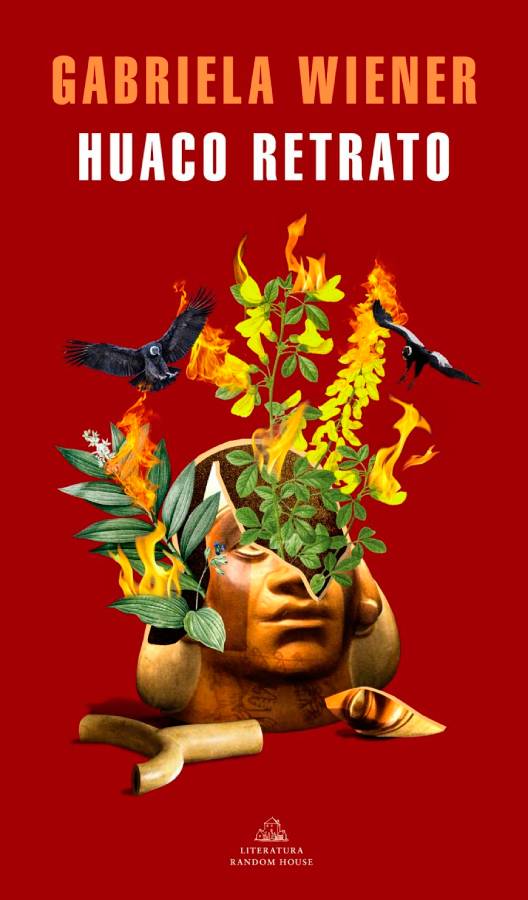
This fragment is a good example of the inquisitive gaze with which Wiener approaches his family genealogy, delving into the silences, doubts, and fears passed down from generation to generation. It also reveals the visceral political perspective from which he writes * Huaco retrato. Anomie y deseo* (Huaco Portrait: Anomie and Desire ).
A book that cannot be told piecemeal by referring to each of its seemingly unrelated parts, but rather as a narrative whole that twists and turns to form a questioning identity. The identity of Gabriela Wiener, but also that of women like María Rodríguez, her great-great-grandmother: the girl from Trujillo who, in the mid-19th century, became pregnant by the Austrian-French explorer Charles Wiener. The forgotten mother who raised her baby alone while the white father went down in history as the man who almost discovered Machu Picchu. That Wiener who plundered nearly 4,500 pieces of pre-Columbian art, still exhibited in Paris, and who brought a child who wasn't his own to Europe to see if his race, too, could progress with the right education. The same Wiener who today provides the writer with a surname and a story that flows forth like an open wound.
—“I could never do anything like that,” you write, referring to books about grief. However, the way the novel's structure unfolds—you use your father's death as a starting point to tell a story that could only take place after that event—is reminiscent of a typical book about grief. Why separate Huaco retrato from this category?
"I think there's a part of the novel that we could call jests about literary genres. At another point, the protagonist also rants about autofiction. I wanted the book to include a minimal critical reflection on where to place it, to anticipate its reception, but with a certain humor. I knew I'd be tiresomely asked if it was autofiction, an autobiographical novel. If it was literature of the self or of mourning, if it was a family memoir or a book of social commentary and political denunciation. So the book itself says what it isn't, or what it doesn't want to be, or what it isn't exclusively. My idea was to make an elusive book, that is, the complete opposite of a typical book. That the literature of mourning within it would renounce being that in order to become something else, and so on with everything else. My somewhat pretentious goal was to plant a decolonial bombshell in both the content and the form. I don't know if I've succeeded. But I like to think that Huaco belongs to a tradition of bastard narrative or that it creates something like a counter-narrative." Its charm lies in its impurity: it precisely attempts to deconstruct the hegemonic way in which we tell stories, manipulating the history of power, of gender, and bringing to the center those of counter-power and those of history with a lowercase "h".
It's also confusing, now we know, that you deliberately imply the story you want to tell is that of María Rodríguez, your great-great-grandmother abandoned in Trujillo, and not that of Charles Wiener. And yet, there are far more pages dedicated to him than to her. How do you honor the life of a woman whose story no one considered important to preserve at the time?
Actually, although the question of the erasure of María Rodríguez's life runs throughout the book, I never intend to tell her biography. Nor is it the kind of book that will rescue her from oblivion or restore her to the spotlight, I'm afraid; it's not a book about a man, but neither is it about a single woman. In fact, the voice that is indignant at only having access to information about the famous great-great-grandfather expressly renounces investigating María and is aware of this limitation. It knows that, from a certain point on, it can only fill the gaps in that memory with speculation and imagination. For example, these gaps are filled through other female figures who have also been erased: the teenage grandmother, the daughters, the lover, and above all, the mother, who appears toward the end as someone with her own story, who moves away from the victim and embodies resistance instead.
– What has the existence of a huaquero [the name given to illegal looters of archaeological sites who profit economically] like Charles Wiener in your family line meant for you, for the construction of your identity?
“I’m the first in the family to have called him a ‘huaquero’ (grave robber), because his figure was always surrounded by respectability. I, as the non-white girl in the Wiener family, the least respectable, always felt like the outsider, perhaps an anomaly, the one who didn’t fit in. That’s why that suspicion is in the book: what if we don’t come from who we’re supposed to? What if we’ve been unfairly swallowing only one version of history? Where did that side go where I could have seen myself represented? Why wasn’t it passed on to me? Can I, with the right questions, do things differently? We build identity from, literally, looting, furtive violence, and abandonment. Understanding that we come from the 19th-century grave robber, or the 15th-century conquistador, or the 20th-century slave owner is part of the baggage we may fiercely grapple with throughout our lives. What revolts me is why on the other side everything is comfort, self-affirmation, and zero questions .” My identity could be that of the dubious one, one of the racial illustrations Charles makes in his book Peru and Bolivia. When I saw it, I said, “This is me, this is us.” I’m interested in doubt as an identity.
-As the narrative progresses, it becomes clear that you establish a certain reconciliation with him. You don't justify him, but instead of demonizing him, you give him context, some difficulties—for example, the fact that he is Jewish . You even find a novelistic connection with him. Did you feel a need to forgive him or understand him?
My plan wasn't even to recount his strengths and weaknesses, but to demolish him entirely, consciously and mercilessly. To give a good shake to the colonial and racist institution of the family, to the myth of the European scientific ancestor, to the pride of the ghostly patriarch who did so much for the world, but so little for his descendants. And to speak in contemporary language about parents and how little they cared. However, I'm quite sensitive, and I'm also moved by the perspective from which he acted. That's why the character of Wiener is fascinating, complex. All that fraudulent, gonzo, mega-protagonist, and self-promotional aspect of him makes me recognize a kinship in him that I hadn't felt before. Can you imagine if, in the end, he isn't the Wiener who goes down in history? Well, this book tries to make that joke in 200 pages.
It seems equally unfair that you have to do this reparative work when you live in a country like Spain, which still celebrates its national day honoring men who unleashed even more violence and suffering than Charles. What does October 12th mean to you?
Throughout the book, there's a constant identification between the huaco (a type of ceramic vessel) and the protagonist, highlighting the objectification and instrumentalization of what in the 19th century was understood as the other and the subaltern, but which remains relevant today. This other, once the savage, the cannibal, the monster, is now the migrant suffering under immigration laws and the hate speech of Vox. I believe that Huaco Retrato (Portrait of Huaco) reveals several levels of dehumanization. The most extreme is undoubtedly the case of human zoos, the exhibition of people like animals for scientific and entertainment purposes. As we know, the last of these European exhibitions only closed in the mid-20th century—practically yesterday. And there were zoos of this kind in Spain, in Madrid, very close to the Crystal Palace, and in Barcelona, in Plaça Catalunya.
– What other forms of colonial violence persist today?
For example, the one that addresses Spain's current relationship with the populations migrating from its former American colonies is, in my opinion, one of the most paternalistic and, therefore, most racist narratives out there. From this perspective, Latin American migrants are like the assimilated and infantilized noble savage. Seduced by the false aspirational narrative of power, which will never be a real threat, and which is only useful as long as their care work can be exploited and as long as they can be used to demonstrate to the world the success of their civilizing project called mestizaje (racial mixing). Just as Charles Wiener doesn't want to exterminate Juan, but sees no problem in buying that child, uprooting him, disciplining him, and using him to portray himself as his savior. Pure pedagogy of cruelty. That is another level of dehumanization. And it is something that, as a migrant who has arrived, after a long journey, in a privileged administrative situation compared to other migrants waiting to enter Spanish territory, the narrator is perfectly able to recognize.
-When the topic of decolonization comes up, some people, even within the left, argue that actions like removing statues honoring Christopher Columbus from public spaces are a minor political issue. A cultural matter, not a material one. In contrast, how would you say symbols influence people's lives and bodies?
The experience of being a South American migrant and the stereotypes surrounding it is perhaps the most significant I've encountered in my years living in Spain. What has always struck me is how much Spanish colonization is present in our collective consciousness, forming a substantial part of self-analysis and discussions about our present and identity, while for Spanish society we're not even a topic of conversation. We're seen as unfocused individuals relegated to the background in their self-image. And I believe this is because, to focus on us and see us with clarity and respect, they would have to examine their darker side, the conquering ego beneath the myth of the discoverer, and begin to understand their own identity as a history of violence and the subjugation of others. Even now, our children have to walk past monuments to slave owners, hospitals, and subway stations named after October 12th.
-It doesn't even seem like we can talk about a postcolonial present.
No. Coloniality is still active because the wound continues to hurt and remains central to our everyday understanding of ourselves. This social model of subordination, this social organization based on castes invented in modernity, and the racism and classism that permeate it, have left their mark on our mental health, our subjectivity, the way we relate to each other as a society, the administration of nation-states, and how these are articulated with neoliberal economic policies.
-Even knowing that it may be a generalization: how is that way of thinking addressed in Latin America?
The advantage of having reflected much more deeply than the Spanish on the colonial past is that we are experiencing decolonization processes as a community, while here nostalgia continues to be nurtured, memory is denied, and the far right is allowed to dictate the public and media discourse. In Spain, colonialism is institutionalized; everything operates according to that logic. Borders are closed, and those who come from the plundered countries are subjected to violence through the law. If we go by the institutions and the speeches of political authorities, I would say that the discourse remains, even, profoundly imperialist and neocolonialist. We are not seeing critical debates about the modern, heteronormative colonial project, nor are we seeing the necessary decolonial studies being promoted as they are there. On the contrary, we are seeing how the president of the Community of Madrid and right-wing leaders, during these recent Hispanic Day celebrations, reinforced the racist colonial discourse and directed their attacks toward Indigenous peoples. They become enraged when Black communities tear down statues of slave owners. What the anti-Indigenous right fears is resistance and organization, demands for reparations, the development of new genealogies, and the renegotiation of contracts with the multinational corporations that exploit resources there. That's why they've tightened their belts and don't seem willing to back down.
"I'm very interested in your communication with that Charles Wiener specialist, Pascal Riviale. Suddenly, an academic claims to know more than you about a family matter, or at least that's what he thinks. How has that communication progressed?"
–I stopped talking to him when he stopped helping me. We didn't make much progress. He has a kind of love-hate relationship with Wiener; he's studied him obsessively and at the same time he tears him apart. That's why I was interested in using his academic discourse in my trolling of Wiener, but only up to a point. It's clear that I actually like Wiener better than Riviale. I think the book takes a questioning stance regarding Western cultural authority. It takes aim at specialists, academia, science, the modern museum—all institutions born from racism.
–In fact, when you start the book you are touring a famous museum in Paris seeing the figurines that your great-great-grandfather extracted from a land that was not his own: museums as corroborators of the pride in that history.
Museums are another space where reflection on coloniality has been gaslit, when what underlies it is outright ethnocide, the cultural dismantling of Indigenous peoples due to the military and religious imposition of another culture. It is not inheritance, it is imposition. The 'new world' is a palimpsest, one writing over another, which erases it, a fiction that necessarily involves attempts to make that real world disappear. Western institutions like museums were used for this purpose, where the heritage of those territories plundered of their origins is exhibited as part of the imperial treasure of the conquest without comment. The alibi has once again been mestizaje, as a process generating a greater, syncretic, romanticized culture. But for such a fusion to exist, the influence and predominance would also have had to occur in the other direction. What has happened and continues to happen is material and symbolic extractivism from one side to the other.
– Has this changed in contemporary art spaces, or does the racialized still exist as the strange, the exotic?
Race only has a place in modern spaces to sell diversity and multiculturalism. The anticolonial and sexual dissidence collective Ayllu (Give Us Back the Gold) and the Peruvian antiracist artist Daniela Ortiz have been politically intervening in these spaces for years, introducing reflection on memory, identity, and the violence behind colonial museums, and the way they ideologically update that Spanish supremacist vision. Behind these works, which are references in my novel, lies the demand that European art and cultural spaces address the return of lives, epistemologies, worldviews, the sacred, and everything eradicated during centuries of cultural colonization. This is the gold that must be returned, according to Ayllu, giving way to other political, critical, and valid voices in the face of this Eurocentric vision of knowledge that relegates them to the past and associates them with backwardness. In this sense, the exhibition by Peruvian artist Sandra Gamarra, currently on display in Madrid, hits the nail on the head, questioning the very idea of a museum, holding up a mirror to this evolutionary idea of Western art through powerful images and visual metaphors that explore various stages of colonial, economic, territorial, racial, and patriarchal violence.
-Meanwhile, elements appear in the novel that have no apparent connection: jealousy or the construction of desire. Why do you decide to explore all of these and not focus solely on the family history?
Because family history is as much about love and desire as it is about racism and colonization; they're all intertwined. And there's a single thread running through the first story, the uncertain and fleeting relationship between Maria and Charles, and the last, the contemporary, polyamorous relationship. In between lies the story of the unfaithful father and his parallel affair. And in each of these stories, there are children involved, both legitimate and illegitimate, some more or less white, some more or less brown, some more or less abandoned.
Jealousy, in fact, is not at all an anecdotal element in the book: it permeates your life and relationships as part of a family lineage. How can this be interpreted? Is jealousy inherited from generation to generation?
–No, jealousy or any vulnerability is intrinsic to power dynamics or domination. And all relationships are, including romantic ones. It's common to find unequal relationships where some have racial privileges and others don't. Some can afford to lead a double life and others can't. This inequality affects how we see ourselves and how we relate to others, and of course, it can be passed down from generation to generation. In other words, the book argues that the greater the vulnerability and racial, gender, or class-based violence we experience, the greater the insecurity and fear of losing what little affection, security, and value we've managed to gain. You can call it jealousy, fragility, precariousness, but it's not something that can be resolved individually; it requires collaboration with others. Understanding this is important so we don't leave those who can't manage their relationships alone because they carry that heavy burden of sad stories and open wounds.
It never ceases to amaze me that the books women write about themselves are generally filled with guilt, self-flagellation, and a kind of confession of all the harm they cause around them. Male writers, on the other hand, tend to be more forgiving of themselves; if they aren't heroes, they at least try to justify their actions. Do you ever see yourself writing a book where the protagonist is something like "the wonderful, beloved heroine Gabriela Wiener"?
– That book already exists and it's called Sexographies.
*This article was originally published in Pikara. To learn more about our partnership with this publication, click here .
We are present
We are committed to journalism that delves into the territories and conducts thorough investigations, combined with new technologies and narrative formats. We want the protagonists, their stories, and their struggles to be present.
SUPPORT US

FOLLOW US
Related notes
We are present
This and other stories are not usually on the media agenda. Together we can bring them to light.