

Work and diverse design at the Claudia Pía Baudracco cooperative
The Claudia Pia Baudracco cooperative operates in Moreno. It provides training and work workshops to a group of trans people.


Share

BUENOS AIRES, Argentina. entrepreneur Claudia Pía Baudracco seeks to solve two problems simultaneously: creating a stable source of employment—cooperative and community-based—and producing garments that the market doesn't offer: gender-neutral clothing, plus sizes with designs for young people from the suburbs, binders to shape masculinized torsos, for example. Furthermore, the textile company perceives its own existence and visibility as a political act.
On a newly paved street, there's a small, separate room in front of the house where Bruno and Seba live in Trujui, Moreno district. It's at the edge of the second gray ring surrounding the capital, where the urban fabric begins to spread out. They got married in early 2022, although, they clarify, "they've been together for years."
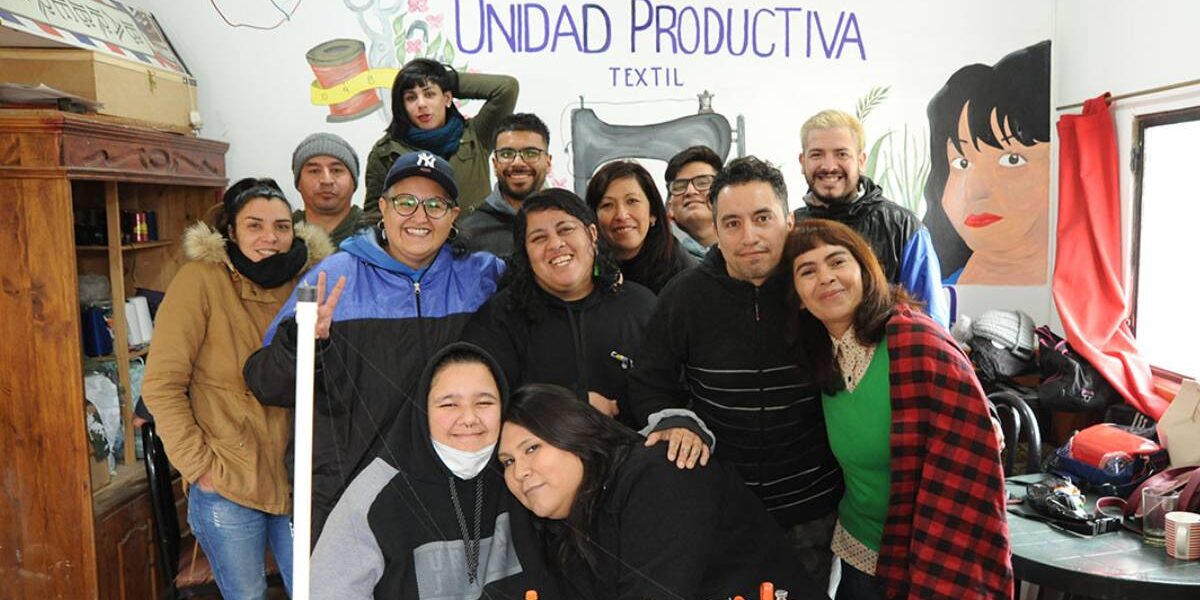
In a small garden, a tree offers sweet tangerines. To reach it, you have to go through it; there, the door opens, and the first thing you see on the wall opposite the two machines is a mural that Eideen (20) painted with her sister.
– And I added a few brushstrokes too! – someone shouts from the back.
Claudia Pía Baudracco's mural encapsulates the collective identity. "She traveled the entire country," they emphasize, "to build the gender identity law (which she didn't live to see implemented), the equal marriage law, she founded ATTTA (in 1995), she led the movement for the repeal of discriminatory misdemeanor codes in 15 provinces (she succeeded in 14). And in 2005 she was a founding member of the FALGTB ," they list almost without pausing for breath.
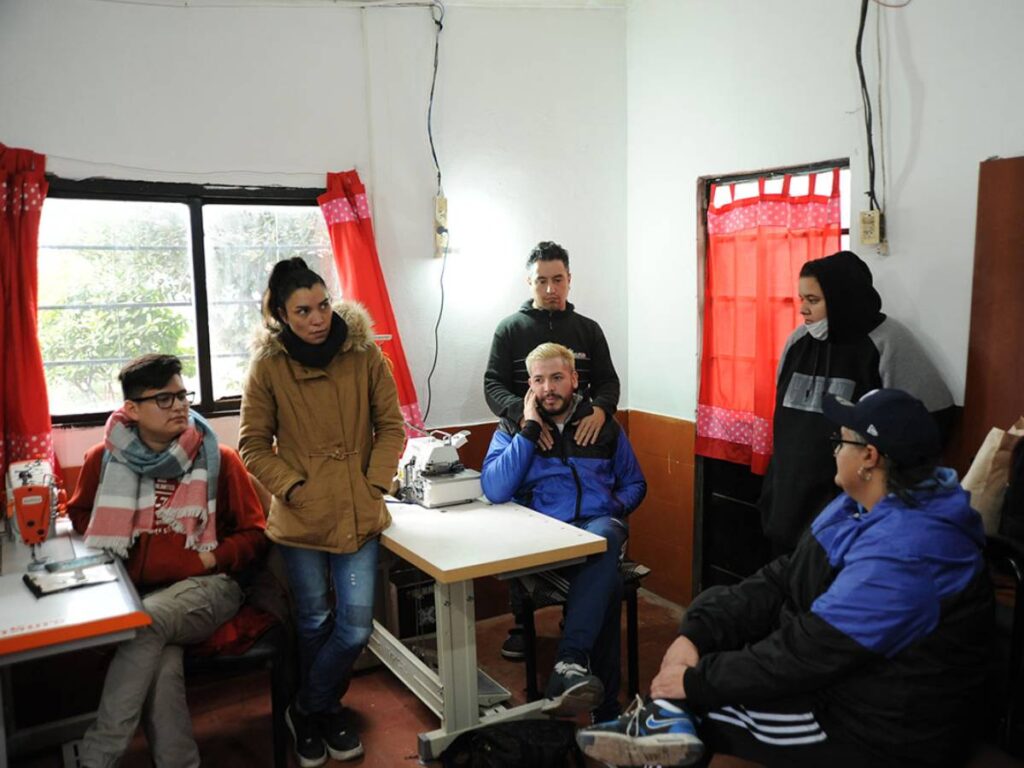
Photo: Ariel Gutraich
Creating jobs after the crisis
“It’s very difficult for trans men, and even for trans women, to find stable employment,” laments Eideen, with the post-pandemic crisis as a backdrop. “And it’s even harder to be respected for who you are,” he adds. He affirms that he is willing to work many more hours when the business starts to pay off.
The textile industry has a bad reputation: exploitation, mistreatment, unregistered work, low pay, uniform bodies. Claudia Pía aims to approach this profession with a different perspective, a different approach, and in a self-managed way.
The space is primarily a school, and it financially compensates the time required for training in the trade. The group consists of 14 people, who are currently learning to use the first two machines —a straight stitch machine and an overlock machine. Twice a week, for four hours, they sew small bags and fanny packs from recycled fabric scraps for themselves. The goal is to learn the ins and outs of the trade. Now that they have completed this first stage of training, they will begin producing items for sale, and the proceeds will go toward strengthening the business.
The classes are taught by Seba, who has 25 years of experience in the textile industry; and Lidia, owner of @bychabelita (on IGM), a business that has sustained her for 10 years.
A place to work with love
While Eideen smokes in the small garden, he introduces himself: “I’m a bisexual trans man. I never had my parents’ acceptance; they don’t know I’m a trans man, and they wouldn’t accept it even if they found out. I found this space where I feel comfortable.” He adds that he has always lived in Las Catonas, a housing complex of 1,600 units built by FoNaVi between 1978 and 1989.
At 16, in 2018, Eideen was going through a difficult time, experiencing homelessness, and sought help by calling INADI's 0800 hotline. Leandro, a compassionate employee, along with his mother, Zulma, brought her a bag of food, and they became friends. In 2020, when Ornella Infante became the national director, she was put in touch with Vale Roxy, an activist in the diverse Peronist movement from the northwest suburbs of Buenos Aires, who had just moved to Moreno. Vale was looking to get a trans textile business off the ground near her home. "I came to an initial meeting and felt good because of the positive energy of the people," she recalls.
Every time he looks for a job, the conversation repeats itself:
-No, they're looking for men here.
-But I am a man.
-No, but…
Designing and producing for everyone
Eideen is still looking for another job. But above all, she wants to make binders wholesale, so that no one goes without. “I’ve used post-surgical compression garments and scraps of fabric to bind my body, and that can really hurt. The bandages cut and burn you. I have all the scars, and over time, it can even lead to cancer,” she explains.
“When I was 13, I didn’t know, and the first thing I grabbed were bandages. And it’s a future health problem that would be good to avoid, and it should be included as part of Comprehensive Sex Education in all schools,” she adds.
Her boyfriend is also a trans man who is experiencing discrimination at his high school (he's 17). Eideen and her group are supporting him in his discussions with the authorities. The very least a trans man needs in his adolescence is the freedom to dress as he pleases and to construct his own image.
“A binder costs 6,000 pesos, and we can make them for much less ,” Gaby says. “And for us, being able to lend a hand to diverse communities is huge. It’s something that resonates with us, that challenges us, because we all come from places where we’ve been discriminated against. From a very young age,” Gaby, 35, explains, adding that she has migrated herself. “I come from Córdoba, a fairly conservative province,” and to top it off, from Alto Verde, an upscale neighborhood. As a non-binary lesbian, she settled in Moreno, the second poorest district in Greater Buenos Aires, where she lives a “much more fluid” life, working while sharing mate with friends, in a “community” setting.
“And this spirit is also reflected in the products, with the aim of making a social impact,” he notes.
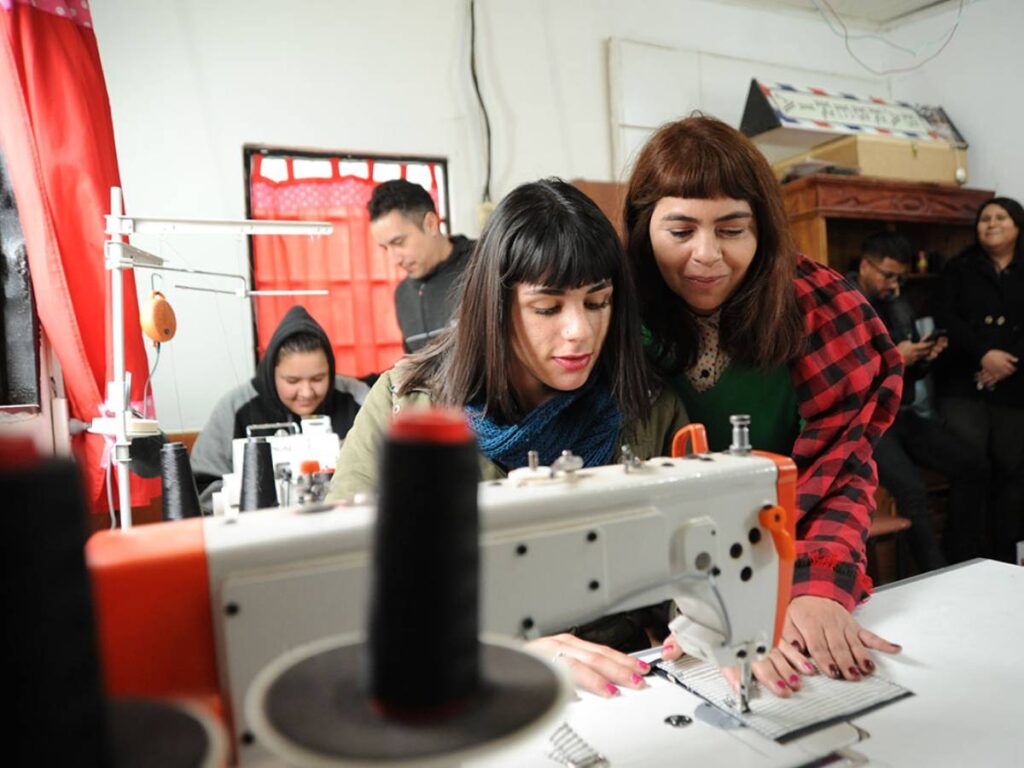
Photo: Ariel Gutraich
Fighting spirit
“Here we organize with comrades from all walks of life, and to have a foundation, an income, our comrades are part of the Potenciar Trabajo Program. Perhaps transvestite and trans people have much more difficulty accessing education and healthcare. But lesbians, non-binary people, and gay men from the greater Buenos Aires area also struggle to find work because of our gender expression,” explains Vale Roxy (38) . She is a non-binary lesbian, representing the diverse composition of the collective, which works with the State at its various levels.
Before receiving the machines, they had already completed initial training with IMDEL (Moreno Municipal Institute for Local Economic Development) . “In setting up the production unit, some of us are handling the management of the institutional framework, the formation of the cooperative, in order to establish agreements with the municipality and other institutional areas,” says Vale, who also works at the Ministry of Women, Gender and Diversity of the Province of Buenos Aires .
In Moreno, the relationship with the municipality is smooth, because since December 2019 Mariel Fernández, the first female mayor, a feminist, and from a social organization (the Evita Movement), has been in power.
The textile company also has the support of INADI (National Institute Against Discrimination, Xenophobia and Racism) and a close relationship with Onella Infante, whom Claudia Pía brought into the political arena in her native Santiago del Estero. The next step is acquiring the machine used for assembling garments and covering seams, the coverstitch machine, and participating in various fairs to sell their products, in addition to online sales and promotion through social media.
Claudia Pía creates garments to embrace rebellious bodies, but perhaps her most valuable product is the space for conversation, visibility, and struggle. As Gaby emphasizes: “We are from the suburbs, we are poor, we are trans, lesbians, gay men,” and “that identity is a strength to reach more places, to compete with the market, a market in which we are invisible.”
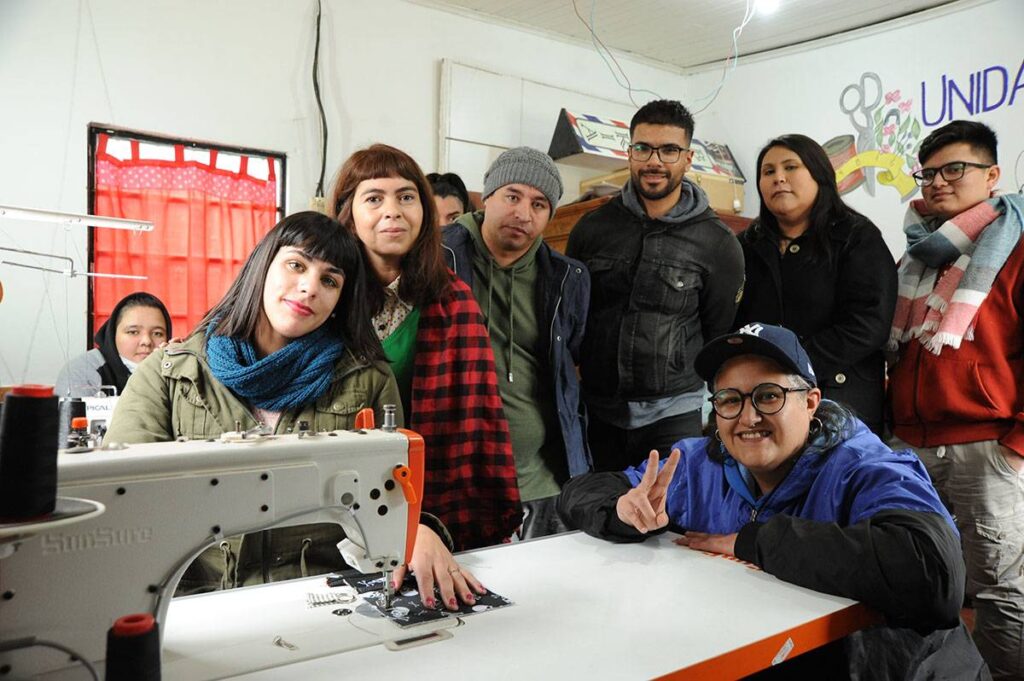
Photo: Ariel Gutraich.
We are present
We are committed to journalism that delves into the territories and conducts thorough investigations, combined with new technologies and narrative formats. We want the protagonists, their stories, and their struggles to be present.
SUPPORT US

FOLLOW US
Related notes


We are present
This and other stories are not usually on the media agenda. Together we can bring them to light.