

This is how the media spreads terror among LGBTI+ people
Under the guise of providing information, the media launches coverage that seeks to discipline and indoctrinate LGBTQ+ lives.


Share


The Grindr killer, monkeypox, attacks on trans people, the gang beating that killed Samuel, shootings in gay bars, and Nazi attacks on LGBTQ+ spaces. Over the past few months, these stories have dominated headlines, news broadcasts, and talk shows.
While all these pieces expose the facts that are happening, they also make it clear that if we don't behave and cross certain red lines, the punishment we will receive is the most brutal violence. From insults to physical assault, a virus, or death. At first glance, these accounts are informing about violence against gay, lesbian, bisexual, trans, non-binary, intersex, and queer people; however, these narratives have another function: to instill fear in LGBTQ+ people in order to discipline and teach them a lesson.
The LGBTQ+ terror narrative circulates freely and brazenly in the media. In just a few weeks, we've been reminded of the boundaries that are best left uncrossed: having sex with strangers, having sex with whomever and however many we want, meeting people through apps , going to certain places, occupying the streets, but without expressing ourselves or showing too much of ourselves there, without making our effeminacy or lack of cispassing obvious, with our clothing, without making any "noise"; in short, without letting anyone know we exist. The "don't bother us or this is what will happen to you" mentality has the clear objective of controlling lives that deviate from the norm, keeping them under surveillance, and forcing them back into the closet. That is, taking away the freedoms we've gained in recent decades.
Who perpetuates the LGBTQ+ terror narrative? Primarily radio, television, and print and digital media. Not forgetting three other important factors: social media, through which it spreads mixed with hate speech (just take a look at Twitch, YouTube, and Twitter); the various forms of violence already mentioned; and politicians who, through their statements and speeches, deny or call into question the rights of people who dissent from the norm regarding affective, sexual, gender, and expressive identities.
Nerea Barjola, a researcher and PhD in Feminism and Gender Studies, explained in her book *Sexist Microphysics of Power* how the Alcàsser case (the 1992 sexually violent murders of Antonia Gómez, Desireé Hernández, and Míriam García) was used by the media to construct a narrative of sexual terror with which to discipline and correct women's behavior from then on. Barjola established an important precedent for research and analysis that helps to articulate LGBTQ+ horror.
In the last two months, two cases centered on the gay community have perfectly illustrated how this narrative of fear works: the Grindr killer and the monkeypox.
To carry out the analysis and draw the conclusions, I have taken into account the news published in print and digital newspapers (El Mundo, La Vanguardia, El Correo, eldiario.es, El País, La Voz de Galicia, 20 Minutos, Diario de Sevilla, ABC, RTVE.es, El Periódico, Onda Cero, Antena 3, El Salto, La Razón, Cadena Ser, CNN, El Español, Telecinco, Clarín and OK Diario), the audiovisual reports in news programs (Telemadrid, 24H de RTVE and Telecinco) and the television talk shows (Cuatro al Día, En Jake de la ETB, Espejo Público, La Hora de La 1, La Sexta Clave, Imagen Televisión and La Sexta Noche) both on the day they were made public and on subsequent days.
The Grindr killer: your deaths aren't that important
In early May, the media was filled with headlines that, under the guise of innocuous news, were targeting a specific population group and creating alarm within it: “The gay killer of Bilbao,” “the gay murderer,” “the profile of the alleged serial killer of homosexuals in Bilbao.” The first message: “They only kill you, the gays.”
The perpetrator, currently in pretrial detention and charged with four murders and two attempted murders, met his victims through a dating app. Television and online media quickly began showing and naming the app in question, Grindr, as well as others like Wapo, transforming them from spaces for gay and bisexual men into public spaces for everyone. The second message: “You’re not even safe in your own spaces.” The third message: “This is what happens when you sleep with strangers through apps,” consequently blaming the victims and gay men for any horror that might befall them. The age-old “you brought it on yourself.”
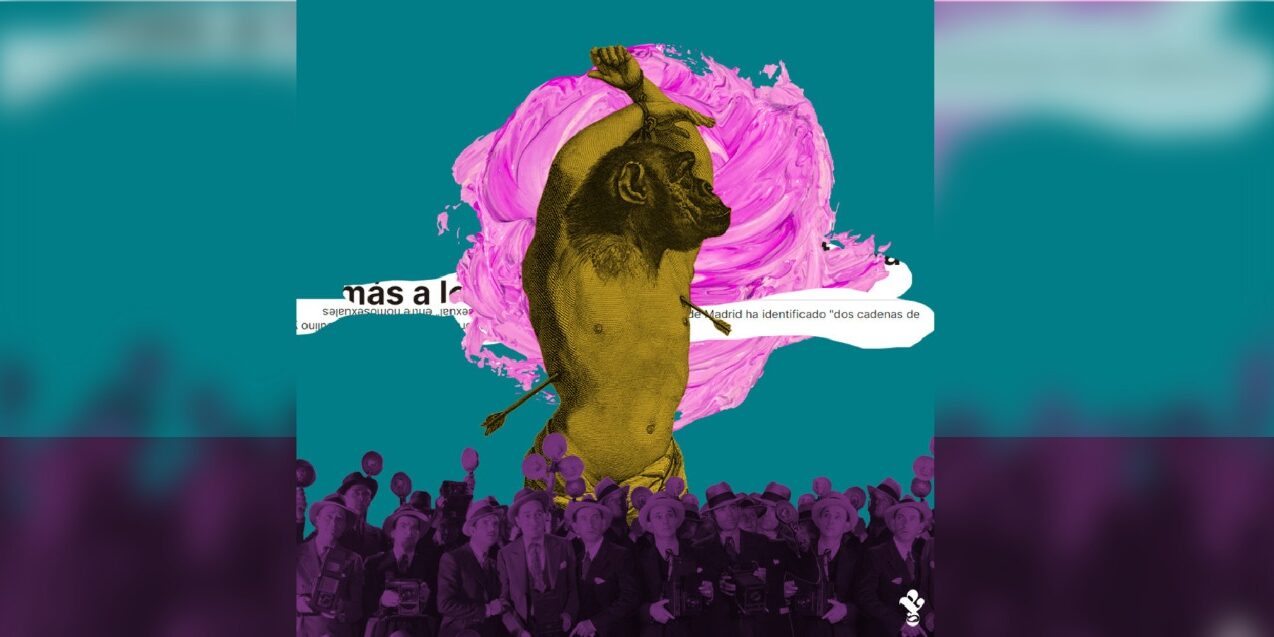
The media portrayed the criminal as monstrous: a “serial killer,” “sadistic,” “cruel,” and exhibiting “animalistic behavior.” This dehumanization conveys the idea that this horror is anomalous and exceptional, something that doesn't reflect the daily reality we see in our society. Furthermore, the vast majority of television, newspaper, and radio stations emphasized his nationality to make it clear that this violence is not part of “us, the Spanish.” They used xenophobia to emphasize that this type of aggression comes from abroad.
The profile created of the aggressor is crucial to understanding the importance of the fourth message sent to the gay community: “The murders are not homophobic.” The hypocrisy of the media in reporting this news is striking. On the one hand, they frame the words “the gay killer” in headlines to grab the public's attention. But on the other hand, in their articles and discussions, they engage in a convoluted exercise to emphasize that there is no homophobia behind these crimes. They shout that there is a killer of homosexuals, and at the same time, radio, television, newspapers, and websites gaslight us by trying to make us believe that the fact that all the victims are gay men is secondary, minor, accidental, irrelevant. Thus, the fifth message is activated: “They're after you, homosexual, but your death isn't important.” This is why the newspapers repeated that “it is still to be determined whether there is a hate motive toward homosexual people.” And even news programs went so far as to use authoritative voices, such as a criminologist, to dismiss the homophobic aspect of the murders: "He was a thief who wanted to steal money and who administered drugs to do so."
The framing of these murders as unusual and the insistence that they are not the result of homophobia serves a clear purpose: to absolve the heteropatriarchal system of responsibility for the violence it perpetrates against LGBTQ+ people. To wash their hands of the matter and ensure that no one notices their responsibility in these crimes and attacks, the media bases its narrative on sensationalism, just as they did with the Alcàsser case. Consequently, we have countless reports and videos detailing the killer's modus operandi, even interviewing his friends and family. But there isn't a single article or mention in any news program about why homophobic violence occurs.
Monkeypox: this is what happens to them for fucking
The media's stigmatization of the gay community during the monkeypox epidemic was so blatant and ruthless that even the UN had to intervene . They did so to put a stop to it and remind everyone that sexual orientation is not a factor in the transmission of the virus. We read and saw how homosexuality was linked to this infection, and by the time the corrections came, the initial message had already been delivered: "This virus affects you because you're gay." They did the same thing they did with HIV in the 1980s. Furthermore, the newspaper La Razón dared to publish an article titled "The Dangerous Parallel Between Monkeypox and AIDS" with absolutely no regard for ethics or journalistic responsibility.
Homosexual men were singled out as the cause of the virus's transmission, and once again, voices of authority, in this case politicians, perpetuated this idea. The Health Minister of the Community of Madrid, member of the People's Party , had already identified a gay sauna as a source of infection. He declared that "the profile of those infected is all men, and it would be worrying if a woman were to appear," and that in different countries the pattern "is the same." Meanwhile, Vox linked smallpox to "drugged" homosexuals . Would the treatment have been different if the first outbreak had occurred among heterosexuals?
To report on monkeypox, the media painted a picture of the face of vice: simultaneously presenting the latest data while showing images on screen of the closed gay sauna, muscular men dancing in swimsuits, and parties with rainbow flags.
Gay spaces were targeted to deliver a second subliminal message, “You’re dirty,” while our sexual desire was scrutinized to deliver the final warning: “It’s your fault for the way you have sex, it’s a punishment for how you experience sex, you’re promiscuous and depraved”; the so-called “slut-shaming” explained by journalist Noemí López Trujillo in Newtral. The goal of this strategy is twofold. On the one hand, to instill fear about having sex, the same disciplinary technique the media used with HIV and AIDS, and, on the other, to once again blame the victim, in this case, gay men, for a virus.
The fear surrounding homosexuality was also instilled through photographs showing the pustules and sores that smallpox causes on the skin. This alarm about what could happen to you was magnified by testimonies recounting all the symptoms suffered. Morbid curiosity reared its head once again. Some of these images shown in newspapers were of the bodies of Black men and children, implanting in the subconscious the racist narrative that, aside from homosexuals, this was "something from Africa." The danger, as with the Grindr killer, comes from outside.
Nazi beatings and attacks: we're coming for you.
Aside from these two cases, on a larger or smaller scale, and depending on how it's handled, every news story related to LGBTQ+phobic attacks sends out messages laden with terror. The gang murder of Samuel Luiz, who was subjected to shouts of "faggot" in July 2021, instilled in the entire LGBTQ+ community the idea that "it could happen to any of us," hence one of the most frequently heard protest slogans is "We are all Samuel."
This identification and symbiosis with the 24-year-old serves as a direct warning: we can end up like him if the aggressor or aggressors consider that we raise our voices too much, that we are too visible, or that our existence bothers them.
Some physical assaults reach the media thanks to reports made by victims on social media, and this has a twofold effect: on the one hand, they are extremely useful for denouncing and showing the world the violence. On the other hand, they serve as a reminder of what could happen to us someday. The same is true of headlines or television reports that, despite not showing the aftermath of the beatings, announce a “brutal beating” of two trans girls in Valencia , a trans boy in Toledo , a young trans woman in Barcelona , a trans woman in Hospitalet , or an attack “with a brick” on a lesbian couple who were kissing in Mexico City.
Sometimes these attacks aren't against our bodies but against our symbols, like the recent attack on a Pride exhibition in Valencia. Other times, these attacks ultimately end our lives: like the shooting by a man in a gay club in Oslo or the attack a group of 31 neo-Nazis planned at a Pride event in an Idaho city. Once again, a clear message is sent: “We're coming for you.”
Limits crossed
What is the goal of the media's queer narrative? To instruct us, dominate us, correct us, discipline us, and control our bodies. If, as a result of this media bombardment, someone decides it's better not to take risks, not to draw attention to themselves in the street, to hide their effeminate mannerisms, not to kiss in public, not to wear that top, not to speak out loud in front of certain people, not to go to certain places, to think twice before having sex or creating a social media account, then at that precise moment the queer narrative will have had its intended effect: to repress our lives and the freedoms we have won.
The message that lingers after these attacks tells us that nothing will happen to us if we are good, if we stay quiet in a corner, if we conform to cisheteronormativity, if we go unnoticed. LGBTQ+ terror seeks our erasure.
As always, and as has been the case throughout the history of all dissent, it is in our hands not to let ourselves be subdued by these corrective mechanisms. We carry a heavy burden and know what it is to have been trampled, silenced, and tortured. It has been hard to reach this point where our existence is increasingly livable, and we are clear that we will not go back into the closet or hide. After the shooting in Oslo, the Pride organizers decided to cancel the march and all related events. However, neighbors of all ages responded to fear and threats by taking to the streets. We have more power than we think. Terror and reactionary forces will not take our lives.
*This article was originally published in Pikara. To learn more about our partnership with this publication, click here .
We are present
We are committed to journalism that delves into the territories and conducts thorough investigations, combined with new technologies and narrative formats. We want the protagonists, their stories, and their struggles to be present.
SUPPORT US

FOLLOW US
Related notes


We are present
This and other stories are not usually on the media agenda. Together we can bring them to light.