

Salta: He promoted a festival with images of naked indigenous women and the Justice system charged him
A man shared images of young people from indigenous communities without clothes to promote a festival organized by the singer Chaqueño Palavecino.


Share

SALTA, Argentina. A teacher from northern Salta who promoted the Trichaco Festival with images of indigenous women was formally charged by criminal prosecutor Armando Cazón.
The actions of the man, who is not Indigenous, sparked outrage from Indigenous, women's, and LGBTQ+ organizations. All emphasized that this incident is part of a broader pattern of sexual abuse, or "chineo," against Indigenous girls and women, perpetrated by groups of non-Indigenous men.
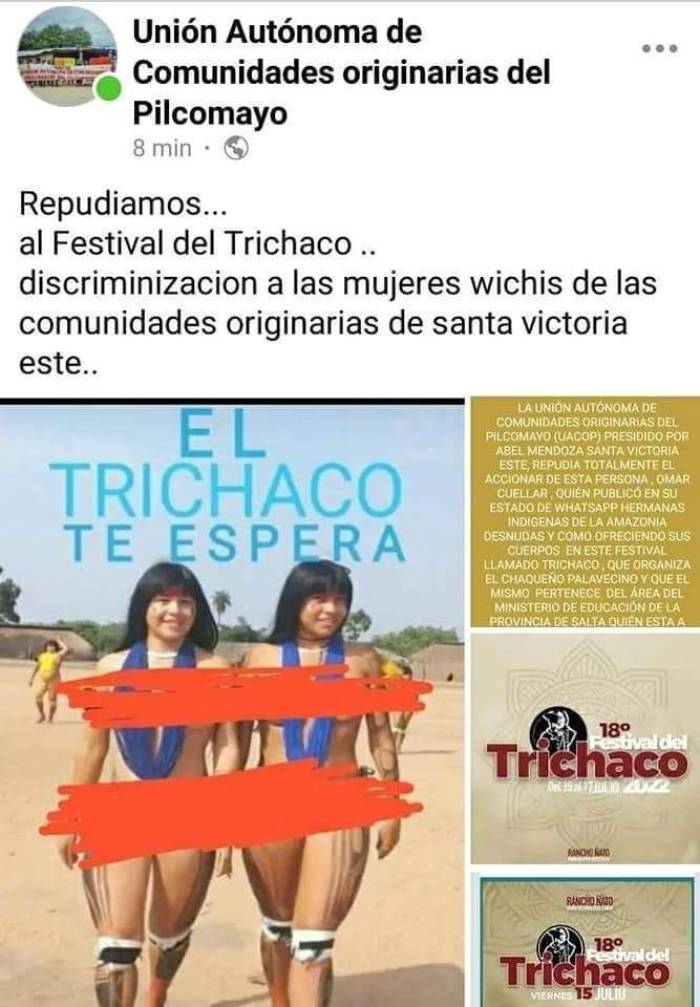
The "propaganda" carried out by teacher Rubén Omar Cuéllar came to light last Friday, near midnight. This prompted a reaction from the Autonomous Union of Indigenous Communities of the Pilcomayo (UACOP), whose president, Abel Mendoza (Lutsej, his Wichí name), released a statement of condemnation and filed a criminal complaint with the Salvador Mazza prosecutor's office, headed by Armando Cazón.
What is the Trichaco Festival?
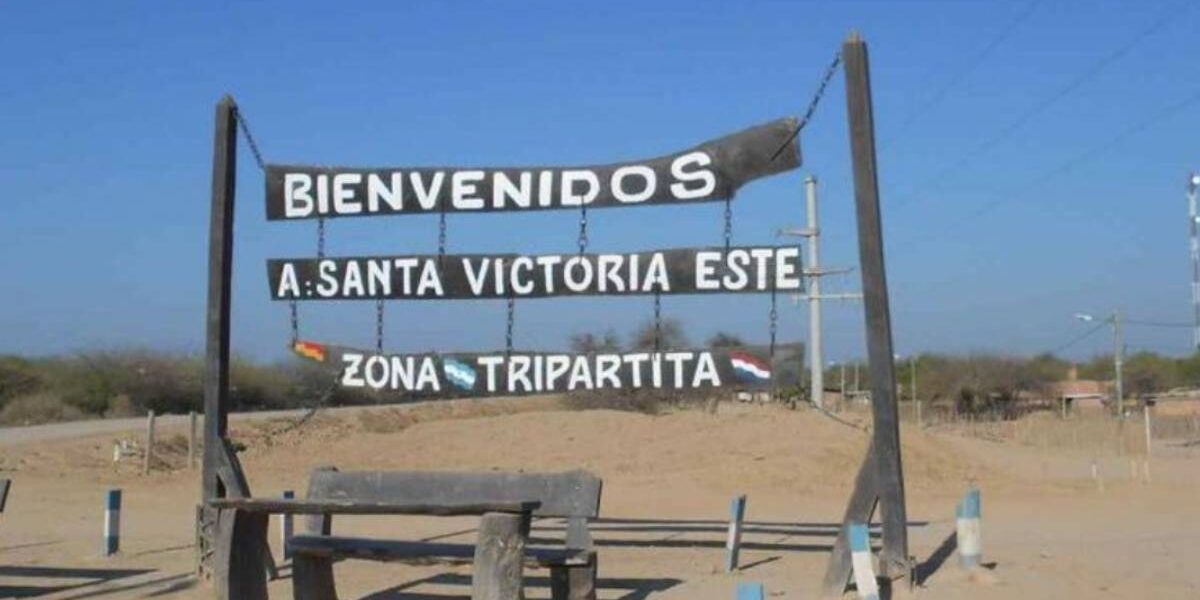
The Trichaco Festival, organized by the singer Chaqueño Palavecino , has been held for 20 years in Rancho El Ñato, a place located 16 kilometers from Santa Victoria Este, the main town of the Rivadavia department, in the north of the province of Salta and on the tri-border area between Argentina, Paraguay and Bolivia, an area mostly inhabited by native populations.
Lutsej said that Cuéllar, who is known by the nickname “Bigote”, put the image of two young indigenous people from the Amazon on his whatsapp status.
Both women are adorned with ornamental clothing, and nude according to Western standards, with the caption “El Trichaco awaits you.” For the Indigenous community, the publication is an open invitation to commit sexual abuse and other forms of violence, especially against Indigenous girls and women.
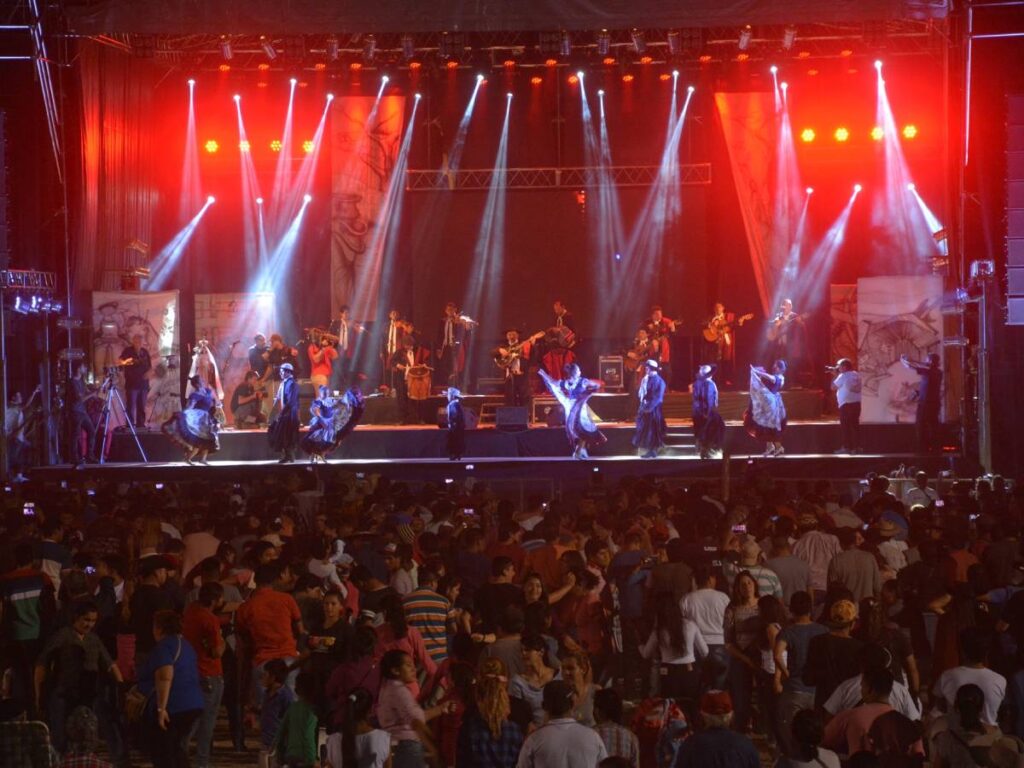
Photo: Facebook Festival Trichaco.
“When there are those kinds of festivals, there are abuses.”
The Indigenous leader used the word “chineo” to refer to these practices . The term was used by the colonizers and is used by the Indigenous Women and Dissidents Movement for Good Living, “because a silenced and historical practice cannot be denaturalized if it is not called by the name by which it is known and reproduced.”
“When there are these kinds of festivals, these kinds of events, there are abuses, there are rapes. And there always have been, which is why we condemn and denounce them,” Lutsej stated. He also emphasized the geographical location of the festival, in a tri-border area where “a lot of prohibited substances” circulate.
“Things have happened here at the festivals that women don't report out of fear,” the leader insisted. He praised the work of Octorina Zamora . The Wichí woman dedicated her life to denouncing the injustices committed against her people, and sexual abuse, especially by non-Indigenous people.
Lutsej explained to Presentes that for these reasons they considered the teacher's post a "serious" matter, filed a complaint, and said they expect consequences. "We denounce the white man's mistreatment," she affirmed. Irene Cari, head of the Women's Forum for Equal Opportunities, also filed a criminal complaint.
The prohibition of justice
Cuéllar was formally charged on Monday, July 18, with the crime of "disseminating obscene images." Prosecutor Armando Cazón informed this agency that the man claimed it was a meme he had received from another user. He did not admit to having made it go viral.
As soon as the complaint was filed, the prosecutor asked the presiding judge, Héctor Mariscal Astigueta, of the city of Tartagal, to order Cuéllar to "cease and prohibit the dissemination of said publications by any means, under penalty of judicial disobedience." By then, the man had already deleted the image from his status.
The prosecution emphasized that these publications displayed “images of Indigenous women as an attraction for visitors from outside the communities.” It maintained that this is linked “to the practice of 'chineo,' which consists of the subjugation of Indigenous women by non-Indigenous people.”
On the other hand, it was learned that Cuéllar tried to excuse himself by stating that he had no intention of promoting the "chineo," a practice he said he condemned.
The proceedings in this case will continue with witness testimonies. Among them are those of Lutsej (Abel Mendoza) and another Indigenous leader, Octavio Barrozo, who also reportedly filed a complaint.
Although in Santa Victoria Este Cuéllar, 62, he is known as an official in the infrastructure department of the Salta Ministry of Education, and it was learned that he appeared in that capacity at the arraignment hearing, the Ministry of Education again denied yesterday that he works there. “He is a retired teacher,” they stated in response to this agency's inquiry.
In addition to appearing to testify at the Salvador Mazza prosecutor's office, the teacher tried to speak with Lutsej. He called him three times, the community leader said, but he didn't answer. "I'm not going to respond, because I simply don't speak to someone like that." "He disrespected us, he disrespected the women," Lutsej maintained.
She added that this is why they don't want things to "stay as they are." They are even considering taking further action to raise awareness of this violence. "We are hopeful that there will be a positive outcome for the communities," she stated.
A call to violence
Lutsej said they haven't received any updates regarding the Trichaco festival, which took place on July 15, 16, and 17. The festival was suspended for two years due to the COVID-19 pandemic.
The spokesperson added that the festival not only brings violence to Indigenous women, but also often encourages poaching and the cutting down of native plants like palo santo, whose wood is highly prized.
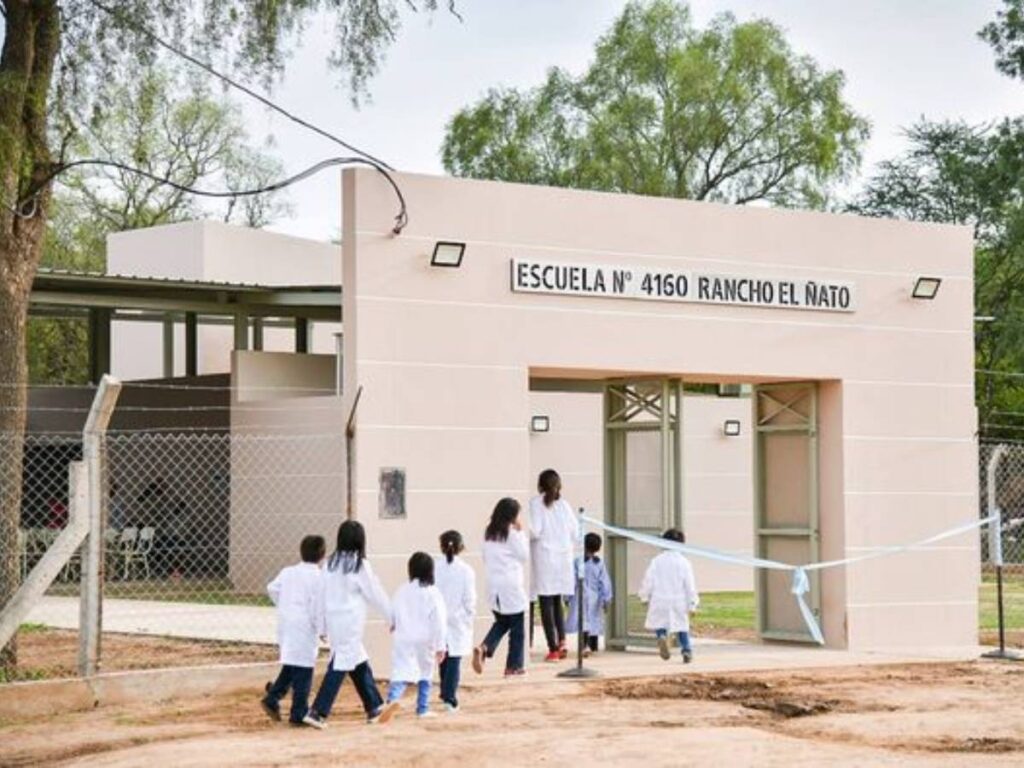
He questioned the former mayor of Santa Victoria Este, Moisés Balderrama, a criollo, and the current mayor, Rojelio Nerón, a Wichí, for granting the permits for this festival. He stated that it is being promoted as a charitable activity aimed at raising funds for local schools.
Lutsej added criticism of Nerón, whom he called a "sexist." The mayor sparked anger among other Indigenous leaders, such as Chief Asencio Pérez of Alto La Sierra. This was because last April he asserted that in Santa Victoria Este there were no cases of rape of Indigenous women and girls committed by "whites."
“Santa Victoria Este is in crisis; it’s a red zone in health, education, in everything,” Lutsej asserted. He recalled that it was precisely in Alto La Sierra that a young girl with developmental delays, known as Juana, was raped by eight men.
“He’s another sexist,” she affirmed about Nerón: “We’re going to gradually uncover the truth; women are finding the courage to speak out.” In this regard, the activist highlighted the work of Octorina Zamora, who passed away in early June, to encourage women to report these incidents .
Misogynistic, racist, and sexist practices
The post by the teacher from Salta was condemned by a wide range of women's and LGBTQ+ organizations. While their opinions varied, there was agreement in describing the Trichaco festival as "extractive, sexist, misogynistic, and racist." This was the description offered by at least a dozen feminist, Indigenous, and gender identity organizations that issued the first statement of rejection.
On July 17, the Indigenous Women and Diversity Movement for Good Living condemned the festival. It also called for “categorically rejecting misogynistic, racist, and sexist practices, such as the Trichaco Festival and all that it entails.”
The Movement recalled that for years they have denounced "the ways in which the patriarchal, racist and colonial system operates in Argentina with state and social complicity, making invisible the practices of child abuse, trafficking and sexual abuse that are recurrent in the North of the country against us and our children."
She argued that the use of images of young indigenous women “as part of the 'cultural goods' to be consumed exposed “how these practices are fostered and encouraged.”
She denounced that the Trichaco festival “has the complicity of artists like its creator, Chaqueño Palavecino, and provincial government officials like Omar 'Bigote' Cuellar, an employee of the Ministry of Education of the Province of Salta. But even worse, the attendees are complicit. By participating, they condone the sexist practices that turn indigenous women into sexual objects that can be used.”
Why is the word “Chineo” used?
The Movement also highlighted the use of the term "chineo" to describe these practices . "Accepting with impunity that our bodies be used for advertising purposes is also inviting, in broad daylight, that we be displayed as something available for the perverse amusement of those who believe they have the right to do so. Simply because we are girls, women, and Indigenous people. It empowers men to feel entitled to 'hunt' girls and young women to rape them, which in some parts of the country is known as 'going out to chinear,' that is, 'chineo,'" they asserted.
The use of the term "chineo" sparked debate, as Indigenous women in Salta reject it. Octorina Zamora was one of them, since she considered it discriminatory, preferring to speak of gang rape and sexual abuse.
In contrast, the Indigenous Women and Diversity Movement argued that “Going out to play with children is not simply gang rape, an infamous act in itself.”
“It is,” he maintained, “a political crime because it has a racist and colonial foundation, made possible by the fact that we are robbed of all dignity. Just as we continue to be robbed daily of our rights to our territories, to food, to decent housing, to safe jobs, and to access justice. It is a crime for which the colonial and genocidal state must be held responsible for the atrocities it has inflicted upon us, historically treating us as barbarians and as trophies. In this case, the crime is aggravated because it has also been transformed into a case of trafficking for sexual exploitation. All of this within the framework of this supposed folkloric ‘festival’ in which the fame of its musicians, particularly the organizer, fosters their complete impunity.”
In addition to denouncing and condemning these practices, the Movement celebrated that “other movements have spoken out in this direction.” It called “on all people and sectors who feel shame and outrage at the various ways in which our peoples and nations, and with them we, our girls, and diverse communities, are subjected to daily violence, to join us in expressing their revulsion for these practices and their determination to join our fight to abolish child trafficking, as well as any form of trafficking and sexual abuse.” It also invited people to endorse this declaration and join the campaign: #AbolishChineTraffickingNow
The questioning of the organization and the State
The Multisectoral Women's Network of Salta also condemned the publication. They described it as a "clear attempt to objectify the bodies and identities of survivors of all forms of sexist and patriarchal violence."
He also noted that the Trichaco takes place in “one of the poorest areas of Salta. Where children and adults die from malnutrition or lack of ambulances for transport and from diseases of poverty. Without access to food, shelter, drinking water, electricity, health and bilingual intercultural education, without medicine. And exposed to indifference, discrimination and the violence of permanent colonization.”
She also asserted that, according to testimonies from local women, “going out to ‘hunt’ poor indigenous and peasant girls and women, subjecting them to gang rapes, is the main ‘entertainment’ of men who enjoy the complicit silence of their peers, who perpetuate the recurring violence. This is compounded by the fact that for these girls and women—who are denied access to justice—the critical path to having their voices heard is far more cruel and brutal than for those who live in urban areas.”
The Multisectoral Group also criticized Chaqueño Palavecino, “known in the country's Women's Movement as the icon of the violent rural macho.” They questioned why he “never” provided a public accounting of the festival's revenue and how those funds were spent, and pointed to the municipal and provincial governments for facilitating the festival's infrastructure.
He argued that "it's no coincidence that the lineup of performers at Trichaco is overwhelmingly male." He also emphasized that "the festival organizers remained silent regarding the offensive post by public official Omar 'Bigote' Cuellar."
Share
We are present
We are committed to journalism that delves into the territories and conducts thorough investigations, combined with new technologies and narrative formats. We want the protagonists, their stories, and their struggles to be present.
SUPPORT US

FOLLOW US
Related notes

We are present
This and other stories are not usually on the media agenda. Together we can bring them to light.