

Transphobia is repeated at the Cinemex chain in Mexico City
The Mexican movie theater chain is obligated to answer for having discriminated against a trans person.



Share

The enemy is not just anyone. And with that certainty, the certainty of someone who knows they will win, they tried to take away Paulette Slava Cárdenas Vergara's right to identity. Paulette, an activist for the rights of the trans community (transgender, transvestite, and transsexual) and a gender-nonconforming woman, was challenged: "Well, go and file a complaint," the manager told her. He had decided, on behalf of the company, that her existence violated the mall's rules. And he kicked her out.
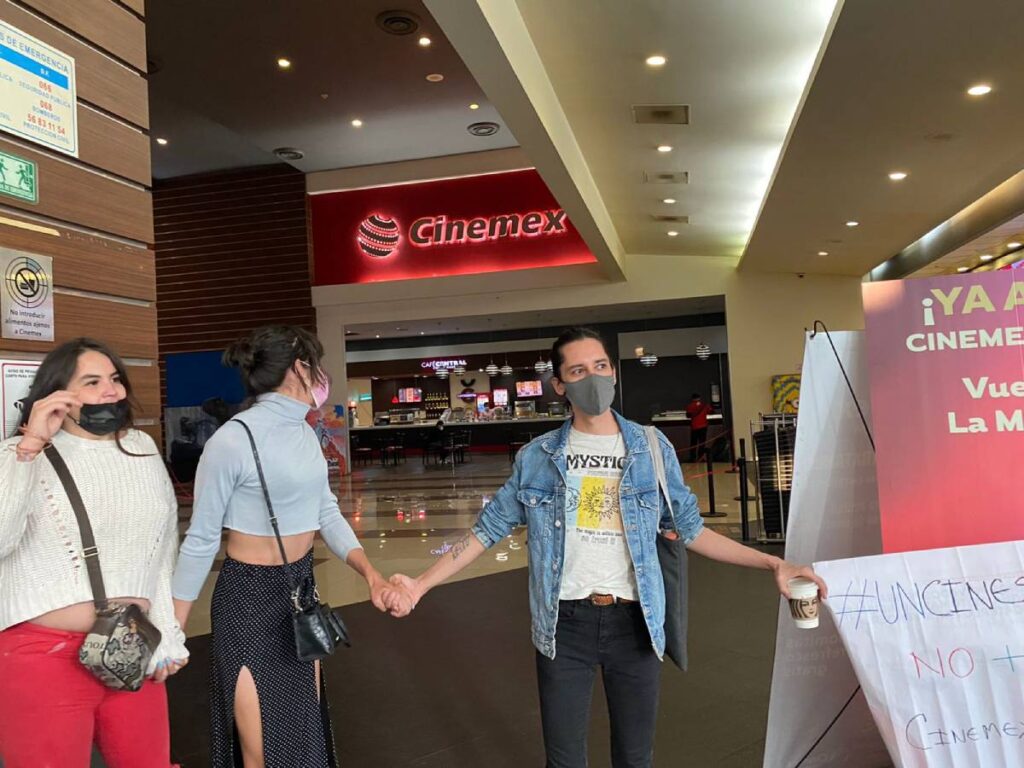
Paulette Slava was at the Cinemex movie theater located in Plaza Reforma 222, near the now-demolished Glorieta de la Palma roundabout, ironically one of the starting points for the annual LGBTTTIQ+ rights march in Mexico City. She was leaving the theater after a movie when she tried to use the restroom. Employees blocked her path and asked her to leave, repeatedly addressing her as "he." After several minutes of discussion, the manager ended the exchange with a threat.
The complaint
In response, Paulette decided to file the corresponding complaints and pursue her case to the fullest extent. This led the Council to Prevent and Eliminate Discrimination (CPED) of Mexico City to issue a statement against Cinemex on April 27, 2022, for the clear violations of the law committed by its employees.
In this document, numbered 4309420 and in the hands of PODER, it is recounted how the activist demands that the authorities take action on the matter.
The CPED document is addressed to Operadora de Cinemas SA de CV, along with its holding companies, subsidiaries, affiliates, and companies under the control of Grupo Cinemex. It explains how several company employees aggressively removed Paulette, arguing that he was a gentleman and that it was not his bathroom.
PODER exclusively that, despite feeling humiliated and heartbroken, she decided to leave the same complaint record with the security unit of the plaza.
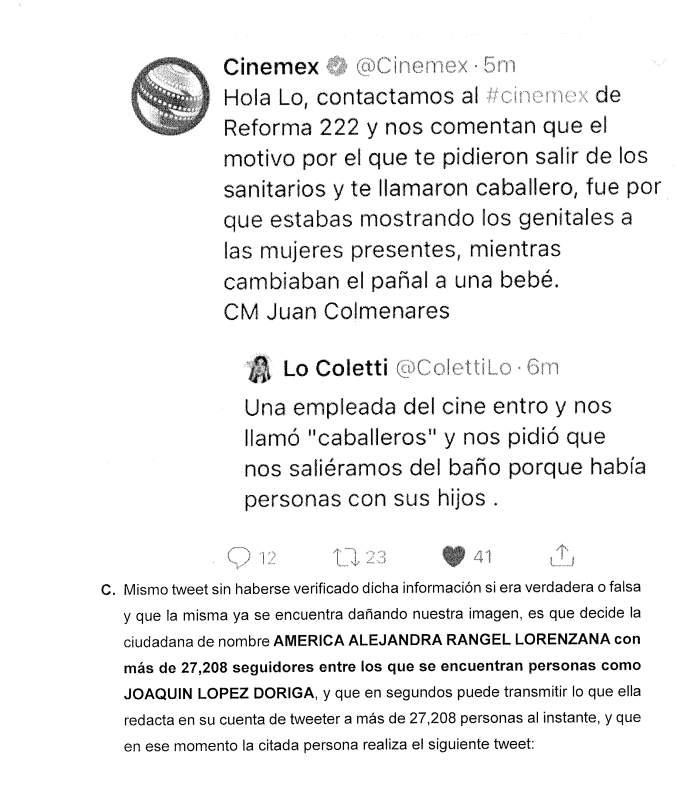
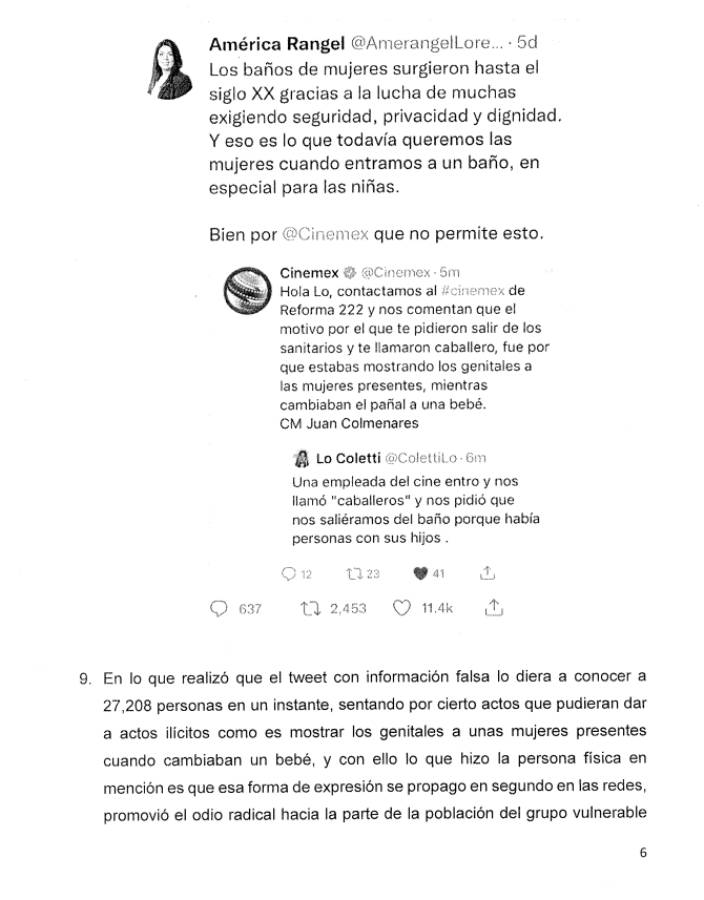
The matter didn't end there. Following the conflict, Cinemex's official account published a statement that, according to the interviewee, contained defamatory accusations against Paulette for allegedly exposing herself in the restroom. Subsequently, Congresswoman América Rangel, from the conservative National Action Party (PAN), republished this same information without giving Paulette the opportunity to exercise her right of reply or present evidence to refute the accusations.
Who is Cinemex? And who or what millionaires are behind it?
The Cinemex Group is part of the holding companies of Grupo México. It is owned by billionaire Germán Larrea Mota Velazco, who currently appears as a Board Member and Executive Chairman in the most recent annual report of the Mexican Stock Exchange (BMV). He is also a shareholder in 88 other companies throughout the country. And although his primary business is mining, so is the company that owns Cinemex .
This is not the first human rights violation case against Grupo México. On August 6, 2014, Mexico suffered an environmental disaster due to a mining spill at the company's facilities. Studies revealed flaws in the installations at the Buenavista del Cobre mine, owned by Grupo México, in Cananea, Sonora. The mine, which extracts copper and molybdenum, released 40,000 cubic meters of acidified copper sulfate (CuSO4) leachate into the Tinajas Stream. This leachate flowed from the Bacanuchi and Sonora rivers to the Molinito Dam, which supplies water to the city of Hermosillo . To date, the affected communities continue to demand reparations.

Permanent contempt
Following the same pattern of operation, the Larrea family's company defied federal government orders to implement health measures during the COVID-19 pandemic. Desiderio Villegas, a former mine worker and peasant leader, recounts that cousins Germán Larrea Mota Velasco, owner of Grupo México, and José Antonio Rivero Larrea engage in very similar corrupt practices. Rivero Larrea's Minera Autlán dumps chemicals into a stream of the Río Claro in Hidalgo, which originates in the Atezca lagoon and flows through Tlaxinca, Ixcatlán, and Cuxhuacán in the municipality of Molango; and through Tamala, San Simón, and Acuimantla in the municipality of Tepehuacán. This same company is accused of employing what community members call "conflict engineering .
In 2007, Grupo México announced a major investment—through its subsidiary Southern Copper Corporation—to extract copper from Tía María, one of the most important agricultural areas in Arequipa, Peru. Farmers rejected the project and began an indefinite strike. Over the course of eight years, violent clashes erupted, resulting in four deaths and more than 20 gunshot wounds.
Finally, in 2006, 65 workers were trapped in Pasta de Conchos by an explosion caused by a methane gas buildup. The mine, operated by Grupo México, had reported safety failures since 2000. The company suspended the rescue operation a year later, and the bodies remain buried .
The paradox of those who want to sell at any cost
The official website of the cinema chain (a subsidiary of the mining company) states in its work policy that respect is one of the cornerstones of the corporation: “We treat people with dignity, courtesy, and tolerance. We recognize at all times the rights, freedoms, and qualities inherent to the human condition and its dignity. We communicate clearly and with sound reasoning, always in a tone of respect for others. We speak positively about people, avoiding any kind of offensive or derogatory comments, without distinction based on their individual characteristics or hierarchical level .” Clearly, this was not the case with Paulette.
And although these terms are not legally binding, meaning there is no regulation with clear conditions for workers who violate this model, in Mexico discrimination based on gender identity is a crime.
According to the provisions of the Federal Penal Code , title three, where mention is made of crimes against the dignity of persons, it is stipulated that said act (discrimination) contemplates a sanction of "one to three years of imprisonment or one hundred and fifty to three hundred days of work in favor of the community and up to two hundred days of fine to anyone who, for reasons of origin or ethnic or national belonging, race, skin color, language, gender, sex, sexual preference, age, marital status, national or social origin, social or economic condition, health condition, pregnancy, political opinions or any other kind, violates human dignity."
Thus, Paullete insists in an interview that she will exhaust all possible institutions in order to enforce the law.
We are present
We are committed to journalism that delves into the territories and conducts thorough investigations, combined with new technologies and narrative formats. We want the protagonists, their stories, and their struggles to be present.
SUPPORT US

FOLLOW US
Related notes



We are present
This and other stories are not usually on the media agenda. Together we can bring them to light.