

Paraguay: Another peasant community violently evicted
In an excessive operation, the police evicted the one hundred members of the community and arrested ten people, nine of them women.


Share

On Tuesday, June 28, another forced eviction took place in Paraguay. This time, 450 police officers, in a large deployment, evicted 100 people from a peasant community in the district of Tembiaporã, in the department of Caaguazú .
Ten people were arrested. Nine of them are women and belong to the landless commission Jóvenes Unidos (United Youth ), two of whom are breastfeeding mothers.
Forced evictions of peasant and indigenous communities are a constant feature of this government . Police operations are carried out with the same characteristics of violence and human rights abuses.
In March 2022, the Paraguayan Human Rights Coordinator (Codehupy) , together with social organizations, had obtained a hearing with the IACHR to denounce the cases of forced eviction..
During the hearing, Codehupy presented its cases, and representatives of the State also participated . After hearing from both sides, the IACHR expressed its concern regarding the reported cases of forced evictions of peasant and indigenous communities.
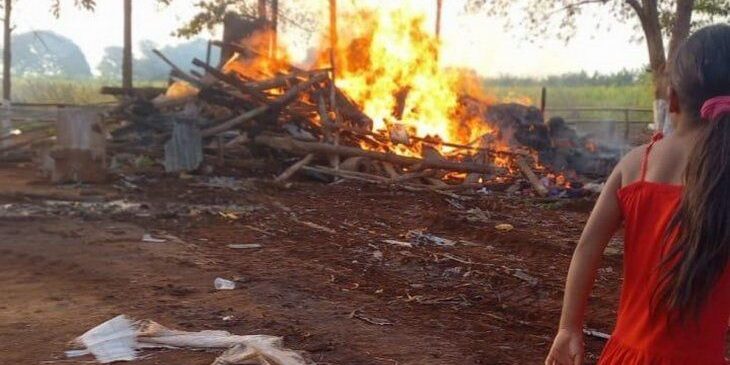
Despite this, on the morning of June 28, another eviction took place at a peasant community in the Tembiaporã district. A contingent of 450 police officers, with water cannons, a helicopter, and mounted police, evicted 100 people from a peasant community belonging to the National Peasant Federation . During the operation, they destroyed homes and crops, and confiscated motorcycles. Several people were injured with rubber bullets, and ten were arrested.
The concern of the female leaders
We spoke with national leader Teodolina Villalba, general secretary of the National Peasant Federation (FNC), and Elida Giménez, leader of the Guahory community. Both expressed their deep concern about this situation of abuse.
The forced eviction took place on the property known as the former Zavala Cue. The FNC (National Federation of Peasant Communities) alleges that the land was illegally acquired, land that the Zavala family resold. “The neighboring community was even attacked by the National Police, not just the occupying community; nearly 10 people were arrested, including women. This is a cause for concern for us, and we condemn the authorities' actions. How can they respond to people's needs in this way? ” Villalba expressed her concern.
For her part, Elida stated that the evicted peasant community did not expect the aggressive attitude of the police and GEO (Special Operations Group). “ It's unacceptable that the large landowner has 27 police officers as foremen on his property, where the evicted landless people are settled. The Public Prosecutor's Office must take note; a complaint is already being filed. The man leading the guard on the property is very aggressive.”
An attack on the farmers
Teodolina Villalba explained that people need land to be able to produce. They complete all the necessary paperwork with the relevant institutions, and the State responds with a forced eviction.
Regarding the claim that the farmers confronted the 450 police officers, he pointed out that this would not make sense given that it was a small number of 100 people.
“They run people over with bullets, they confront them. They left that place empty, how are those people going to defend themselves?” Teolodina said, referring to the situation faced by communities evicted or threatened with eviction in the country.
According to prosecutor Rita Prieto, Cerealista Campo 9, from the district of J. Eulogio Estigarribia, is the company claiming the land. The FNC maintains that the land was illegally acquired.
Nine women arrested, two of whom were unable to breastfeed their babies.
The 10 people arrested during the eviction are being held at the 2nd Police Station in Caaguazú. Although they have legal representation, to obtain any legal measures they must present several documents: birth certificates for their children, proof of residence, and property titles as collateral. It is this last document that they are having difficulty providing.
“One of our comrades is sick; we brought her medicine. They are still being held at the 2nd police station in Caaguazú. Two of them have babies and are being cared for by relatives. They can’t breastfeed; one of them has hardened breasts, and for the other comrade, they only gave us 10 minutes, and for those reasons, she can’t breastfeed,” says leader Elida Giménez.
The fact that mothers are unable to breastfeed their babies is another serious violation of basic human rights. According to Giménez, the detained mothers are physically well, but are distressed about their children, whom they had to leave in the care of other relatives. This is affecting them psychologically, in addition to having experienced a violent eviction.
“It affects women, especially those who left their children behind. Those who left their babies and minor children are worried; they didn't expect these abuses and injustices from the departmental and national authorities,” the leader stated.
Protests against state violence
On Wednesday morning, they held a rally in front of the Ministry of the Interior in Asunción. Police attempted to prevent the demonstration, but the FNC, accompanied by organizations such as Conamuri, ultimately managed to proceed.
In addition, there was a nationwide deployment in various departments across the country. In the department of Caaguazú, there were demonstrations in front of the Prosecutor's Office and the Judiciary in the city of Caaguazú, and in front of Cerealista Campo 9 in J. Eulogio Estigarribia.
In the department of San Pedro, in front of the Santaní, Santa Rosa, San Vicente and Guayaibí police stations. In Canindeyú, in front of the Curuguaty, Maracaná, Yhovy and Puente Kyha police stations. Department of Guairá, in front of the Melgarejo police station; in Misiones, in front of the Santa Rosa police station and the department of Concepción, in front of the Horqueta police station. While in the department of Itapúa they demonstrated in front of the General Delgado police station.
Demonstration of solidarity
The Conamuri, an organization of peasant and indigenous women, released a statement in solidarity with the nine women detained. They pointed out that the Paraguayan state is once again demonstrating its contempt for disadvantaged communities, and especially for women. “We know that, in our country, throughout history, women have been socially denied access to land. What happened yesterday demonstrates that the institutions are also violating the right to a life free from violence in the territory, where the full exercise of all rights for the development of families and women themselves should be guaranteed.”
The Association of Peasant Women of Caaguazú (AMUCAP) also expressed solidarity with the evicted community. “Today in the San Jorge settlement of Tembiaporâ, Caaguazú department, some 100 families suffered violent abuses. The cruelty and cowardice of the Colorado Party government was demonstrated once again, with the destruction of homes and crops belonging to the legitimate owners of these lands, along with torture, gunshot wounds, and arrests,” reads part of the statement, which also addressed other issues related to the struggle for land in Paraguay.
The leaders of the FNC stated that they will continue their permanent mobilization.
We are present
We are committed to journalism that delves into the territories and conducts thorough investigations, combined with new technologies and narrative formats. We want the protagonists, their stories, and their struggles to be present.
SUPPORT US

FOLLOW US
Related notes



We are present
This and other stories are not usually on the media agenda. Together we can bring them to light.