

One year of transvestite trans job quota in Argentina
María Pía Ceballos, a transvestite activist, reflects on the Law for the Promotion of Formal Access for Transvestite, Transsexual and Transgender People, its impact on the culture of work and politics.


Share

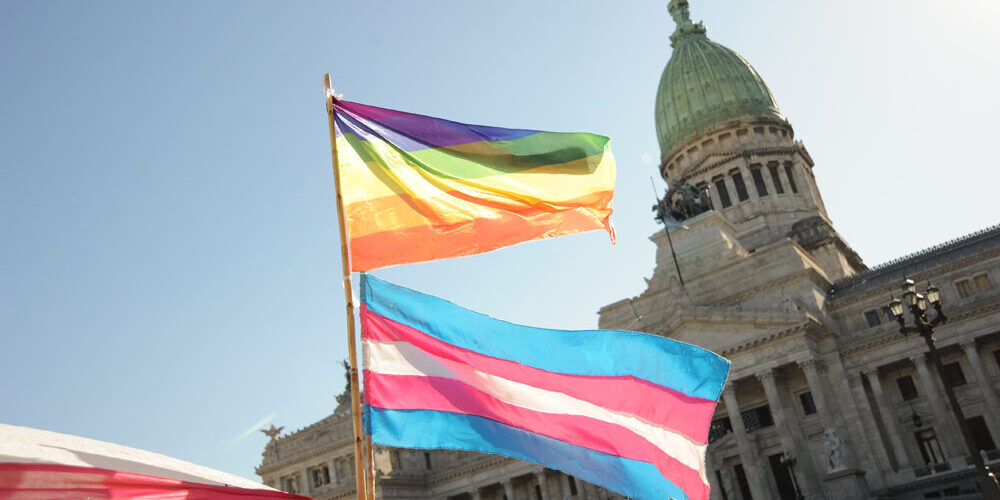
On this day, the Senate passed the transgender employment quota law. The Diana Sacayán-Lohana Berkins Law for the Promotion of Access to Formal Employment for Transvestite, Transsexual, and Transgender People ( Law No. 27636) mandates the hiring and inclusion of 1% of transgender, transsexual, and transvestite (TTT) people in both the public and private sectors throughout the country—not just in the City of Buenos Aires! It's important to note that compliance must also occur at the provincial and local levels. And the 1% should be considered a minimum, not a maximum.
This law promotes access to employment in all three branches of government and invites universities to join. It emphasizes the autonomy and development of work in the social and popular economy, with a focus on providing loans to entrepreneurs and creating incentives for small and medium-sized enterprises. It considers educational attainment, training, skills development, and career advancement; and the real equality of opportunity throughout Argentina. It also promotes job security and sustainability. This law is based on the cross-cutting principle of non-discrimination and violence . This should be the commitment and the challenge for employers and for every hierarchical and structural organization within the workplace of the cisgender norm.
Transfeminist politics
In 2020, amidst a complex situation exacerbated by the pandemic, in addition to responding to urgent needs arising within and for the community, we built and strengthened solidarity and institutional networks, weaving connections across the territories. In this context, Decree 721/20, signed by President Alberto Fernández, was achieved in September. This is a significant milestone in the long struggle for this legislation.
Fortunately, the foundations of the public policy design for diversity were laid by a great colleague and activist like Alba Rueda. I supported her from the employment coordination office. We had to mainstream transfeminist policy, fighting both outside and within the very institutional structures of heteronormativity . We built the foundations of a policy so fundamental for the transvestite and trans community, and in a very short time because it was and is an urgent policy.

I am convinced that all of this is only possible when it is in the hands of fellow activists who collectively promoted and fought to achieve this policy. Proud of what we trans people gave .
Work culture will be transformed when we have areas, institutions, and jobs with many trans and gender-diverse sisters and brothers . That's how our society and democracy will be transformed.
Inclusion is transformation
Large teams of workers accompanied us with concrete achievements, not only in joining the National Public Administration (APN), but also in developing policies such as the Single and Voluntary Registry, HR training and development, the TTT Retention Days, training and awareness workshops, and partnerships with cooperatives and women entrepreneurs. Some may want to take a biased view, but don't be fooled: this policy was built with trans people!
It's easier to "negotiate," to be "heard," and to "get things done" if you're not trans . Because the structures of the workplace are exclusionary, and discriminatory and violent practices persist. It won't be possible to eradicate the structural conditions of exclusion toward our community if inclusion isn't approached from a transformative perspective . Unless every corner of the workplace becomes an engine of change, striving for an increasingly just and diverse Argentina .
For us, it is crucial to analyze the implications of affirmative action policies of this kind, adopting perspectives that value inclusion without losing sight of that other “critical value of difference ” that Lohana Berkins . What does this mean? It means that it is fundamental to foster coexistence in diversity, breaking with paradigms that call for “tolerance” without questioning a system of inequality that is repeatedly inscribed within the guidelines of a patriarchy where cis-heterosexuality is the norm . This should lead us to embrace, in all its positivity, the irreducible singularity of a community that affirms other ways of life, socialization, and work. That is why we say: ¡traVajo! (Work!).

Transvestite and transgender employment quota in Argentine universities
I want to congratulate the National University of Salta, which, with a large majority, achieved the university's adherence to Law 27.636. We achieved this as a community. We presented the first project during the resistance against Macri's policies; we've been working for many years, building and mobilizing with fellow professors, union members, and students, and this achievement is a community effort with everyone. Congratulations to my trans and travesti brothers and sisters and the organizations. And now there are more than 12 National Universities!
#28J
This June 28th, we will take to the streets, with trans fury demanding compliance with the laws and full rights for our community. Let the earth tremble with trans fury because this June 28th we will shout: Stop Transfemicides, Transvesticides, and Transhomicides! Where is Tehuel?
This June 28th, we will also shout for reparations and compensation for our adult sisters. This June 28th, we will shout for territorial agendas, together in the streets with the same spirit as the transfeminist movement. June 28th. The pride of being who we are, of shouting out against oppression, inequality, and social injustice. The pride of fighting with love to transform everything.
María Pía Ceballos is an Afro-Indigenous trans activist from Salta. She is a member of Mujeres Trans Argentina (MTA).
We are present
We are committed to journalism that delves into the territories and conducts thorough investigations, combined with new technologies and narrative formats. We want the protagonists, their stories, and their struggles to be present.
SUPPORT US

FOLLOW US
Related notes

We are present
This and other stories are not usually on the media agenda. Together we can bring them to light.