

The murder of Melody, a transvestite: Mendoza will have its first trial for a hate crime
The police officer who murdered Melody will face a jury trial, the date of which has not yet been set. The prosecution cited "hatred of gender expression" as the motive.



Share

BUENOS AIRES, Argentina. A jury trial will be held for former Mendoza police officer Darío Jesús Cháves Rubio for the murder of Melody Barrera, a trans woman. The trial, which has not yet been scheduled, will consider the "hate crime based on gender expression," according to judicial sources. LGBTQ+ organizations are using the hashtags #FueTravesticidio (ItWasTransphobic), #AMelodyLaMatóUnPolicía (A Police Officer Killed Melody), and #JusticiaPorMelody (Justice for Melody) to raise awareness of the case.
“We are fighting to ensure that her death was not in vain: that she leaves something for her colleagues so that no other police officer kills another Melody. She has to be part of history,” Melody’s mother, Victoria Pincheira, Presentes
Homicide prosecutor Andrea Lazo, along with the head prosecutor of that unit, Fernando Guzzo, will prosecute Cháves Rubio, who served as a police officer in the Mendoza Police Department's 34th Precinct in Godoy Cruz. The case was recently sent to trial and is expected to begin in August of this year.
The crime for which the man is currently detained is that of "aggravated homicide due to hatred of gender expression in ideal concurrence with simple homicide aggravated by the use of a firearm, in real concurrence with violation of the measures adopted by the authority to prevent an epidemic," reported sources from the Public Prosecutor's Office.
The Penal Code establishes that for this type of crime (aggravated homicides, contemplated in article 80) the penalty is life imprisonment or life detention.
“She played a lot of jokes, she was mischievous.”
Melody Barrera was a 27-year-old trans woman who transitioned when she was 16. On August 29, 2020, she was murdered in the early morning with at least six shots fired from a vehicle on Correa Saa and Costanera streets, a red-light district in the Guaymallén department , a few meters from the border with the provincial capital.
According to the Medical Examiner's Office, most of the bullets struck the chest directly, and death was instantaneous. A number of spent 9mm shell casings were found at the scene of the attack by the Scientific Police.
Victoria Pincheira, a Chilean woman who has lived in Mendoza for 41 years, gave birth to three daughters, of whom Melody was the last to be born.
In a telephone conversation with this agency, she remembered her like this: “There are many days when I'm silent all day, I just cry. And other days I laugh a lot because she made a lot of jokes, she told me funny stories, she teased me, she hid things from me, she was mischievous.”
“She had a very serious problem,” she said, laughing. “She loved to clean. She was three times better than a housewife: she’d run her finger over it and it would come out spotless. She made me take off my shoes when I came in so I wouldn’t get the floor dirty. She did the laundry, changed the sheets, cooked. We watched TV together, talked, we liked to gossip.”
After their father, Melody's older sister left home first, followed by her middle sister, to live with their respective partners. "It was just the two of us left. So she took care of the house, and I worked all day," Victoria said.
“I insisted she finish high school, and thank God she did. I also convinced her to start a degree in 2021, when the pandemic was over. She would have liked to be a child psychologist. I told her no, that she should study food science instead, which she also liked: she knew all the names of the bacteria. But she didn't pursue that,” she continued.
Victoria is currently in therapy and has previously consulted with six psychologists and two psychiatrists. “It’s not easy. We are all prepared to bury our parents, and no mother is prepared to lose her son or daughter ,” she noted.
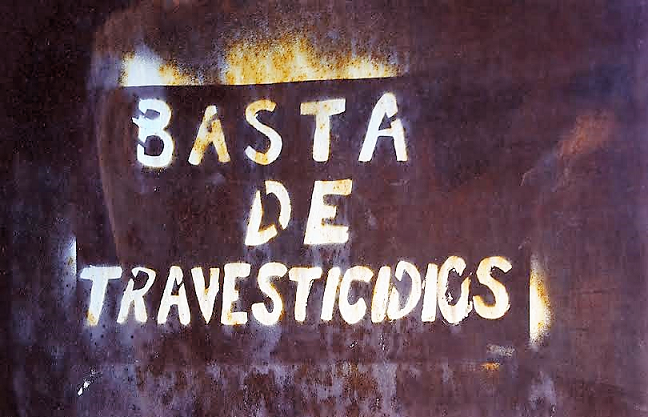
For an end to institutional violence
Mario Vargas is a sociologist, sex and political activist, and member of the Movement for Freedom, Equality, and Change (CLIK) , where he, along with Melody's family and other institutions, forms the Commission for Justice for Melody. This group seeks to bring the case to the public's attention, to share "how trans people live and die," and to provide information.
“I think that in a state that recognizes laws like Equal Marriage, the Gender Identity Law, and the trans and travesti employment quota, the relationship it has with the trans and travesti community , which until now has been through the police, needs to change. Institutional violence must end,” she stated in an interview with Presentes .
He added: “We want police officers to think twice before killing someone from now on. We believe that this officer's conviction must be a landmark, marking a turning point: from a state that persecutes you to one that recognizes your rights.”
“Let the police or other people think before they hurt us.”
National Institute against Discrimination, Xenophobia and Racism (INADI) is also accompanying Melody's family and friends
“Our job is to remove Melody from that pejorative place, from the place of common sense that doesn't see her as a victim but as guilty of her own situation. Because the first thing people think is 'oh well, she was a transvestite,' 'oh well, she was a prostitute': all those prejudices that people have that subjectively interfere when analyzing Melody's situation and what happened,” Consuelo Herrera, INADI's delegate advisor in the province of Mendoza, a transvestite and trans activist, member of CLIK , and a social work student, Presentes
“What we want is for this sentence to serve as a cautionary precedent so that future police officers or other people think twice before harming us,” Consuelo added, and stressed the need to keep in mind “that this is a hate crime, a transphobic murder.”
On the other hand, Uma Daniela Flores, a trans activist and representative of the Movement for Housing Inclusion for the Trans Collective in the province of Mendoza, expressed that “a year and a half after Melody's transvesticide, it is hopeful to know that her case has finally been brought to trial.”
Furthermore, he emphasized: “This is an extremely important case because it would be the first time that the murder of a trans person has been classified as aggravated homicide motivated by hatred of gender expression in the province.”
We are present
We are committed to journalism that delves into the territories and conducts thorough investigations, combined with new technologies and narrative formats. We want the protagonists, their stories, and their struggles to be present.
SUPPORT US

FOLLOW US
Related notes
We are present
This and other stories are not usually on the media agenda. Together we can bring them to light.