

The judge who increased the sentence of a trans woman because she was a migrant was acquitted.
The judge who had been denounced and suspended in 2019 for aggravating the sentence of a trans woman for being a foreigner was acquitted.


Share

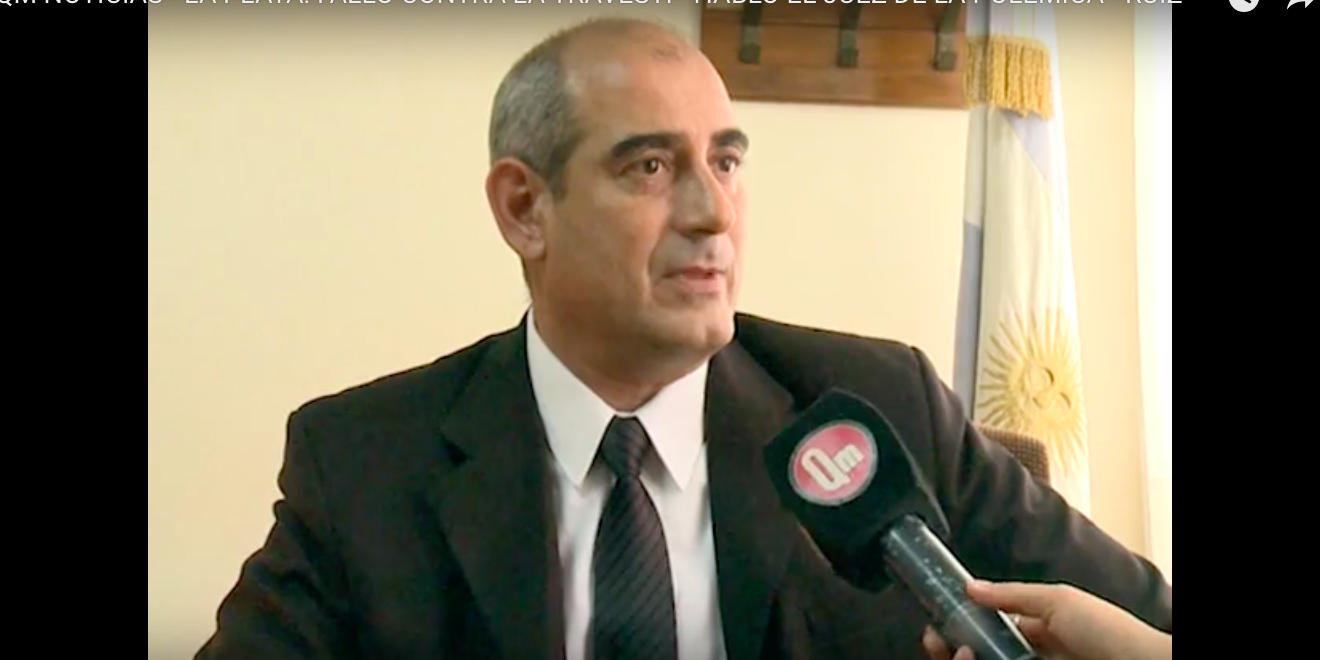
A jury acquitted Juan José Ruiz de La Plata, the judge accused of increasing the sentence of a transgender woman because she was a foreigner, in an act that social and LGBTQ+ organizations considered discriminatory. In his ruling, the judge had also referred to the woman, Claudia Córdova Guerra, using male pronouns, as well as the female witnesses who testified.
Presided over by Hilda Kogan, Chief Justice of the Supreme Court of Buenos Aires Province, the impeachment jury acquitted Judge Ruiz of La Plata by majority vote. Thus, the judge returns to his duties. He had been suspended from his position at the Oral Criminal Court No. 1 of La Plata following complaints filed by various organizations regarding his "discriminatory" conviction.
“The acquittal surprised us,” María Rachid , head of the Institute against Discrimination of the Ombudsman of the City of Buenos Aires and member of the board of directors of the Argentine LGBT+ Federation (FALGBT) Presentes .
Rachid had filed a personal complaint with the judge. The Permanent Assembly for Human Rights (APDH), the Argentine Federation of Lesbians, Gays, Trans and Transvestites (FALGBT), the Association of Transvestites, Trans and Transgender People of Argentina (ATTTA), and the Provincial Commission for Memory also .
The discriminatory sentence
In April 2014, Claudia Córdova Guerra, a trans woman of Peruvian nationality, was arrested for the crime of “possession of narcotics for sale” in La Plata. Ruiz, who at that time was a judge of Criminal Court 1, sentenced the woman to 5 years and 3 months in prison, and considered her being a foreigner an aggravating factor.
“ The State can and must apply sanctions as an accessory penalty to imprisonment and increase the penalties for foreigners who commit common crimes in the country, without this implying a violation of the principles of equality before the law and non-discrimination, among others, given that we are dealing with an exceptional measure endorsed by our Constitution and the international treaties that form part of it. The only unconstitutional thing would be not to do so .” This is how it was explained in the ruling.
Furthermore, the judge's ruling referred to Claudia using male pronouns and her former name, only using her self-identified name as an "alias." It also referred to her as a "transvestite person " instead of a trans woman. The ruling also used male pronouns to refer to the female witnesses who accompanied the defendant, even though they identified as women.
Being a migrant and trans
According to María Rachid, “ the migrant status of the accused, far from worsening their situation, protects them because, as a migrant, they fall within what we call in national and international legal doctrine and jurisprudence a 'suspect category' of being a victim of discrimination.” She explained, “Any distinction based on this reason (their migrant status) must be proven—through strict scrutiny—to be non-discriminatory.” And she warned, “There is a procedure for this with broad consensus in the field of law, which has not been followed in this case.”
“The same judge who is supposed to ensure compliance with the law. At no point did he respect the Gender Identity Law. This alone—proven through his ruling and the testimony of the accused—should be enough to remove this judge from office,” Rachid asserted.
In November 2016, the Fifth Chamber of the Criminal Cassation Court, upon appeal, modified the ruling. It ordered that the case file be officially labeled to include Claudia's gender identity. Furthermore, it changed the charge to "simple possession of narcotics" (eliminating "trafficking"), and rejected the aggravating circumstance of being a "foreigner" argued by Ruiz.
Acquitted due to the impunity of the Judiciary
Following complaints from social and LGBTQ+ organizations, Ruiz was suspended by the Jury for the Impeachment of Magistrates and Officials of the province, presided over by Eduardo de Lázzari . However, the judge later faced a jury trial—which could have resulted in his removal from office—and was recently acquitted.
For Claudia Vásquez Haro PhD in Social Communication and trans activist , “it is regrettable that these judges make decisions based on their worldview, which is so reductionist and, above all, discriminatory .” “We know very well that the ruling has a deeply xenophobic and racist component . This is an issue that has to do with ideology when it comes to handing down their sentences,” she stated in an interview with Presentes .
In response to the acquittal, the president of OTRANS Argentina stated that "this speaks once again to the level of impunity that exists within the judiciary ." She added, "It also highlights "a lack of a transfeminist, intersectional, and human rights perspective ." "It underscores once again the need for judicial reform to transform these kinds of practices. They harm not only the lives of individuals but, in this case, the lives of a community, which is the most excluded group in our civil society," she concluded.
We are present
We are committed to journalism that delves into the territories and conducts thorough investigations, combined with new technologies and narrative formats. We want the protagonists, their stories, and their struggles to be present.
SUPPORT US

FOLLOW US
Related notes


We are present
This and other stories are not usually on the media agenda. Together we can bring them to light.