

Lesbian Coming Out Poems: A Necessary Anthology
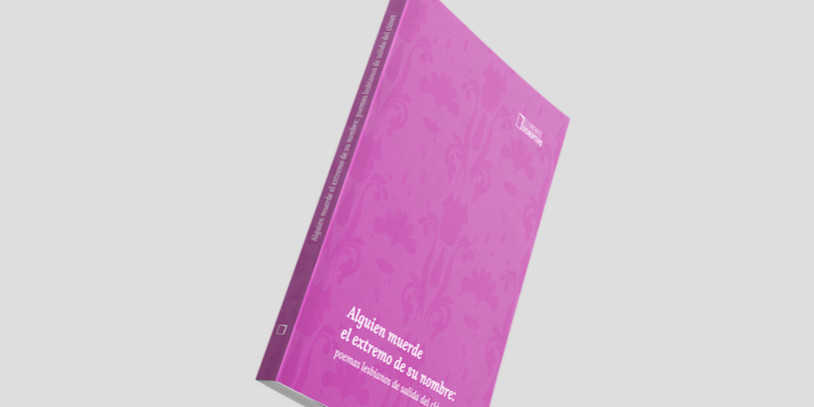
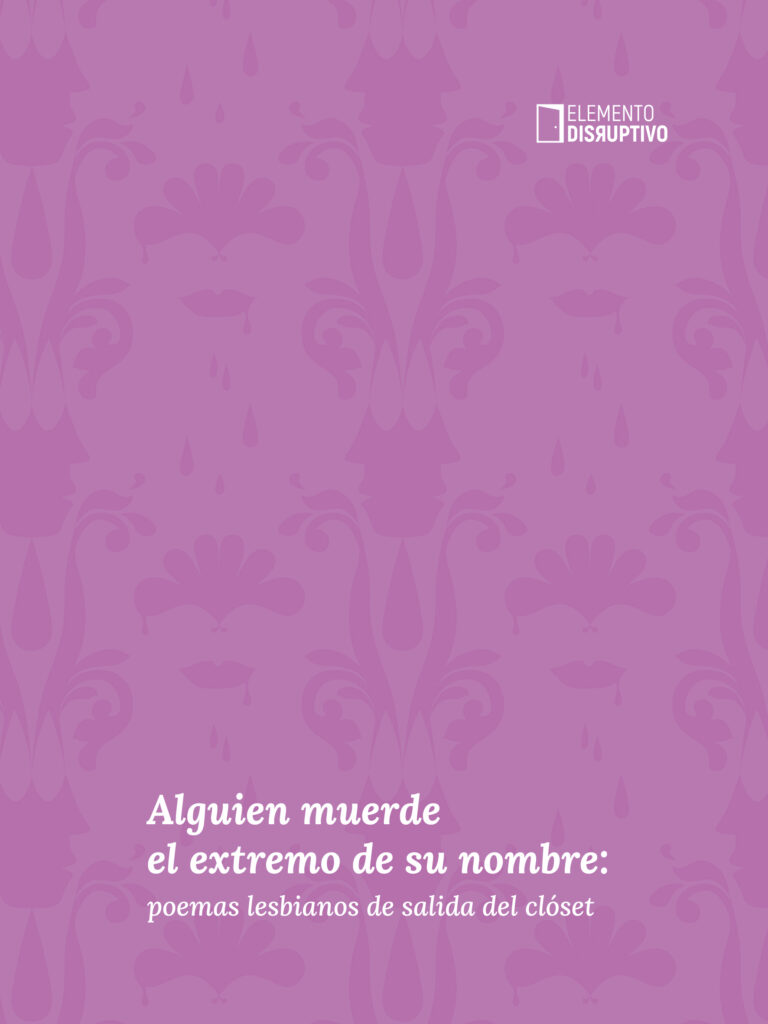
"Someone bites the end of their name" is an anthology of urgent and necessary lesbian poetry, recently published in Argentina.


Share

“Cicadas also spend their lives starving themselves in pursuit of their desire,” Anne Carson explains. And she raises a question that emerges indirectly: what others are hidden within that “others”?
Cicadas, says Carson, are happy with their life-as-death choice, and their sole activity throughout their lives is the pursuit of their desire. Of course, these cicadas the author speaks of exist only in literature, and her task is to rescue them from the lost lines of a historical time—a heterosexual temporality—that condemned them to oblivion. Thus, we affirm that there are intertexts with an overwhelming force, but which emerge in moments when they dare not be read. Texts that leave a mark through the years so that, when the precise moment arrives, someone can return to them and find, between their lines, a gesture, an inaugural word, an open secret hidden for centuries. Texts that allow us to say, “This book was necessary; thanks to this book, we can now say this.” The anthology Someone Bites the End of Their Name is one of those books.
This is, if I'm not mistaken, the first Argentine anthology of lesbian poems coming out of the closet, a movement of openness and welcome to eroticism, desire and lesbian love in the history of literature in our country.
But this is also a book about how writing is (re)appropriated by lesbian poets across the country to (re)inscribe themselves in memory and in the present, to (re)produce their own discourses, their own bodies, and their own desires. The act of gathering these poems and publishing this book is a reaction, a political response against the heterosexual education that promotes concealment, confinement, and shame as regimes of (in)visibility for gender and sexual dissidence in the social sphere . Against this backdrop, the poems contained within these pages shed light on multiple experiences of lesbian life, constantly shifting the centers and peripheries of desire, ultimately constructing new narratives of friendship and love. These are discourses that (re)write the paradigms of sentimental education with which we grew up and propose new frameworks of intelligibility with which to read the world through a lesbian lens. And poetry, as María Zambrano explains, “has always been, living according to the flesh.”
The contemporary, the disruptive
Now that water has flowed under the bridge, we can ask ourselves, how disruptive is the contemporary? Or, put another way, is it enough for something to be contemporary to be disruptive? Currently, heterosexual thought (and its constitutive heteronormativity) remains entrenched in common sense as the locus of “the natural” in much of the national discourse. And like all vestiges of the discourse of nature that prevails in the culture, it pretends to be a totalizing and universalizing interpretation of reality, denying and rejecting gender and sexual existences that deviate from this norm. This idea also appears in some of the poems in the anthology: “the table turns to ice, / he doesn’t understand / how I never had a boyfriend / if I’m already an adult, something doesn’t fit / in the equation he draws / in his mind.” There is something that doesn’t fit in heterosexual thought. I imagine, from the (im)possibility of nostalgia, that this book reaches the hands of a teenager born in a rural province in the early 1990s. I think about how the verses in this book enter through their eyes, reaching straight to their heart. I feel how, once inside, a voice speaks to that person who barely understands what's happening in their body, in their sex life: you're not the first, you're not the only one, nor will you be the last . Here we are, we are many . As one of the poems in this book so aptly puts it: “In the end, fears / are never as big / as we imagine them.”
We agree. The contemporary, simply by virtue of being contemporary, is not disruptive. This anthology, however, is a force that disrupts the remnants of a conservative discourse that persists in the present and rises up against heterosexual thought presented as the only possible discourse. In the words of Alicia Genovese, “poetry resists the flattening of perception, the routine of seeing the same thing, and proposes new approaches, new versions of reality activated by the subjective charge or discharge of the writer.” We believe that where heterosexuality is positioned as obligatory, as dominant, there also exists the possibility of developing discourses of disobedience to break down that domination. The power of these poems lies in the (re)appropriation of the poetic text as a writing technology placed at the service of narrating diverse lesbian subjectivities and experiences in a situated, federal, and fragmented way. Through these coming-out poems, lesbians critique the heterosexual contract that appears natural and manage to replace it with new, possible contracts, reinforcing the power of deviations and focusing on the potential of failures. This transformative power pulsates in each of the poems in this book: “I don’t know yet if we’ll manage to rebel on a Venetian bridge / but the wise kiss that breaks the norm / not very discreet, very noisy / without asking permission / with a Nordic fire’s warmth / will set off all the bureaucratic fire sirens.”
Some considerations
First. Like any literary endeavor, this anthology cannot ignore the history that made its existence possible. I propose a brief recap that begins at the end of the last century. In 1978, during the Modern Language Association's annual conference in New York, Monique Wittig presented a paper entitled " The Heterosexual Mind " and concluded with the phrase "lesbians are not women." It is no coincidence that, also in 1978, Adrienne Rich wrote the essay " Compulsory Heterosexuality and Lesbian Existence," proposed for publication in the issue on sexualities of the journal Signs , and that, like "The Heterosexual Mind ," it was published in 1980. A decade later, the repercussions of these writings would be felt in Argentina. They were reflected in the publication of the Cuadernos de Existencia Lesbiana (Lesbian Existence Notebooks), spearheaded by Adriana Carrasco and Ilse Fuskova. The Notebooks were the first visibly lesbian publication in the country. There, diverse lesbian testimonies and experiences were collected, demonstrating that we were always there, everywhere, and everywhere. They were first publicly shared at the feminist demonstration on March 8, 1987, in Plaza Congreso by lesbian feminist comrades who wore purple ribbons on their foreheads bearing the slogan “Passionately Lesbian,” despite the initial resistance many closeted feminists and lesbians felt to this visibility. This anthology is a continuation of those works. In keeping with national and international feminist tradition, * Someone Bites the End of Their Name* proposes the poetic text as a space to explore new ways of naming lesbianism.
Secondly, I feel it necessary to clarify that this anthology does not claim to universalize these experiences. On the contrary, it is built from a situated perspective, centered on the concrete lived experiences of lesbians across the country who decided to share their poems with the publisher and make them public as a gesture of coming out. Here, unlike in much academic discourse, lesbians are not objects of study but narrators of their own experiences, their own lived experiences of the lesbian body, and their own desires. With this gesture, lesbians embrace the complexity of language and its vital force to make visible a possible space from which to speak: poetry.
Inclusive for what?
Finally, I've decided to write to you using inclusive language and the letter "e" to acknowledge that lesbian existence cannot be categorized into a single, fixed form. I don't want to reduce gender to a single possible expression, to make invisible the infinite ways we identify as lesbians, or to exclude lesbians who identify as women, those who identify as men, or those who belong to the vast spectrum between femininity and masculinity. I choose to write to you using the "e" also to respect the arduous journey that gender and sexual dissidents are undertaking regarding their spaces of expression and the infinite spaces of existence they are creating outside the male/female binary. I consider writing with the "e" to be, for now, a form of resistance against the norm.
For all these reasons, Someone Bites the End of Their Name is an urgent and necessary anthology. But it is also the beginning of a long journey. A series of anthologies, which I am sure will follow, remain to be compiled. Anthologies about the experiences of queer, trans, intersex, and non-binary people . Anthologies that give voice to the specificities that permeate each of these identities. This is only the first step so that no other child grows up thinking they are alone, that they are the only one, that there is no one else like them. So that they don't think they must choose between the normal or "the other." But it is also a book offered to us, those of us who did have to choose and chose to deviate, to burn, and to be consumed by the flames, as a kind of historical reparation. Or as that poem says: “Give me back / what that day / in the public school / a nun invited / to defend order / gave me the choice of: / normal to heaven / lesbian to hell / and I, so friendly with fire / preferred to burn.”
***
Who writes
This text is the prologue to "Someone Bites" the end of your name .
We are present
We are committed to journalism that delves into the territories and conducts thorough investigations, combined with new technologies and narrative formats. We want the protagonists, their stories, and their struggles to be present.
SUPPORT US

FOLLOW US
Related notes
We are present
This and other stories are not usually on the media agenda. Together we can bring them to light.