

Who does inclusive language include?
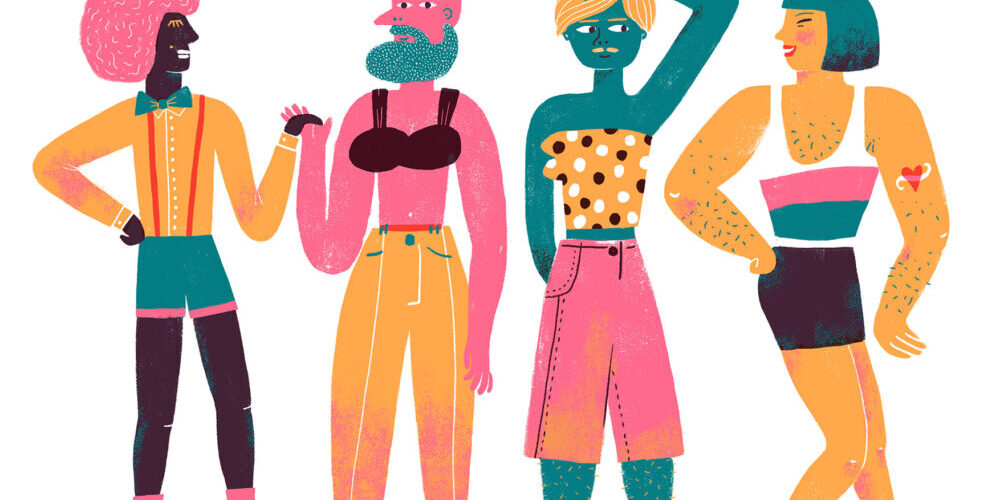
Inclusive language seeks to reflect the diversity of genders when we speak and write. "Language is updated to facilitate and include many other things."


Share

“They are destroying the language” is one of the arguments that can be read on social media – and in several press articles – when someone manages to write 'todxs' (or todes) using inclusive language to refer to a human group.
After the “we” comes the mockery and the correction about the “true Spanish”.
What do we mean when we talk about inclusive language?
Inclusive language is a set of proposals that seeks to reflect gender diversity in our speech and writing. It aims to eliminate sexist bias from expressions. In Spanish, the masculine gender is often used as an all-encompassing term to refer to a large group that includes both men and women: students, workers, etc.
The use of inclusive language originated in the 1970s with LGBTI activism and feminism. Intersex activism proposes the use of an asterisk (*), as advocated by the Argentinian intersex activist Mauro Cabral.
“The changes and additions made to inclusive language reflect historical moments. Initially, it was about women's independence; for example, allowing women to keep their surnames, or eliminating the distinction between 'señora' and 'señorita' based on marital status,” Juan Ernesto Cuba García, a linguist specializing in gender and a professor at New York University, tells Presentes.
TodEs, ellXs, nosotr*s
Non-binary and queer people have raised their voices in their community spaces, academic spaces, and on social media to advocate for a language that recognizes them and identifies their identities.
According to linguist Loreta Alva, this phenomenon "has to do with the fact that non-binary people do not feel represented by the use of certain vowels in pronouns, which is valid from their perspective."
“Our generation conceives of the construction of identity – which involves language, appearance, and performance – as a political act, an act of resistance against the violence we have suffered,” the linguist adds.
In the Spanish language, gender is a phenomenon of agreement, that is, a linguistic phenomenon of repetition of information.
In English, grammatical gender does not exist, but sex and social gender are marked. Ernesto Cuba explains that in this language, for example, the personal pronoun 'they' can be used, and is used, as neuter:
Thus, gender-neutral people have been able to successfully adopt and replicate it. In Spanish, the story is different.
A "bottom-up" political action
“As a linguist, I find any change that arises from the speakers themselves interesting: it is a political reaction to what happens to users of the Spanish language every day,” says Loreta Alva.
In that sense, Ernesto Cuba points out that since it is a proposal that comes from the bottom up, there is no way to administer it and give a 'ruling' to indicate the correct way to pronounce that morpheme.
For sociologist Malú Machuca, a specialist in gender and sexuality issues and a professor at the University of Wisconsin, the X signifies “a disruption, a break in language. “If you write it with an ‘e’ it might go unnoticed, but with an X you have to question it,” she says.
In 2013, Ellx was able to use inclusive language in a text from the Pontifical Catholic University of Peru and, she recalls, added a note explaining that the X was used because not everyone on campus felt identified as men or women.
And the RAE?
In June of this year, the Royal Spanish Academy (RAE) referred through its Twitter account to the use of some words characteristic of inclusive language.
According to this institution, the letters "e" and "x" or the use of @ for gender-inclusive purposes is "unnecessary." "The grammatical masculine already fulfills that function as the unmarked term in the gender opposition," they state.
#RAEconsultas The use of the @ or the letters "e" and "x" as supposed markers of inclusive gender is foreign to the morphology of Spanish, as well as unnecessary, since the grammatical masculine already fulfills that function as the unmarked term of the gender opposition.
— RAE (@RAEinforma) June 15, 2018
The RAE's stance is consistent with its history. Eleven women have been admitted to the Royal Spanish Academy since its founding in 1713. Only in 1979, not so long ago, did the Colombian Carmen Conde Abellán join the Academy.
The RAE's motto is "It cleans, it fixes, and it gives splendor." However, according to Alva, the RAE "is doing the exact opposite, by fixing only the opinions of academics and obscuring those of Spanish speakers," and adds that he doesn't believe the RAE has any influence on the private lives of speakers.
For Ernesto Cuba, this institution is becoming detached from its speakers and their lives. “You have a very biased view of what people's actual practices mean. Traditional linguistics is like someone who became so strict with their guest list that they ended up with no one.”
[READ ALSO: Dusan Fung: “Art cannot be detached from social struggles”]
“We don’t tell people how to speak or how to speak correctly. It’s a science, and science has to be objective,” says Cuba, who believes that the RAE responds so bitterly because they feel they are losing their monopoly, at least symbolically, on the administration of the language.
Whether we like it or not, inclusive language is gradually becoming more popular. And not just in Peru; a simple Google search for "inclusive language" will turn up articles from neighboring Latin American countries.
It can make us uncomfortable when we hear or read a text with this type of language, and that's okay. “When you're going to learn something new, when someone changes your worldview, when you're transforming, it's okay to feel uncomfortable. There's nothing wrong with it; it's something to question. Being uncomfortable is a basic condition for learning,” Machuca reflects.
We use it and we'll explain why.

I believe it's necessary to use inclusive language because I don't feel represented by a fixed idea of identity. Perceiving myself as something mutable, constantly changing, is understanding myself as just another piece in the overall order of things. Neither superior nor inferior to any other creature, just someone else. I feel that inclusive language is a way to rethink ourselves and connect with others. To see our differences and similarities.
Ibrahin Cerebros, artist

I've always been really bothered by this rule that everything has to be masculine, it really bothered me. I always said boys and girls, students and students. I always liked to emphasize the existence of the feminine, of women, and then I realized that wasn't enough, that there were many intersex, non-binary, trans women who weren't included in that supposed inclusive language either. We even have indigenous languages where gender doesn't exist. What I like most is changing the gender of words, even those that don't have a gender: the universe, the body, the world. Filling them with feminine qualities, or simply rethinking them. I love it when conservatives get so worked up over something so simple and straightforward.
Malú Machuca, sociologist

For me, using 'todxs' felt strange at first because I received more questions from people, since part of my social circle is heterosexual and cisgender. When I realized that I was, in one way or another, making invisible people who didn't fit into that binary, I decided I was going to use it and start incorporating it into my language. I thought it was a brilliant idea that language is a space for politics. I'm still learning about it; what we've learned in school isn't absolute or the only way. I'm using inclusive language more and more with affection and less fear in my mixed-gender spaces.
Gabriela Gallegos, actress

I use it to support this movement; we want to include people who have been invisible for years. Many people who weren't taken into account for a long time. I believe that inclusive language is important in this era, and it's a form of empowerment, a rebellious and just way to make many people visible. We're not forcing people to speak this way. These are changes that will happen at any moment; language isn't static, it evolves to facilitate and include many other things.
Michelle B Garcia, journalist.
I use inclusive language when I'm in safe spaces; I'm afraid of confronting patriarchal men and women. When I first heard it, it was completely strange to me, and for a moment I even made fun of it because I didn't understand it. Today, I don't know where I fall on the gender spectrum; the masculine weighs heavily on me, and I even struggle with identifying as a 'gay man.' I prefer queer, and when I'm in spaces where I'm surrounded by LGBTQ+ people, I use the neutral gender and sometimes even the feminine.
Esteban M Marchand, journalist
We are present
We are committed to journalism that delves into the territories and conducts thorough investigations, combined with new technologies and narrative formats. We want the protagonists, their stories, and their struggles to be present.
SUPPORT US

FOLLOW US
Related notes


We are present
This and other stories are not usually on the media agenda. Together we can bring them to light.