

Lucía Ixchíu: “I am a rebellious Indian woman who will not be silenced”
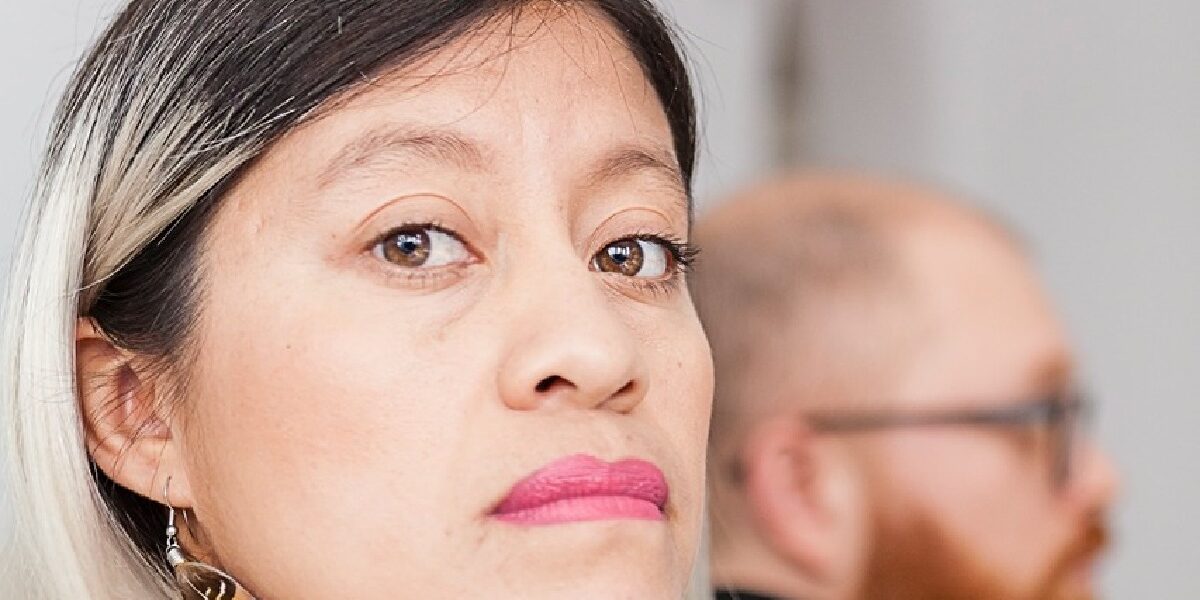
Lucía Ixchíu, a K'iche' indigenous woman from Guatemala and a community communicator, has requested political asylum in Spain along with her partner, photojournalist Carlos Ernesto Cano. In this interview, they discuss the situation in their country and the repression suffered by those who "refuse to remain silent."


Share

This interview is not an interview, it is rather the fruit of a conversation, pleasant and tough, where the questions sometimes did not have space and where the answers went so far that on occasion they returned to the beginning, to a distant and recent yesterday, necessary to understand the context.
“I am an architect by profession, but I became a journalist on the street, documenting and walking with people and fighting for their rights. I call myself a community journalist from that category which is empirical, which is self-managed. It is not the same to be an indigenous journalist from a village as someone from a corporate media outlet who has all the resources and who studied.”
Lucía Ixchíu is an indigenous K'iche' woman from Guatemala. She is an architect. She is a community communicator. She is a feminist. She is a cultural manager. She is an artist. Now she is also an asylum seeker.
This interview is a history lesson about Guatemala.
“1954 is a pivotal year in Guatemala: the first coup d'état carried out by the United States government, through the CIA, in Latin America and the Western Hemisphere. From then on, the elite, in conjunction with the Catholic Church, consolidated its power. Since that time, they have kept us under the thumb of imperialism. We are not the United States' backyard; we are the warehouse of their backyard, where you can store anything and do whatever you want without anyone noticing. Even since 2015, there has been US legal intervention.”
Carlos Ernesto Cano is a community documentary filmmaker from Guatemala. He is of mixed race. He is an anthropologist. Now he is also an asylum seeker in Spain.
This interview is a sociological analysis of the country.
“The genocide in Guatemala is the most brutal in Latin America, yet it remains largely unknown. It is a silenced genocide that continues because the signing of the 1996 peace accords represents no progress and no implementation of any agreement. The reasons that sparked the war in Guatemala remain relevant today , and since we were once seven million and now we are 22 million, the problem has only worsened. For me, Guatemala is not a country; it is an estate that operates according to the interests of its owners, the racist Guatemalan oligarchic elite, stuck in the colonial mindset. There is a prevailing doctrine of shock, violence, and silence, in which people are accustomed to murder, silencing, and exiling.”
Ixchíu speaks from a sofa in a private home in Bilbao where she is temporarily staying, in solidarity, along with Cano. Her story of defending human rights and the land in Guatemala is now joined by the story of exile. “The asylum process is incredibly revictimizing. The reception system is quite paternalistic, patronizing, and racist. They see us as numbers, not as people. Europe sees Latin American migrants, and migrants from all over the Global South, as suitable for cleaning their toilets.”
This interview is a hurricane.
“I am a rebellious Indian woman who will not be silenced.” And that’s how it is: “I admire the Guatemalan people because I don’t know how they can survive in a country like that, how they walk amidst so much dispossession.”
And she says: “The government of Alejandro Giammattei hates the population; it thinks about stealing, dispossessing, murdering, and criminalizing, but it has no idea whatsoever of policies that would benefit the people. And stemming from the structural patriarchy and the original patriarchy of this territory, these policies specialize in hatred toward women's bodies, in dominating women, diversities , and differences; and, obviously, even more so, Indigenous peoples and women.”
He continues: “We are talking about Guatemala because that is where we come from, but we are clear that the Central American region is part of a permanent humanitarian crisis, a genocide that no one talks about and that no one cares about because we are indigenous, because we have brown skin, because we are and come from a normalized reality of violence, of colonialism, but that is just as outrageous as what is happening in Ukraine.”
And he concludes: “Guatemala is a narco-state corporation.”
The Alaska massacre, the beginning of it all?
This interview transcends questions and answers; it's not linear, but rather follows a circular or spiral path, returning to the beginning. But not to 1954, but to 2012, to the student movement mobilizations—and the criminalization they brought—and to the Alaska massacre , in which seven people from Totonicapán, Lucía Ixchíu's hometown, were killed and more than thirty wounded while protesting against rising electricity rates and in defense of the right to education.
“We had to assume a role and a position of denunciation through communication. Because what I discovered with this massacre was the brutal media racism that justified killing Indigenous people because they are savages, because they are against the progress of the country. I don't need anyone to tell the story for me; I can tell the story of my people, I can tell what we are experiencing,” says the activist, who uses this term while simultaneously questioning it.
All of that, in 2012, was the beginning of the Solidarity Festivals , created by Ixchíu, Carlos Ernesto Cano and another colleague, whose identity they do not reveal for security reasons, as a tool to raise money to pay the fines of colleagues imprisoned for demonstrating against the massacre.
“Art is the possibility of fighting from a place other than violence or the reproduction of the hatred into which this system of dispossession has plunged us. Art has been an exercise in healing and, without realizing it, in positioning ourselves from a non-colonial perspective, because suffering and guilt are colonial. We have joined the fight through festivals, in traveling caravans, documenting, making visible those Indigenous struggles that were invisible and are of no interest to anyone in the country, and we do it in a self-managed way, in collaboration with the communities,” explains Ixchíu, who also worked for five years in Prensa Comunitaria (Community Press) alongside Cano.
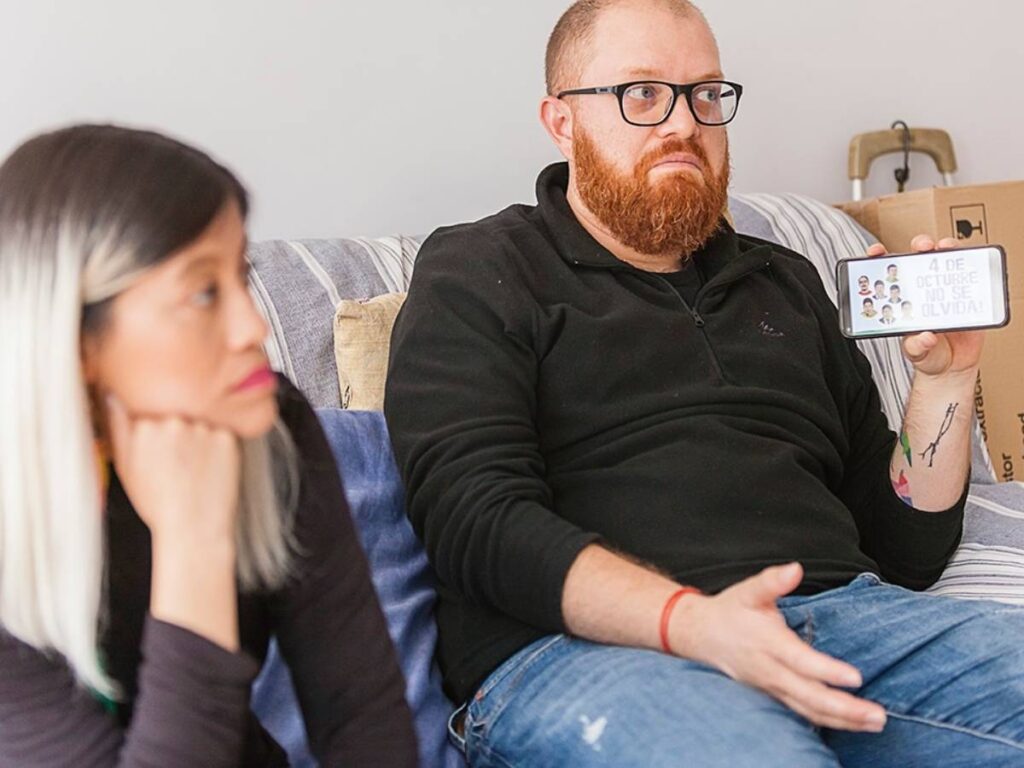
Photo: J. Marcos
“We use artistic and communication tools to work on three interconnected themes: historical memory, political imprisonment, and defense of the territory. That's why I mentioned 1954, because we like to play with the past, the future, and the present, with historical memory, to understand why Guatemala is one of the most screwed-up countries in Latin America,” says Cano, a photojournalist and anthropologist by training.
“Since 2012, we have supported political imprisonment not only because we experienced it ourselves, but because it opened our eyes to the reality of hundreds of Indigenous women, of hundreds of Indigenous communities, who were imprisoned for defending a hill, a river, for speaking out against extractivism, for speaking about reality. For telling the truth, many people are imprisoned and have died in prison,” Ixchíu adds.
And that denunciation, they say, has led them to exile, “because we make people uncomfortable,” Cano summarizes. “Lucía is very visible and uncomfortable. She has a rebellious energy and breaks with that stereotype of the submissive indigenous woman. It would be strange if we weren't out of that country because we have three options: to be buried, in jail, or in exile,” she adds.
Exile, the now
“Our departure from the country occurred during the pandemic, where violence intensified and all those things we thought would happen over ten years happened in a few months. We couldn't believe how quickly the system adapted to use the pandemic as an excuse for repression and violence,” the community communicator points out. In fact, during the height of the pandemic, Lucía and Carlos's safety became critical. They recount that in September 2020 they survived an attack for documenting illegal logging in a communal forest: “It left my sister with fractured ribs, and we experienced an overwhelming amount of violence; it's the continuation of a series of events recorded since 2012, year after year. It's a series of aggressions and acts of violence against those of us who refuse to remain silent and who are against the system.”

This interview is also a duty.
“We have a mission, the mandate to speak out, to continue our fight from another place. We continue fighting, and we haven't stopped, nor will we stop for a single day,” Ixchíu proclaims. Since arriving in Spain, first in Madrid, then in Gallarta, and now in Bilbao (both in the province of Bizkaia), this couple has not stopped denouncing injustices and advocating for change, holding meetings and gatherings with grassroots groups, social organizations, and public officials from different regions.
“We are trying to make an impact amidst the persecution, amidst the violence and the fear of having our families there,” explains the community feminist.
Now the conversation turns to the future, to the June 2023 elections, in which Zury Ríos, the daughter of Efraín Ríos Montt, the dictator accused of genocide and crimes against humanity, will be a candidate. “Solidarity networks save lives, especially women’s networks,” the journalist states. “Because if this daughter of the former dictator becomes president next year, it’s likely that more people will come forward,” the photojournalist predicts. Impact and networks.
This situation is now being exacerbated by the exodus of several lawyers from the country due to the criminalization they are facing. “Lawyers are being forced out of Guatemala, but there is no effort to continue the legal process of identifying those responsible for corruption and impunity. It’s easier to remove those who are inconvenient from the country, and that’s what the United States is doing,” Cano explains.
Talking about current events in Guatemala isn't just about political power or the recent attempt to roll back abortion laws ; talking about current events means talking about hunger. “The struggle for water and the struggle for land are fundamental parts of the problem. Guatemala still has colonial land tenure systems; it's a farm disguised as a country, but it operates according to the interests of an elite that owns the majority of the land and has access to all the means of production. With the signing of the peace accords, the privatization of services—electricity, telephone service—was reaffirmed… everything is privatized. It has the highest basic food baskets in Latin America. Eating in Guatemala is a privilege. Hunger is the norm in that country : hunger, poverty, ignominy, because we don't even know how to name it anymore,” says Lucía Ixchíu. “The genocide continues, it's low-intensity, which means killing people—the lower classes and the indigenous communities—through hunger and lack of access to healthcare,” adds her partner.
The future is “re-existence”
To speak of Guatemala's current situation is to delve into history, into entrenched structures . “The founding of the Guatemalan nation-state 202 years ago stemmed from the Indigenous struggle. We have fought and will continue to fight for generations. Indigenous peoples have existed for over 5,000 years and will continue to exist, to re-exist, but the level of violence, doctrine, and domestication is brutal. And the religious fundamentalism implemented after the genocide has been a way of whitewashing our thinking, of stripping us of our Indigenous identity and making us believe that the genocide happened to us because we were satanic, because we were evil, because we were animals. One way to stop being seen as such is to become evangelicals now, but at the time it was Christianity,” shares the K'iche' woman.
The words twist and turn, going back and forth. “We don’t consider ourselves victims of anyone because we are the subjects of our own history; it’s essential to position ourselves from that perspective. Indigenous peoples are not pitiful; we are joyful, we are multicolored, we are scientific, we are the ones offering alternatives to climate destruction. We are anything but pitiful, never, ever,” she adds.
This non-interview concludes, after almost two hours, with a discussion of the present, of the bureaucratic maze of asylum, which requires going back to past events to apply. “We are reconstructing the asylum case and have documented almost everything that has happened: attacks, hate campaigns, and defamation. Defamation and hate campaigns are very normalized, especially against women and land defenders. How many defamation and hate campaigns have been launched? Countless, against me and my family. And I know I'm not the only one; it's the norm.”
Share
We are present
We are committed to journalism that delves into the territories and conducts thorough investigations, combined with new technologies and narrative formats. We want the protagonists, their stories, and their struggles to be present.
SUPPORT US

FOLLOW US
Related notes


We are present
This and other stories are not usually on the media agenda. Together we can bring them to light.