

Alba Rueda: "It is no longer enough to just talk about LGBTI+: we need to talk about inequalities and living conditions"
Interview with Alba Rueda, Special Representative of Argentina on Sexual Orientation and Gender Identity. Gender, diversity and political agendas.


Share

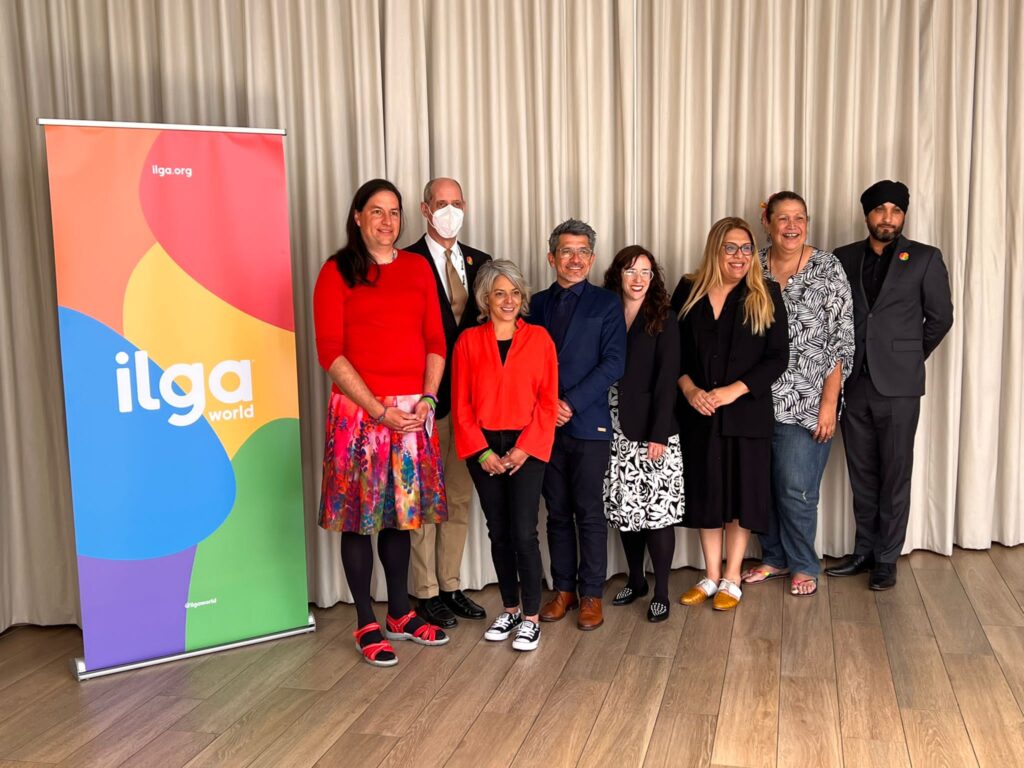
In a convention center in Long Beach, south of Los Angeles, American activist and now government official Jessica Stern is one of the keynote speakers at the opening of the ILGA World Conference, the largest gathering of LGBTQ+ activists worldwide. The room is packed: more than 600 LGBTQ+ activists from every continent are listening to her. Jessica explains that President Joe Biden appointed her in 2021 to a role that very few countries in the world have: the "envoy" or special envoy for the defense of LGBTQ+ rights. Only the United States, England, Italy, Germany, and Argentina have this position. Seated in the audience is Alba Rueda, a trans activist, who is taking on this role for the first time. In Argentina, it is called the Special Representative on Sexual Orientation and Gender Identity at the Ministry of Foreign Affairs, International Trade, and Worship. Jessica Stern speaks about the importance of having envoys there and asks Alba and Fabrizio Petri (the envoy from Italy) to stand so the activists can identify them. Alba stands, smiles, and waves somewhat shyly. She receives loud applause. She has come a long way. Another journey awaits her. That a trans activist is currently occupying this role is a political victory for the movement.
Alba Rueda was born in Salta and moved with her family to Buenos Aires as a child, where she still lives. An activist with Mujeres Trans Argentina (Trans Women Argentina) and one of its founders, she was the first trans woman to hold a public office, serving as Undersecretary for Diversity Policies at the Ministry of Women, Gender and Diversity. She left that role to take on this one and promote an agenda that transcends borders. In 2021, the BBC included her in its list of the 100 most influential and inspiring women of the year ( BBC 100 Women ).
Alba is also, among many other things, one of the people who campaigned and worked politically for the approval of the Gender Identity Law (LIG), which recently celebrated its 10th anniversary.
-Do you remember when you started thinking about and dreaming of a gender identity law?
I remember that when I was a teenager, I didn't know and I was very worried about what I was going to do. At 16, I was constantly asking myself that question. And all the answers I had were illegal and outside the legal system. For example: forging an ID, leaving the country, having to get surgery in Chile or France. All situations of how I was going to manage , given my situation of poverty. Since I was a teenager, it was one of the most important and difficult issues because it affected everything: getting into the library, going to the doctor. I was studying Philosophy at university, and all my documents were based on the birth certificate my parents had given me. Not everyone has a hard time with their birth name, but I had a terrible time . Besides, it was used in a derogatory, violent way, like a joke . "What's up, so-and-so ?" But such a situation didn't exist in my mind. It never occurred to me that the State could recognize my gender identity.
When Alba started working at INADI in 2006, it took almost two years for her position to be officially recognized. The process is usually lengthy, but in her case, it was much slower. At every level she approached, she was held up "because my name and my gender identity were incongruous." Finally, she was able to receive her payslip as Alba Rueda. It wasn't such a simple equation: she worked at INADI—how could the State discriminate against her there?
-Were you without receiving your salary all that time?
Yes. I was working but not getting paid. The day I got paid, it was like receiving a ton of money, and I had to chip in to divide it up because I owed a lot of people money. When my dad died, my friends took up a collection to help out. On a personal level, it was a really awful situation. Even though it might seem like I'm speaking for myself, it wasn't just about me. For example, before I had my ID, I was dating a boyfriend at university. And when he found out that all my information was on file, his face changed. It wasn't just about accepting that he had a trans girlfriend, but the institutional implications that had. The problem wasn't so much the former name, but that we were bullied because of it. It wasn't just a fact, it was how it was used .
We have sexual diversity rights
-What do you see today when you look back at that historic moment when the LIG was approved?
I think the most important thing in that context was what happened before, with the impact of the Equal Marriage Law (EM, passed in 2010). What changed the political and social landscape was what happened with EM. The debate surrounding it was absolutely cross-cutting. And because the moment it was won was so epic, and because the Catholic Church had pushed so hard to portray it as a war of God against the devil, and because on TV they had said that we were going to rape children and that all same-sex couples were sick, the right wing had gone all out, creating a debate that was very important. The political summary of the achievement was: " When rights are recognized, all of society advances ." Cristina Fernández de Kirchner said this when the law was enacted. In 2010, the first court ruling was also obtained, allowing Florencia de la V to obtain her national identity document with her name through the courts.
-Had you also introduced yourself?
I had gone to court along with other women with a strategy: we wanted gender identity to be legally recognized, as had happened before with marriage equality, and to begin proving that it wouldn't destroy society. We had filed collective injunctions; there were more than 40 of us trans people. My sentence came on April 7, 2011. That allowed many of us to be the first trans people in our home provinces. In my case, the first trans person in Salta. It was about bringing the issue to the forefront, saying, "The law now recognizes it."
Alba recalls that once the Gender Identity Law was approved and with a certain heated atmosphere in the Chamber of Deputies and the Senate, the same lines of dialogue and lobbying were used. The bills had different styles. “In retrospect, what was being debated wasn't who would draft the bill, but who could best define the bill. Who would maximize the rights of transvestites and trans people. That was beautiful. Because one bill emphasized health, while another explored the issue of identity in greater depth. There was the Gender Identity Law Front and the Argentine Federation of Lesbians, Gays, Bisexuals, and Trans (FALGBT) with a massive campaign for the Gender Identity Law. “We talked a lot with colleagues from the Family Committee in the Chamber of Deputies, which was headed by Vilma Ibarra. We put together a synthesis of the organizations; several comrades participated. Today, only a few of us are still alive.”
-One of the most celebrated points was the inclusion of health services.
"We mustn't forget that the trans movement, besides forming as an institutional response, also arose in response to violence in healthcare settings. And that's the other major issue linked to the name: access to healthcare. We're very happy that the Gender Equality Law included that. HIV/AIDS without public policy was a ticking time bomb in our entire community. When I started my activism, I began with HIV/AIDS. You'd go to the Muñiz Hospital, and inside the hospital—the first to adapt its practices—we, the organizations, were there."
-How was the transvestite trans movement configured at that time?
That's where the first peer support group, Tacos Altos, was formed. Claudia Pía Baudracco was part of it; it was a smaller-scale activist movement. With the legalization of marriage equality, the movement grew tremendously, and trans activism took a beautiful leap forward. It's a moment I remember vividly; it's not something you forget, it lives on because the entire debate surrounding the Gender Equality Law, the context, and the moment itself were truly precious. That epic narrative of defeating the church and establishing a debate in society— we have rights as sexually diverse people —was present in the Gender Equality Law debate; they were already talking about trans living conditions. Claudia Pía had already passed away by then. And I remember that in 2012, a few months after the Gender Equality Law was passed, Diana (Sacayán) called to talk about a transvestite/trans job quota.
-What was Diana proposing then?
She called some trans women to start campaigning for the trans quota law in the province of Buenos Aires. When she put out that first call, I think many of us—and I regret having been in that position at the time, I regret it, but it happened—we thought it would be resolved because we had achieved the Gender Identity Law. And that was a mistake. But not everyone saw it that way.
-Was the mistake thinking that things were easier because of what had been achieved?
-Exactly. What we had to do was delve much deeper, fight for the agenda, and keep fighting for a different legal framework. By the time Diana called, we were still trying to explain what the Gender Identity Law was all about. Mujeres Trans Argentinas (Argentine Trans Women) was born because we needed to talk to each other. A Facebook group was created to discuss what was happening with the paperwork and hormones. There were 3,000 trans women connected for the first time. The movement grew a lot. And then came Macri's policies, Diana's murder, Lohana's death. It was terrible.
-10 years after the approval of the LIG: what do you see?
I see more clearly the enormous achievement of trans and travesti social organizations. The political subject is emerging, occupying, and taking to the streets like never before. A presence of travesti feminism in feminist spaces. The transvesticide of Diana and the death of Lohana had a profound impact on activism; it made us fully understand that our lives are fragile, that they were killing us—it was brutal. Today, I think what popular feminism was is further solidified. There were already cis feminists who supported the agendas of trans and travesti women, but I think that after the deaths of Diana and Lohana, a popular feminism was solidified, which allowed us to navigate the Macri administration more united, demanding justice for Diana, an end to travesti and transfemicide. On one level, this was a feminism that raised the trans banners, and on the other, it didn't necessarily support the trans agenda.
"Do you still see it that way?"
"I think we're at a different point politically. Feminism today is at a crossroads because of the trans-exclusionary movement, which shouldn't be ignored. We saw what happened with the census . And then there's the fracture within the Women's Meeting. Because there aren't two meetings, there's one, and it's the Plurinational Meeting of Women, Lesbians, Transvestites, Trans People, and Non-Binary People. Let's not forget that there were cisgender feminist activists who attacked transvestites and trans people in 2019."
Trans/Trava Politics
Lohana said that when a trans woman enters university, her life changes. And when many trans women enter university, they change the life of society. What happens when a trans woman enters the public sector?
There's an issue here, which is the balance of power and influence. One of the biggest challenges a trans woman faces within the state is navigating a world with cisgender logic. For example, the state's binary information system. Starting to work on domestic policy means starting to work on changing information systems, even though it doesn't have an immediate impact in terms of citizenship. Because if the registration methods and information systems aren't changed, the structure doesn't change. When we worked on the trans quota decree, the issue was how to register people. And that question wasn't a scientific exercise, but rather a collaborative effort to bring about change; a lot of literacy work was involved in that case.
-Does a transvestite/trans person do politics differently?
I think we have other priorities, and whoever sets the agenda sets the priorities. I'm not going to answer thinking only of myself, but also having seen how Pia Ceballos, our trans comrade, managed her agenda. She joined the ministry to work on coordinating trans employment. With a lot of genuine commitment to the vitality and importance of certain issues. I also feel that I did it with genuine commitment. Of course, they weren't negotiable, and they had to be discussed in personal terms, with a personal impact because you're not outside of it. That's what's happening now. The social transphobic violence against my comrades over 45 affects me, not personally, but it affects my comrades with whom I grew up. Many of the things that are done in political terms are done from a position that doesn't have to do with those vital implications. But you're the one there with a historical responsibility. And the cost is very high because you're part of the community that demands things from you and lets you know that there's hunger and need. And we really do work incredibly hard. But that's when you start to see that the cis world has different values and priorities. No salary can compensate for the burden of carrying out a trans agenda. For us, doing politics also means dealing with those tears that Lohana sang about in "Cumbia, Copeteo y Lágrimas" (Cumbia, Drinking and Tears).
-What is that trans/trava political mode like?
There's a different way of listening, a different logic, and a different history to reclaim; there's a different relationship with the State to repair. There's anger towards institutions because they violated us for years. So there's a position regarding the policies that need to be implemented. That doesn't mean a different genetic makeup, but rather a different awareness of those implications, a different historical responsibility, to gather and examine the history of trans people, and a different way of relating to institutions from that perspective. What takes a lot of time is having to do educational work to be able to convey this. Because you encounter not just one, but 100 officials of different ranks who don't know about this. We are trans people in a cisgender world with institutional logics that don't belong to a political party, but to the cisgender world.
Where is Tehuel?
-It's been 1 year and 2 months since Tehuel was killed.
Tehuel is a trans man who has been one of the most sought-after by organizations and the community in Argentina. What does that mean? For me, it highlights the value of organizations that document poverty and the need to include trans men in the conversation. What worries me about this issue is how this situation is interpreted from both trans and cis perspectives. Disappearance in a democracy is not enough to explain Tehuel's disappearance as a trans man. We need to consider the situation of trans men and the complex web of violence, life, death, and disappearances that affect trans youth. This also reveals the State's inability to address the issue of disappeared trans men and implement substantive changes. When people say, "The State is responsible," I think they don't fully grasp where that responsibility lies, for example, judicial responsibility. It's not just about the prosecutor's office, but about the judicial system, which lacks the perspective to address this. Ten years after the Gender Identity Law (LIG), we must consider the chapter on trans-feminist justice. To be able to talk about Tehuel and all the comrades who experience judicial violence. Whether they are criminalized, or affected by how the judicial system acts, until organizations come out to raise their voices on the issue. As happened with Marian Gómez or Joe Lemonge.
For an LGBTI+ agenda for the global south
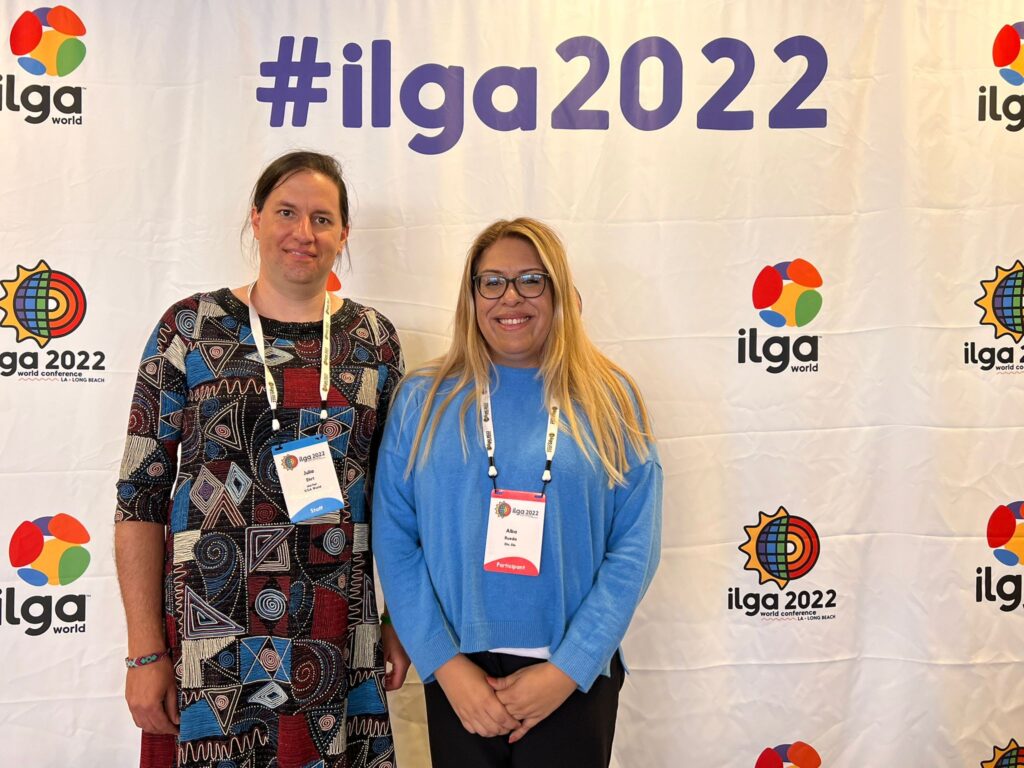
At the ILGA Conference, Alba Rueda, like her counterparts Jessica Stern (USA) and Fabrizio Petri (Italy), held meetings with activists from various continents.
-What global map of LGBT+ rights were you able to access based on what you saw and heard at the ILGA World Conference?
In a space as activist as this gathering, with this federation of organizations in dialogue with the State and the States meeting in multilateral spaces, the diagnosis is all that we lack. I think that both the pandemic and the war truly overwhelmed us. There were no international mechanisms to address them dynamically, with the urgency that was needed. There is a lot of desire, a lot of effort from international activism, and there is a diplomatic effort to be made. It seems to me that the trans perspective is missing when considering the international agenda. I find myself once again confronted with the historical responsibility of changing these dynamics. There is something about LGBT culture that is perhaps lost because almost everything is accommodated as a chapter within international diplomacy. I think that these diplomatic efforts need to learn a little more from our movements, not only in terms of how we can generate better policies but also how to generate a different culture . When I have spoken with authorities and organizations from other countries, I think we can indeed highlight differences in ethical and political terms; it seems to me that there are other implications. There is a mismatch in where priorities operate. There is a funding mismatch. It is no longer enough to talk about LGBT issues: we must talk about decoloniality, global funding, financial capital, and racism.
-What urgent LGBT agendas does the global south raise today?
I think it's essential that we start talking about LGBTI+ issues in terms of living conditions and inequalities. Unlike simply valuing our agendas, this approach amplifies them. It's not enough to talk about people of diverse sexual orientations or a community. We have to place them within agendas that affect us as a society. For example, the tension with the state when there are unpopular governments that don't champion our community and whose policies don't just address sexual orientation or gender identity, but are also linked to exploitation and support for models of that global financial matrix. I believe the most urgent thing is to engage in dialogues that connect us to political agendas that address the global economy and the international crisis, trans migrants, and trans Latinas. In Latin America, the challenge is even greater: to give meaning to an agenda within the context of a very strong presence of religious institutions that threaten us, for example, through conversion practices targeting our community. Speaking from the perspective of living conditions means acknowledging that LGBT people also live under conditions of profound inequality, not only because of our sexual orientation or gender identity, but also because of racialization and the implications of our emancipation agendas . It also allows us to envision ourselves within the agendas of broader social movements.
We are present
We are committed to journalism that delves into the territories and conducts thorough investigations, combined with new technologies and narrative formats. We want the protagonists, their stories, and their struggles to be present.
SUPPORT US

FOLLOW US
Related notes
We are present
This and other stories are not usually on the media agenda. Together we can bring them to light.