

Napalpí Indigenous Massacre: A 114-Year-Old Survivor Will Testify at the Trial
On April 19, the historic Truth Trial begins regarding the Napalpí massacre, perpetrated in the province of Chaco in 1924.


Share

(News updated 18/4/2022)
CHACO, Argentina. On April 19, the historic Truth Trial regarding the Napalpí massacre in the province of Chaco, where 423 people—the vast majority of them Indigenous—were murdered by a group of police officers and civilians in 1924. It will be the first criminal trial to investigate crimes against humanity committed by the Argentine state against Indigenous people. Since there are no living defendants, the verdict is expected to reconstruct the events and provide reparations.
The hearings for this Truth Trial will be broadcast from the YouTube channel of the National Judiciary:
Judge Zunilda Niremperger, presiding over Federal Court No. 1 in Resistencia, ordered the trial to determine the truth about the Napalpí massacre. This order had been requested by the Human Rights Prosecutor's Office in Resistencia, comprised of Attorneys General Federico Carniel and Carlos Amad, Federal Prosecutor Patricio Sabadini, and ad hoc Prosecutor Diego Vigay.
“The effective search for the truth is relevant not only in terms of collective memory but can also operate favorably in the area of historical and symbolic reparation towards the communities that would have been directly harmed by such events,” the judge stated in the ruling.
What happened in the Napalpí community
The massacre took place on July 19, 1924, in the Napalpí community. On that day, a group of 130 police officers, along with civilians, murdered approximately 423 people, 90 percent of whom belonged to the Qom and Moqoit indigenous nations. This is according to documents and testimonies gathered in the preliminary investigation conducted by the Human Rights Prosecutor's Office of Resistencia, which is handling the case.
Political leaders
The massacre was carried out on the orders of Fernando Centeno, then governor of the Chaco National Territory. Centeno was acting under the government of President Marcelo Torcuato de Alvear of the Radical Civic Union. His aim was to silence the demands of Indigenous people and Creoles who were calling for fair compensation for the cotton harvest, or for the opportunity to work from the Chaco territory in the sugar mills of Salta and Jujuy, where better wages were offered.

Right to the truth for all
“The expectation is that the community and society can follow the process of reconstructing the truth about what happened in Napalpí. It is also hoped that the trial will have the same characteristics as a trial for crimes against humanity committed during the last dictatorship, because it is a crime of equal magnitude. This would allow the community to have access to the right to the truth , as the victims of state terrorism during the last dictatorship have. Furthermore, it should provide some form of reparation and ensure that the State assumes its responsibility,” Diego Vigay, federal prosecutor of the Human Rights Unit of the Resistencia Prosecutor's Office, told Presentes.
The first hearing will begin at 8:00 a.m. on April 19, Indigenous Peoples' Day, at the House of Cultures in Resistencia, Chaco Province. Opening statements will be presented there. Audiovisual recordings of interviews with survivors Pedro Balquinta and Rosa Grilo will also be shown, as well as the testimony of Qom historian Juan Chico , who died in June 2021 from Covid-19.
Pedro and Rosa are among the 38 children who managed to escape the massacre. However, about half of them were given as servants in the towns of Quitilipi and Machagai, and the rest died along the way.
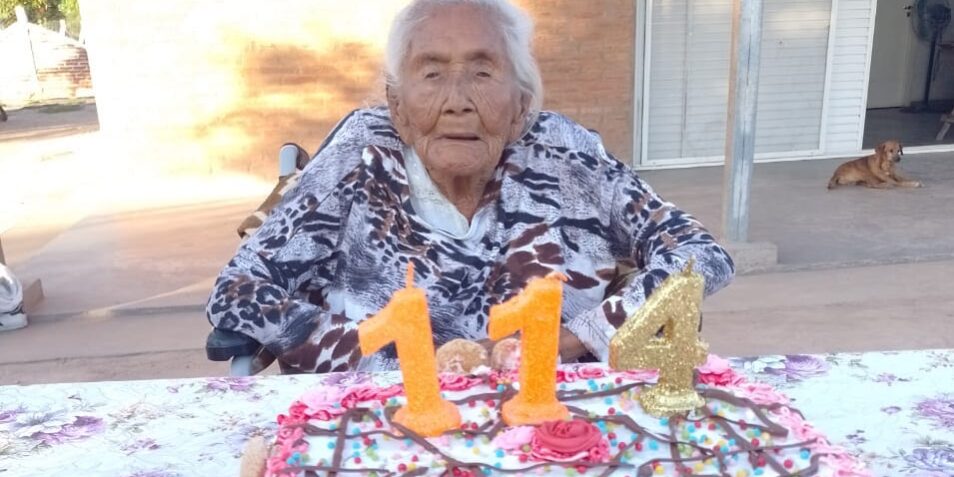
At 114 years old, Rosa is the only survivor
Rosa Grilo is the only living survivor. She turned 114 on February 5th and celebrated with a very hot day that began on Saturday the 26th of that month and lasted for two more days. From different parts of the country, some five hundred people, including family, neighbors, and friends, came to see her at her home, located in Machagai (“Low Land” in Qom), a city in the province of Chaco.
Rosa gets up at 6 a.m. and drinks bitter mate. “We make her rice pudding, and lunch has to be ready by noon sharp. She eats very healthily,” her grandson, Herminio Gómez, told Presentes. “She gets angry too. She remembers the beginning of her life. We stay and listen to her. She teaches us,” he added.
Herminio also said that Rosa “is in good health,” but that she hasn't seen a doctor in about six or seven months because “she doesn't have the means to get to town.” He also complained that his community “lacks water” and that they are requesting “rural electrification.”.
“What happened was never discussed”
At the time of the massacre, Rosa was a child, “but not that young, that’s why I remember,” she said in an interview conducted by the Human Rights Unit of the Federal Prosecutor’s Office in Resistencia on November 27, 2018, to gather her testimony. She emphasized: “ What happened was never talked about; only now is it being discussed.”
“It’s very sad for me because they killed my dad, and I almost don’t want to remember it because it breaks my heart. A plane was dropping bags from above, and they would fall to the ground and be killed there. My grandfather and my mother were shouting, ‘Shoot, shoot!’ I don’t know why they killed so many children and adults; there was so much suffering,” the survivor recounted.
He also said that the communities were firing from the mountains “because we wanted to survive.” “I don’t want to see it happen again. These things hurt. How can you not feel for your family?” he concluded.
“There is an issue of traumatic memory related to the fact that the four survivors were children when the massacre occurred and only spoke about it when they were 80 or 90 years old. Many decades passed because of the terror, because of the fear. Many of the victims from the Qom community lost their language, and a large part of the population lost it because of the terror it represented. Knowing the language was risky,” explained the ad hoc prosecutor handling the case regarding these testimonies.
How did the trial come about after so many years?
The Prosecutor's Office became aware of the massacre after the community of Colonia Aborigen . "They spoke of a crime that had all the characteristics of a crime against humanity," Vigay emphasized.
Thus, since 2014, a search for records and testimonies was initiated, which constituted the preliminary investigation that today serves as proof of the massacre.
“The Colonia Aborigen community, together with the Napalpí Foundation, had been doing extensive work to reconstruct historical memory. We relied on that. There were multiple investigations into the massacre, and we incorporated several books, historical and scientific research by anthropologists, sociologists, and historians into our investigation,” the prosecutor explained.
They also took statements from researchers, as well as from the children and grandchildren of the survivors. They also requested collaboration from various public, provincial, and national agencies, such as the National General Archive , the Chaco Historical Archive , and the Chamber of Deputies, "because there are records from that time where socialist deputies denounced the massacre," he indicated.
Public hearings with priority given to indigenous people
Throughout the trial hearings, approximately 50 witnesses will testify, half of them Indigenous. “Oral narratives are fundamental in Indigenous culture, and these children and grandchildren who are testifying are essentially doing so in the first person, recounting the stories of their mothers, grandmothers, and grandfathers,” the prosecutor commented. The verdict will be translated into the Qom and Moqoit languages.
The hearings, meanwhile, will be in person, public, with priority access for Indigenous people, and will also be broadcast via social media . This was proposed by the Chaco Human Rights Secretariat, a plaintiff in the trial . The first four and the last will take place at the House of Cultures in Chaco, while two of them (May 10 and 11) will be held at the Haroldo Conti Cultural Center for Memory in Buenos Aires.
Witness schedule
On April 26, interviews with survivors Melitona Enrique and Rosa Chara will be broadcast, while Ramona Pinay, David García, Analía Noriega and researchers Mariana Giordano, Graciela Bergallo and Neri Tete Romero will give testimony.
In turn, on April 27, the filmed testimony of Felipa Laleqori will be shown and the investigators Pedro Solans, Teresa Artieda, Laura Rosso, Gabriela Barrios, Alejandro Jasinski, Rubén Guillón and Luciano Sánchez will testify.
For their part, on May 3, the descendants of survivors of the Massacre will testify: Matilde and Salustiano Romualdo, Sabino Irigoyen, Cristina Gómez, Lucia Pereira, Cristian Enríquez and Guillermo Ortega, and the indigenous Qom and Moqoit researchers: Raúl Fernández, Raquel Esquivel, Gustavo Gómez, Viviana Notagay, Juan Carlos Martínez and Florencio Ruiz.
On May 10, investigators Marcelo Musante, Nicolás Iñigo Carrera, Jorge Ubertalli, Lena Davila, Alejandro Covello, Alejandra Aragón and Eva Nazar Gaulo will testify at the Haroldo Conti.
On May 11, in the same place, Silvina Turner, Valeria Mapelman, Carlos Salamanca, Héctor Trinchero, Mariano Nagy, Diana Lenton and Eugenio Zaffaroni will present their testimony.
Finally, on May 19, the prosecution's arguments and the plaintiffs' complaints will be presented at the House of Cultures in Resistencia, Chaco.
The Qom and Moqoit communities, as well as the prosecution, hope that this trial will bring reparations.
“The reconstruction of the truth is a right”
“What this does is reconstruct the truth, which is a right of the victims. Reparative measures would be decreed, such as incorporating the sentence into the Chaco curriculum. Also, the Napalpí mission's administrative headquarters would be converted into a memorial museum; the remains found by the Argentine Forensic Anthropology Team would be returned to the community and buried in the Napalpí memorial; and the community, currently called Colonia Aborigen, would be given the option to change its name,” Vigay concluded.
We are present
We are committed to journalism that delves into the territories and conducts thorough investigations, combined with new technologies and narrative formats. We want the protagonists, their stories, and their struggles to be present.
SUPPORT US

FOLLOW US
Related notes
We are present
This and other stories are not usually on the media agenda. Together we can bring them to light.