

Marilina Bertoldi: “On stage, I am my own heroine and I am also a villain”
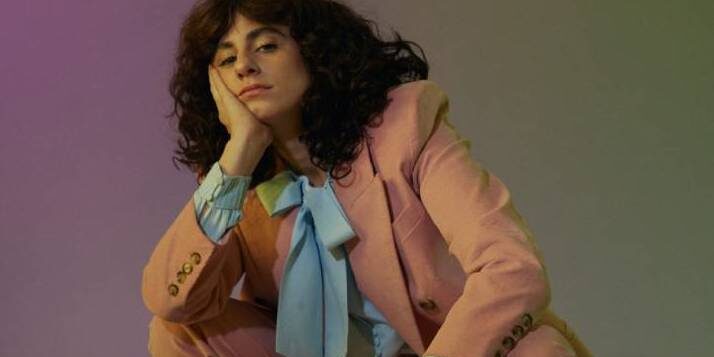
The musician released her highly anticipated album, Mojigata. Openly lesbian and feminist, she turned the traditionally male-dominated world of rock upside down. In June, she will present it at Luna Park.


Share

BUENOS AIRES, Argentina. There isn't a lesbian music fanatic who doesn't know—and even, to a certain extent, admire— Marilina Bertoldi . This isn't merely indicative of a musical trend or what's playing on the radio; it speaks to the long career of a versatile yet consistent artist with a unique and rock-infused sound like few others. It speaks to an artist who has always championed the same causes.
When she speaks with Presentes , Marilina will tell us that coming out publicly wasn't difficult for her. She didn't even decide to do it: she simply felt it was right to say it. And so, through an almost instinctive act, she became an icon, a beacon of representation in the male, cisgender, and heterosexual world of rock.
Just seeing her on stage, wearing suits and sunglasses, moving her hips almost like Elvis while playing her electric guitar, is enough to understand that she not only belongs to that world, but that she, an openly lesbian woman, is today the living image of rock, and a crucial figure in the current music scene.
After her last and highly successful album, Prender un Fuego ( ), for which she won the Gardel de Oro in 2019—making her the second woman and first lesbian to receive the award—Marilina released Mojigata ( ). If Prender un Fuego was an explosion of outward energy, Mojigata invites us to be moved and excited on an inward journey.
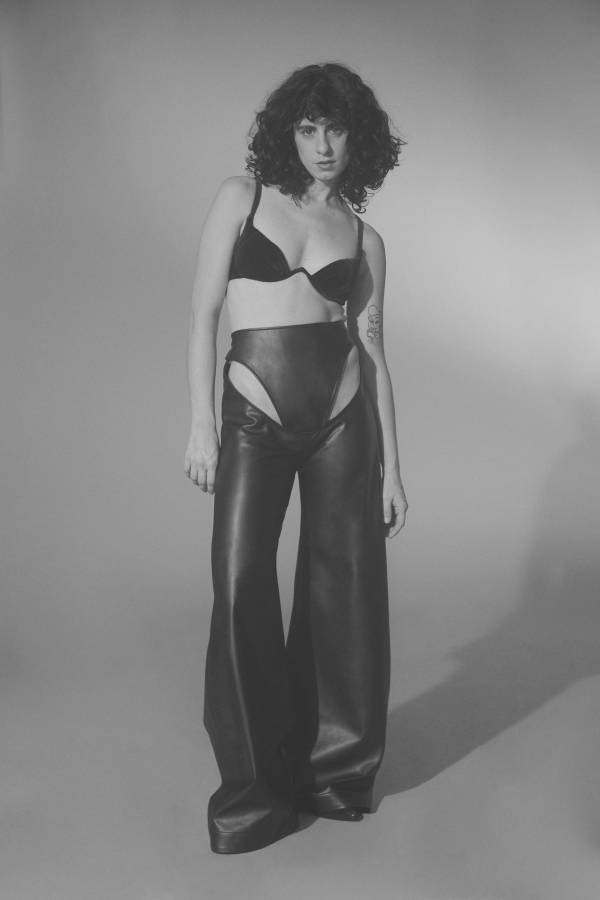
Photo: Victoria Del Sel
-How would you describe your latest album, Mojigata ?
"All artists are between 15 and 25 now, so music has become very saturated with discourse about love, sex, partying, and problems, all from the perspective of kids. I feel like this album speaks from the perspective of a young adult. It's a woman speaking; I'm not some kid acting like a fool. And that, to begin with, is something I wanted on the next album, something that simply had to happen. The same goes for the prudish concept and the photo; I felt it had to have something else, a different feel. The lyrics are some of my favorites I've written so far. I feel like it's really a reflection of a time, a moment, and issues that I'm actually experiencing. I composed and produced it all during the pandemic. In this case, I was the right person to produce it because I had very specific requirements for each song; only I understood how it had to sound. This album is my favorite so far. The process of making it was the healthiest; I feel like I wasn't limited by anyone." So everything you hear there is solely my own conscious decision. The truth is, I'm very happy.
– How do you think it fits in with the rest of your career?
"It's different, although it's within a certain aesthetic I work with and a certain sound that's mine. It's the first time I've consciously made a rock album saying, 'I'm going to make a rock album.' Before, I'd compose and sometimes a kind of rock song would come out, and every now and then a kind of pop song. This time I wanted to make a classic rock album. What is classic to me? I went back to my references, which are more from the nineties, and the women of the nineties, especially. There's a lot of influence from Sheryl Crow, from Fiona Apple—there's a song that's a direct reference to her—and I also have a bit of Beck. Those nineties artists who weren't mainstream . They were known, obviously, but they were more the outsiders of that era, the ones who weren't cool. They weren't Nirvana."
-It's a bit like what happened to you. You come from something more underground, and with Prender un Fuego you entered a more mainstream scene. Do you feel that it changed the way you make or think about music?
Luckily, no, actually, it's better that way. You know why? Because it was gradual. It's not like I just appeared one day, uploaded a video, and suddenly I was playing in front of 20,000 people. Everything had a logic to it, and it was super organic how it grew step by step. Anyway, what's always surprising is the attention people pay to what you do. Until you release it, you don't know if they'll really keep supporting you. I'm never going to do anything to keep an audience. I don't want to hold onto them; I want people to listen if they like it, and that's it. The priority is that I like it. And it keeps happening; I still like it, and people come to see me, and I can't believe it.
– How did the idea for the videos for “Amuleto” and “La Cena”, and the collaborations with Javiera Mena and María Riot, come about?
Javiera is the only one who appears on the album, on the track “Amuleto.” When Miche, who directed the video for “Amuleto,” and I started brainstorming what we wanted to show in “La Cena,” we thought of filming it in the countryside because that's where I'm from. We started talking about her needing a partner for the film, and I said, “María Riot is perfect.” I have absolute love for María. I'd wanted to do something with her for a while, but I wasn't quite sure what. I came across her during the rise of feminism, entering this new wave that must have been about six years ago. I'd heard her by chance on the radio, and I was blown away because I'd never heard the perspective of a sex worker. Besides, I thought she was an incredible and incredibly well-rounded artist, an icon. Luckily, she was happy to come because she doesn't live here; she lives in Spain.
-The videos contain sexual content made by lesbians for lesbians. How did you work to move away from the more fetishistic perspective, the one aimed at men who are aroused by seeing two women?
That was always the fear, falling into that cliché. Basically, Miche and I sat down and said, “What would we like to see?” In “The Dinner,” the first thing we considered was, “Let’s not be so binary.” Let the more tomboyish one do things that aren’t so tomboyish.” And then we said, “Why shouldn’t we be binary about this? Let’s do it, since this hasn’t even been represented any other way.” The twist from a lesbian perspective is that María’s role isn’t passive or weak. She’s the one with the gun, the one who actually shoots it, and she teaches me how to shoot it. She’s a woman who can stand on her own two feet; she’s not defenseless.
-It's clear they're two women who are already lesbians, who see each other and like each other. It's not that liking each other is part of a problem, as often happens in certain narratives.
That's something we also wanted to avoid, this thing of always having to put on a brave face, like we're doing great despite the world. We're here in the middle of the field because we don't want to be bothered and we want to live our lives, period. There's no one else around. After that, everything else unfolds very naturally.
Mojigata 's performance at Luna Park?
"I'm so excited. There's going to be a super lesbian mosh pit. I missed playing live during the pandemic. I missed the people jumping around, I missed that thing that rock music has. Being able to have a beer, smoke a cigarette, come dressed however you want because you're going to sweat; feeling at home. The thing about my mosh pits is that they're mostly women, so suddenly they're topless. It's fantastic, they feel very safe. What could be better than that? Feeling safe in a place like that and also singing with other women."
– How do you approach going on stage? There's something about posing and playing a character when you perform live.
"I get angry before going on stage. It grips me like a bull about to burst out. I go all out because I feel that's the energy required to be there singing those songs in that moment, in front of that audience. It's not you; it's like a parenthesis in your life where you become this other person, someone you can project a lot of who you are, but amplify it immensely. I'm like my own hero on stage, and that's the character where I'm everything I wish I could be every day. I'm a villain because if there's one thing I also want, it's to be a much more confrontational person with people who are awful."
Javiera Mena says that being a lesbian is a form of activism. Do you agree? Is being openly lesbian and making music activism?
-In this day and age, inevitably, yes. Saying it is now a highly political act, and it occupies certain spaces more than ever. I look around, and the truth is, I'm the only one in the space I occupy. And not only do I occupy it as a lesbian, but also as a woman. The lack of diversity is absolute. We come from times of fighting for so much representation and visibility in every sense, everything that isn't what we've always seen: cisgender, heterosexual men. In the end, we've reached a time when there are definitely more women than before, but the only thing we've achieved is that cisgender, heterosexual men change a little. Suddenly, they're the queer ones now, because now they paint their nails. It's surprising. I think it's good, though, because I believe that if there's anything that will benefit humanity, it's for heterosexual men to start letting go of the pressure they have to be this solid, rigid structure that lacks any kind of sensitivity. That femininity isn't a dirty word and that it's something that belongs to them too. That seems like a victory to me. But in the end, victories are always more theirs than ours, even when they're our struggles, won with our bodies or our lives. It's funny; it's a laugh-cry situation.
Marilina Bertoldi will present Mojigata on June 19th at Luna Park. Tickets for the show are now available for purchase here .
Here you can listen to the full album.
We are present
We are committed to journalism that delves into the territories and conducts thorough investigations, combined with new technologies and narrative formats. We want the protagonists, their stories, and their struggles to be present.
SUPPORT US

FOLLOW US
Related notes
We are present
This and other stories are not usually on the media agenda. Together we can bring them to light.