

A school in Asunción wanted to expel two girls for being lesbians.
Her classmates held a protest in front of the institution to denounce lesbophobia.


Share

The principal of the "Nuestra Señora del Huerto" school threatened on March 8th to expel two lesbian girls. This was confirmed to Presentes by Lourdes Irala, the mother of one of the girls. According to the principal, there were complaints from parents who said that their daughter Federica was "too open" and that "it was too embarrassing for the school."
“He told us: you have one of these options: either take her out of school or let her stay and we’ll file a complaint, because we were told they’re living together outside your house,” Lourdes added. “He called us two or three times about this, to see if we knew anything about it. I was already aware of the relationship with Alejandra. It was discrimination because we, as families, have already discussed this thoroughly.”
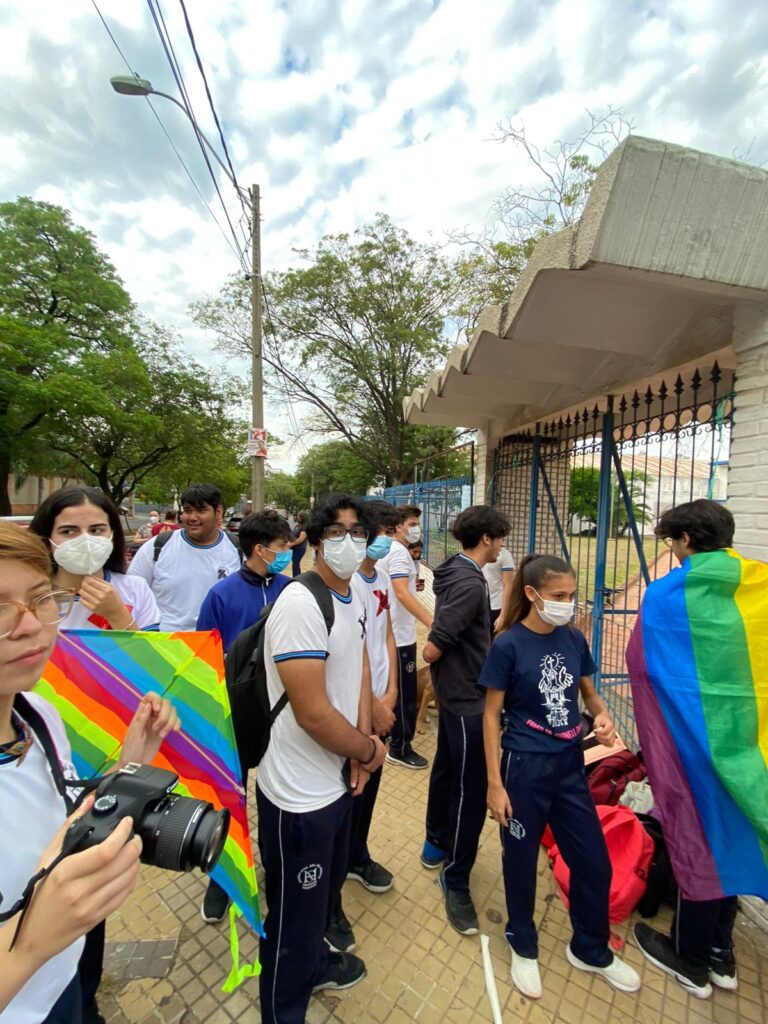
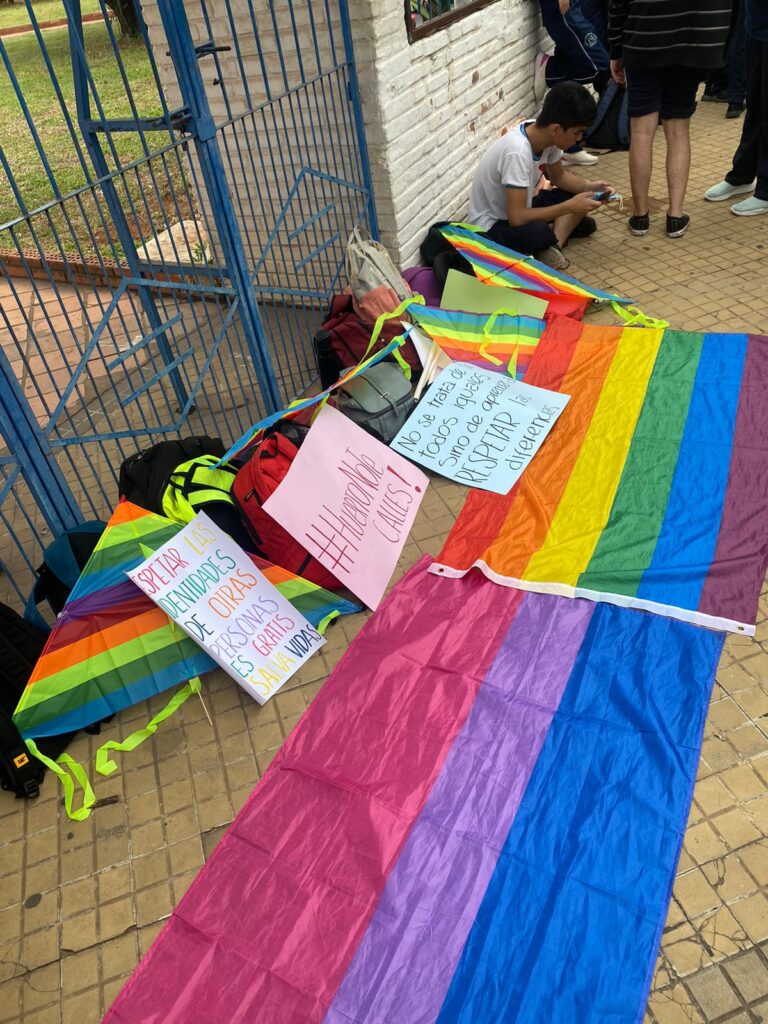
Her classmates held a protest on Wednesday in front of the school to denounce lesbophobia. The Ministry of Education and Science intervened and assured that the students would be able to re-enroll.
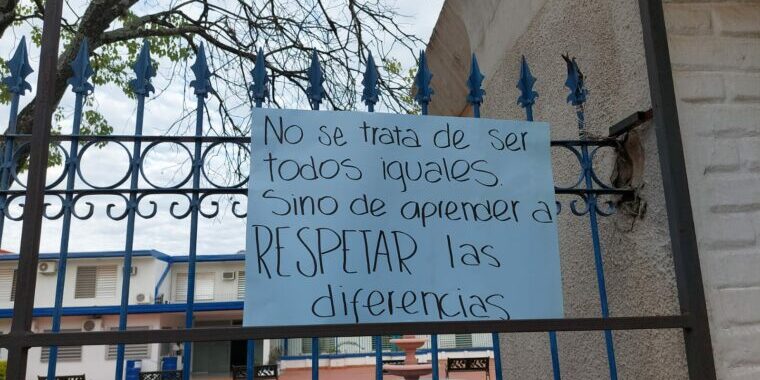
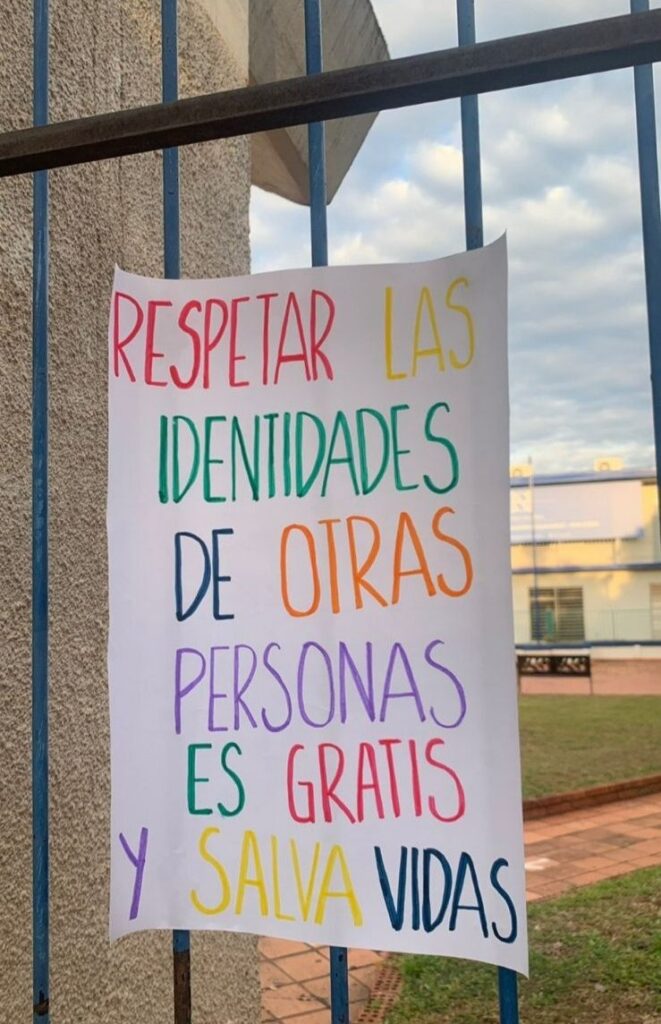
“According to God, we are all his children, he doesn’t discriminate,” his classmates chanted in unison through a megaphone. From the main gate hung LGBTQ+ flags and signs that read “Huerto, don’t be silent,” “Respecting other people’s identities is free and saves lives,” and “It’s not about everyone being the same, but about learning to respect differences.”
"Since when did it become a school for lesbians?"
According to Lourdes, when she and Federica's father returned from the meeting, they had to explain to their daughter that she had been withdrawn from school and that they would look into what to do about it. But Federica didn't take it well. "Later, at one point, when we left her alone, she took some drops of alprazolam (a drug used to treat anxiety and panic attacks); we don't even know how she got it," her mother said.
“After this discrimination at school by the principal, it affected both of them psychologically. That's precisely why this little girl couldn't bear so much pressure and humiliation and tried to take her own life,” Rocío Solís, Alejandra's mother, told Presentes. She was also asked to withdraw her daughter from the school. The principal told her that if she didn't, she would be expelled and wouldn't be able to attend other schools.
“The principal started picking on her from the beginning because a mother from the afternoon shift at the elementary school said to her, ‘Since when did this school become a school for lesbians?’ That’s exactly what the principal told Federica. That she had to take action, that she would never support this because otherwise she’d have to go sell onions on the street,” Lourdes stated.
“She forbade them from being together or talking to each other at school, even saying they went to the bathroom together, which is a lie. She looked for excuses to expel them from school because they supposedly tarnished the institution's reputation. 'We're receiving complaints from parents who know your daughter is bullying her classmate,' she told me, and that's a lie. My daughter's classmates have been friends for years; they adore each other,” Rocío said.
35% of the complaints against Rohendu are for discrimination in the educational field
The Rohendu helpline, an initiative of Aireana, a lesbian rights group, has registered an increase in cases of violence and discrimination since the start of the pandemic. Thirty-five percent of calls related to discrimination are in the educational sector. Many of these cases, like this one, don't reach government agencies or remain within Rohendu because people are afraid to report the abuse.
“It’s a low percentage because these kinds of situations are so normalized. Since the school has the power, the mothers end up just taking them out. In most cases, we receive complaints from third parties, or often from a classmate. We receive cases from teachers who ask us if we can do something or intervene, but they ask us not to give their names for fear of being expelled from the school,” says Carolina Robledo Desh, president and one of the founding members of Aireana.
In 2020, Aireana assisted in a similar case. It involved an 18-year-old lesbian who suffered discrimination and domestic violence, as well as harassment from the principal and psychologist of the private evangelical school she attended. When her mother found out she was a lesbian, she went to the school administration. The teenager was subjected to a series of “treatments” to “correct” her sexual orientation.
According to the Codehupy report , she was sent to a psychologist who administered hormones and then antidepressants. Faced with such harassment at school by the administration, the teenager filed a complaint with the legal department of the Ministry of Education and Science (MEC), which accepted the complaint and conducted an investigation into the matter.
As a result, she sent a letter to the school warning that its actions were discriminatory. Nevertheless, the school principal imposed a series of restrictions on the student's readmission: she was not allowed to approach her classmates, dye her hair, lower her grades, or attend church.
“It’s a progressive harassment, that’s why we always say that discrimination kills. Obviously, in the case we cited in the Codehupy report, they paved the way for her suicide. The directors harass the poor teenagers to the very end. That’s what discrimination leads to. So, that’s why it’s so important to talk about this issue and have a law against all forms of discrimination,” Carolina maintains.
Aireana published a statement on the evening of March 10, in which they applauded the support shown by Federica and Alejandra's classmates, who protested against the measure implemented by the administration. "In Paraguay, there are no laws that prohibit or criminalize sexual orientation and/or gender identity; it is the institutions that act based on their prejudice," they emphasized.
Expelling young people from school because of their sexual orientation is unconstitutional.
Representatives from the Ministry of Education and Science (MEC) announced their intervention in the case and assured that the affected students would remain enrolled at the school. They also recommended an investigation into the principal's actions. Sonia Escauriza, Director of Childhood and Adolescence at the MEC, told local press : “We recently launched the campaign for Anti-Bullying Month and are working together with the relevant institutions to prevent this from happening again. We are concerned that this complaint will lead to other similar cases.”
Human rights lawyer Diana Vargas explained to Presentes that any institution, whether public or private, must comply with Paraguay's constitutional and legal framework. "The current 1992 Constitution clearly states that it enshrines the right to equality and expressly prohibits discrimination. The right to equality, when we talk about discrimination, has the characteristics of a fundamental right, a human right, the core of the Constitution," she indicated.
Since the “Julio Fretes” Law Against All Forms of Discrimination has not been approved, there is no established complaint mechanism. This means that the resolution of cases often depends on the goodwill of the person in charge. However, Vargas pointed out: “It’s a good precedent. We must highlight the positive aspects: the actions of the Ministry of Education and the leading role of the students, their peers.”
The Human Rights Commission of the Senate stated on social media: “As a Commission, we are already intervening in the case of the alleged discrimination based on sexual orientation of a teenager, the consequences of which endangered her life.”
We are present
We are committed to journalism that delves into the territories and conducts thorough investigations, combined with new technologies and narrative formats. We want the protagonists, their stories, and their struggles to be present.
SUPPORT US

FOLLOW US
Related notes
We are present
This and other stories are not usually on the media agenda. Together we can bring them to light.