

Arrest warrant issued for peasant leader Rosa Acuña for staying in her community
Acuña is one of the first farmers charged under the new Zavala-Riera Law. Her community lost all their crops and their homes after 12 years of work.


Share

Rosa Acuña, a leader from the Cristo Rey settlement in Guayaibi, San Pedro department, is one of the first peasant women charged with an arrest warrant under the new Zavala-Riera Law No. 3440/2008, which amended Article 142 of the Penal Code, criminalizing the struggle for land in Paraguay.
On Monday the 21st, a hearing was held where the individuals charged with "Property Invasion" gave their statements. They now await the decision of the Paraguayan justice system.
Acuña has been fighting alongside families in the department of San Pedro for years.
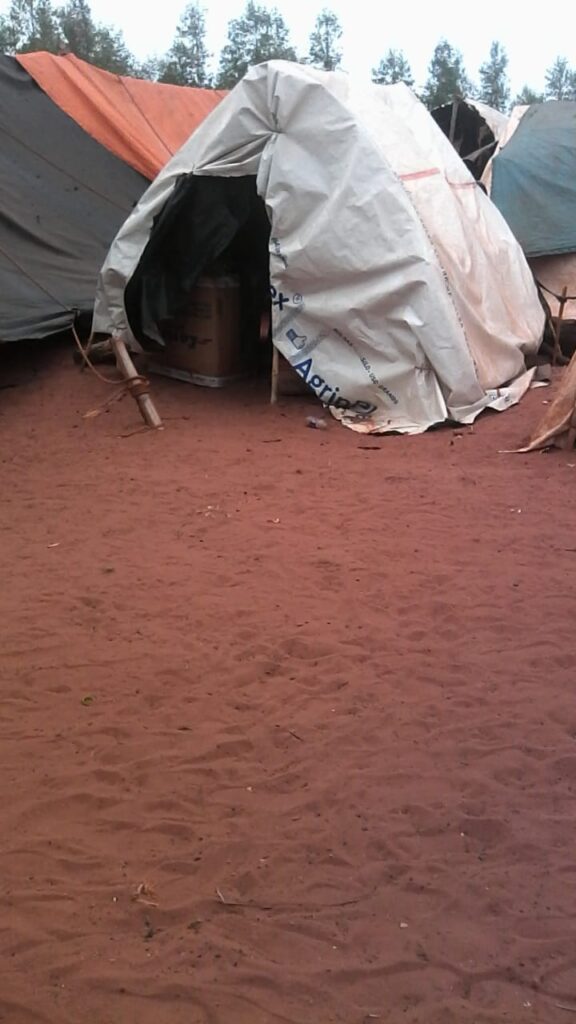
At the end of October 2021, the Cristo Rey community lost all their crops and their homes after 12 years of working 700 hectares of land. The land is recognized by the National Institute for Rural and Land Development (INDERT).
Last Monday, Acuña and his colleagues Marcial Gómez, deputy secretary, and Sixto Portillo, departmental leader, gave their statements to the judge. Their defense is being handled by Daniel Ortega González, a public defender from Santaní, who requested conditional release.
Rosa and her companions are awaiting the judge's decision on the measures she will impose, but, as they told Presentes, the investigation into the accusation of trespassing has already begun . "We hope that the mobilization planned for March will lead to the nationwide repeal of this law that criminalizes the struggle for land in Paraguay," said Acuña.
The leader also explained what criminalization means for women who decide to organize in the countryside: “Women have a very important role within society, in the world of struggle, when women are criminalized they are more affected because many times they have less defense, they give up many things, they have to leave their daughters and sons and go; the struggle is double or triple.”
Criminalization of peasants and indigenous people with the Zavala-Riera law
The new criminalization law stipulates that a person found squatting could face six to ten years in prison, without the possibility of alternative measures. On February 2, Rosa Acuña, along with peasant leaders from the National Peasant Federation (FNC), received news that the Prosecutor's Office had issued an arrest warrant and formal charges against them. The peasant mobilization succeeded in having the arrest warrant lifted and allowing the case to proceed without it, a victory for the FNC.
“This indictment with an arrest warrant is directly orchestrated by the prosecution and the landowning elite, because these key leaders are the ones being persecuted. We understand that this criminalization law that was passed in the country is being used to directly bring charges,” Teololina Villalba, General Secretary of the FNC, told Presentes.
According to the Paraguayan Human Rights Coordinator, in recent months there have been 12 cases of evictions against Indigenous communities, at least 10 of which were violent, and 10 cases of evictions against peasant communities: some 3,500 people were dispossessed of their homes. All the operations share the same characteristics: destruction and burning of homes, food production, their chapels or sacred temples, and theft of belongings and/or small animals.
The land fraud
The underlying problem that worries peasant communities, indigenous peoples and human rights defenders is that the modification is made by prioritizing the right to property over other rights, such as access to housing, food, and even the rights of indigenous peoples that predate the Paraguayan State.
Furthermore, Paraguay has approximately 8 million hectares of illegally acquired land, which should have been allocated to beneficiaries of the Agrarian Reform. However, the dictator Alfredo Stroessner handed it over to his associates, and during the democratic transition, the Colorado Party continued these policies. In total, this period of land giveaways extended from 1954 onward.
Many of the occupied lands were obtained fraudulently. According to the organizations, the Zavala-Riera law aims to address only land ownership, not its origin. The definition of a crime in the struggle for land means that those who claim ownership can file charges against those occupying the land. It's worth noting that this can happen with illegally acquired lands, because the occupants are not the legal owners.
No right is better than another.
Codehupy and other organizations had already warned about the danger of approving the modification of Article 142 of the Penal Code, especially because of the inequality that would grow even more, far from the peace in the countryside that Senator Fidel Zavala, one of the project's proponents, advocated, whose family owns 3 illegally acquired lands, one verified by the Truth and Justice Commission, and a third recently through the journalistic investigation of Roberto Irrazabal of the media Made In Paraguay .
Oscar Ayala, Executive Secretary of Codehupy, explained on the program “Made In Paraguay”: “ When we are faced with the invasion of someone else's property, we are facing malice aforethought, the intention to cause harm. A peasant occupation is not motivated by harming anyone; it stems from the state of poverty that the State denies them and then criminalizes. It represents a breakdown of the rule of law; it cannot be that the State denies them rights and then criminalizes them. It is a set of things that are incompatible with rights .
He pointed out how the order of things was being altered in Paraguay, placing private property at the top and other basic human rights below it. This privileges the agribusiness sector.
Rural and urban organizations announce actions and mobilizations for the month of March in Asunción, just as they did on December 10th with a historic march of 10,000 people through the city center and downtown area of the country's capital.
We are present
We are committed to journalism that delves into the territories and conducts thorough investigations, combined with new technologies and narrative formats. We want the protagonists, their stories, and their struggles to be present.
SUPPORT US

FOLLOW US
Related notes

We are present
This and other stories are not usually on the media agenda. Together we can bring them to light.