

Violence in nightclubs: Warnings about the increase in homophobic attacks
In recent months, several reports of assaults have come to light. All of them occur in full view of security personnel and the police, who, in every case, condone these attacks. This has caused concern among LGBTI organizations.


Share

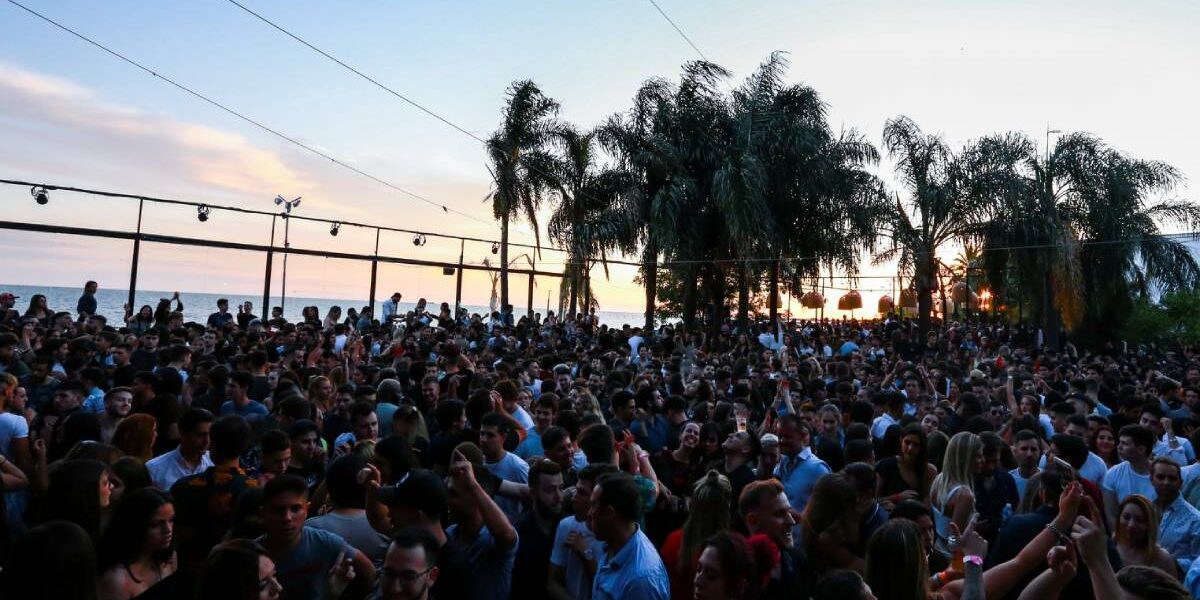
BUENOS AIRES, Argentina . Daniel, Simón, Brian, and Manu have something in common: they are members of the LGBT+ community who have experienced or know someone who has experienced a clear situation of violence in a nightclub, a place of relaxation and leisure with friends.
“Discrimination and violence of this type are systematic,” say LGBT+ activists who spoke with Presentes about the attacks they experienced in nightclubs or when leaving them.
Aggressed and unprotected
Calchaquí is a small town in the north of the province of Santa Fe, one of those that grew up with La Forestal and where everyone still knows each other.
One of the most well-known nightclubs in the area is El Gigante two men were beaten to death outside that establishment .
On Friday, February 11, Brian Blanco went dancing with his friend Juan. At one point, they decided to go to the bathroom. “There was a guy at the urinals, and Juan stood next to him. I waited, and when a stall with a toilet became available, I went in,” Brian recounts in an interview with Presentes . He continues: “At that moment, my friend came out of the bathroom, and this man came into the stall with me. He opened the door, with my back to him. I looked at him, and he stared right into my eyes and closed the door. That's when I thought, 'This guy is going to rape me.'”
Brian struggled with him, pushed him, opened the door, and managed to get out of the bathroom. But the situation didn't end there. There were five police officers on duty at the bowling alley. “I told them what happened, and they laughed. They told me that since I had defended myself, nothing was wrong. They didn't even bother to check if the guy was still in the bathroom, or if he had grabbed someone else,” he recalls. They also didn't offer to accompany him to the police station to file a report. As he was leaving, while they laughed, they told him: “Slap him.”
Faced with that response, Brian decided not to file a report. “This is a small town. Why would I report the guy or the officers? I'd have to see it everywhere,” he lamented, while maintaining that what he experienced was a direct attack on his personal integrity.
After experiencing those situations, the young men—still in shock—decided to leave. They were getting on the motorcycle when a man who was also leaving the nightclub approached them, punched Juan in the face, and yelled, “You faggot!” “My friend flew off the motorcycle about two meters and his face started to swell up,” Brian recounted.
The urgency of a cultural change
Mariano Espinosa , director of the Promotion of Rights for Equality in the province of Santa Fe , was consulted about this case. “In all areas, we need to break down the barriers that hinder the restoration of rights, for example, through administrative procedures or filing complaints. We need to eradicate prejudices and continue providing training. There are laws that have allowed us to move forward toward equality, but we continue to develop public policies to prevent these incidents from happening again.”
Furthermore, she explained that upon learning of this case, the protocol was activated. This means that her department contacts local authorities, who then coordinate an intervention by "first communicating with the person who suffered violence due to their sexual orientation or gender identity" and defining strategies to support them.
Beyond the specific actions and deadlines in each case by different state levels, the fact is repeated throughout the country that situations of violence always affect first the organizations linked to the collective – long before reaching the institutional sphere.
That case was no exception. “In light of these events, the National Diversity Space of the Socialist Party wishes to express its deep concern about what has happened and demands that municipal, provincial, and judicial authorities take the necessary measures to ensure that these events do not happen again (…) We urge society to show solidarity and not normalize this hateful violence,” the organization stated in a press release.
A recurring episode
Violent acts against LGBTQ+ people in nightclubs have come to light recently. This was highlighted by the homophobic attack suffered by 28-year-old queer man Daniel Callejas at a nightclub on the Costanera Norte in Buenos Aires.
Daniel Callejas is a dentist, paramedic, model, and arrived in the country from Venezuela in 2016. He is also a survivor of a homophobic attack he suffered in the early hours of Monday, January 31, as he left the Río Electronic Music in Punta Carrasco, north of the city of Buenos Aires.
That day she made her situation public in a video she shared on her Instagram account, which quickly went viral. “What happened to me is the most horrible thing that has ever happened to me,” she told Presentes .
Initially, the young man was ejected from the nightclub by security guards because some customers had complained about the way he was dancing. Once outside, two men approached him and began hitting him while hurling homophobic slurs.
“They started saying to me, 'You fucking faggot, we're going to kill you.' I thought they were going to kill me, because they started hitting me so hard in the face that I lost consciousness,” he said.
When he woke up, he approached the security personnel, “covered in blood.” “I asked them for help because there was supposed to be a doctor there. They didn’t give me medical assistance or call an ambulance, they ignored me and treated me like I was crazy,” Callejas said, adding, “They did nothing.”
In response to this incident, Daniel filed a complaint at the 14 C Neighborhood Police Station, located at 2961 República Árabe Siria, in the Palermo neighborhood of Buenos Aires, and the National Institute against Discrimination, Xenophobia and Racism (INADI) made themselves available.
Following the Callejas case, Claudia Neira, a legislator for the city of Buenos Aires from the Frente de Todos party, submitted a request for information to the Legislature demanding "information from the Government of the City of Buenos Aires regarding private security service providers, the training received, and the existence or absence of prior sanctions."
“We believe it’s important to have all this information because we see instances of discrimination and violence as systematic in private security, especially in nightclubs,” Neira explained to Presentes . She also warned that “the Ministry of Security is not fulfilling its obligation to send the reports it should be submitting periodically regarding private security in the City.”
She also stressed the need to put the Buenos Aires Public Security Council into operation, “an organ created by the Constitution, which has a law that regulates it and yet has not been formed,” the legislator explained, adding that “this should be the forum where these issues could be discussed.”
The complaints
In 2021, there were 2,567 complaints filed with the National Institute against Discrimination, Xenophobia and Racism (INADI), of which three were made by LGBT+ people in the context of dance venues.
“The number of complaints has decreased in the last two years not because they have ceased to exist, but because the nightclubs closed due to the pandemic,” Demian Zeyat, director of Victim Assistance at INADI, Presentes
From 2015 to the present, the year with the highest number of complaints, relative to the total, was 2017, with 24 complaints out of 2,495, equivalent to 0.96% of the total. In the other years—excluding the pandemic years—the percentage ranged between 0.60% and 0.65%.
“In general, issues related to LGBT+ people account for about 3% of the complaints we receive, and assaults in nightclubs exceed 0.6%, so it is quite significant,” Zeyat added.
Regarding the type of complaints, she explained that the most common ones they receive "are not physical assaults in nightclubs, but rather complaints from trans people whose gender identity is not respected."
Who reports it and where.
However, many cases are not reported through judicial mechanisms, nor to INADI.
“Making a complaint of this nature, especially when it is something as mobilizing as a case of violence, involves a strain that is focused on coping with the situation of aggression that was received,” said Manuel Ferreiro, activist and coordinator of the Argentine Network of Positive Youth and Adolescents (RAJAP) in the city of Buenos Aires.
RAJAP denounced, via their social media channels, an “act of violence, discrimination, and violation of diagnostic confidentiality” perpetrated by security personnel at the Palacio Alsina event venue in Buenos Aires. The incident occurred on February 5th of this year, during the Dorothy Festival .
“When he was about to enter the Palacio Alsina hall, security personnel found the antiretroviral medication pills among the victim's belongings and accused him of possessing illicit drugs. They threatened him, saying that if he didn't get rid of them, they would soak them in water and dissolve them to ensure their destruction,” said Manuel, who spoke with the victim.
He continued: “To keep the medication, the person had to explain their diagnosis, not only to the security guard, but also to the people around them. Finally, the person decided to say they were going to get rid of them and managed to hide them on the street before retrieving them.”
“These are the strategies that a person living with HIV has to deploy if they simply want to go out to a place to dance,” he said.
Ongoing aggression
Violence isn't confined to private spaces. On February 11th of this year, Simón Facio left the Plop party, located on the border between the Chacarita and Colegiales neighborhoods of Buenos Aires, with his friends. He said goodbye to them to catch the bus that would take him home.
Once at the bus stop on the corner, Simón was attacked by two people and knocked unconscious. When he awoke, none of his belongings were with him.
“They left my nose, mouth and eye all swollen, with bruises, they broke a tooth, but I didn't have any terrible aftereffects,” he told Presentes .
Simón isn't sure whether to classify it as a homophobic attack because during the assault "there was no dialogue." However, he clarified that "it happens all the time." "When I posted about it on Twitter, many people told me that at least outside Plop, it's something that happens every weekend," he said.
From Santa Fe, Brian, speaking on behalf of many, concluded: “I want this to be known so that concrete LGBT public policies are urgently established to take care of us, protect us, and guarantee our health, access to housing, and above all, safety.”
We are present
We are committed to journalism that delves into the territories and conducts thorough investigations, combined with new technologies and narrative formats. We want the protagonists, their stories, and their struggles to be present.
SUPPORT US

FOLLOW US
Related notes
We are present
This and other stories are not usually on the media agenda. Together we can bring them to light.