

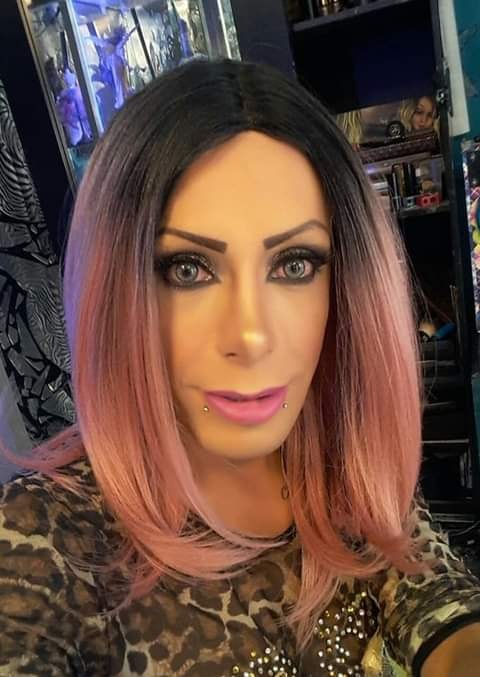
Loren, a trans woman who had been missing since December in Guanajuato, was found brutally murdered.
Loren Guzmán was reported missing on December 3rd. Two months later her body was found with signs of torture.


Share

GUADALAJARA, Mexico . Loren Guzmán was a 33-year-old trans woman. She was reported missing on December 3, 2021, and on February 2 of this year, her body was found with signs of torture in Irapuato , Guanajuato , a state in central Mexico.
Activists are demanding a gender-sensitive investigation and that the case be classified as a hate crime. The local prosecutor's office has not released any information on the matter.
According to family reports, Loren left her home, located in the Flores Magón Sur neighborhood , at six o'clock in the afternoon on December 3, 2021. When they had no news of her, her family filed a missing person report and on February 2 announced on social media that she had been "found dead" on the outskirts of Irapuato.
Arturo Álvarez, a human rights defender and director of the Human Development and Sexuality organization ( Dehusex ) in Irapuato, met Loren and remembers her as "a very cheerful girl, with a great desire to live (...) Loren was very hardworking, very extroverted and even opened two beauty salons and she loved that."
When Arturo learned of her disappearance, he approached the family as a human rights defender to offer support "to the extent they would allow me," he recalls. But it wasn't until he learned that Loren had been murdered that he spoke out and demanded that the Prosecutor's Office investigate the crime with a gender perspective and classify it as a hate crime.
Arturo reported Loren's disappearance to the National Observatory of Hate Crimes against LGBT+ people because he says that "the authorities in Guanajuato do not take into account the sexual orientation and gender identity of the victims.".
However, the Observatory only has a record of four murders that occurred last year and no disappearances.
“Loren was brutally murdered and the Prosecutor’s Office is ignoring it.”
“Loren’s tongue was ripped out and his penis was cut off. That’s cruelty, brutality, and why don’t they mention it, why don’t they investigate it as a hate crime? Here, the Prosecutor’s Office links everything to the cartels, and I can understand that given the situation in Guanajuato, but those crimes are committed with firearms; there are three or four deaths every day. But when there’s a person like Loren and others, we know they were murdered with cruelty. And that’s where I draw the line. However, the Prosecutor’s Office ignores it, doesn’t investigate from a gender perspective, and therefore we can’t have information that helps us understand the scale of the violence against the community,” activist Arturo Álvarez pointed out in an interview with Presentes .
Arturo explains the above knowing that since 2018, people in Guanajuato have been living in a state where violence has increased. This is particularly evident in homicides, disappearances, and a forensic crisis that has resulted in people being buried in clandestine graves . All of this stems from the security strategy of the so-called "war on drugs" and the territorial disputes between criminal organizations.
To put the situation in Guanajuato into perspective, according to data from the Executive Secretariat of the National Public Security System, from 2018 to 2021, an average of 59.79 people were murdered per 100,000 inhabitants in that state ; the national average for the same period is 26.8. In addition, 2,649 people disappeared in Guanajuato, according to figures from the National Registry of Missing and Unlocated Persons ( RNPDNO ).
Presentes contacted the Guanajuato State Prosecutor's Office. When questioned about the line of investigation into the disappearance and murder of Loren Guzmán, and the application of the National Protocol for Action for Personnel of Law Enforcement Agencies in cases involving Sexual Orientation or Gender Identity —approved in 2017—they briefly responded: “all that information is confidential” and ended the call.
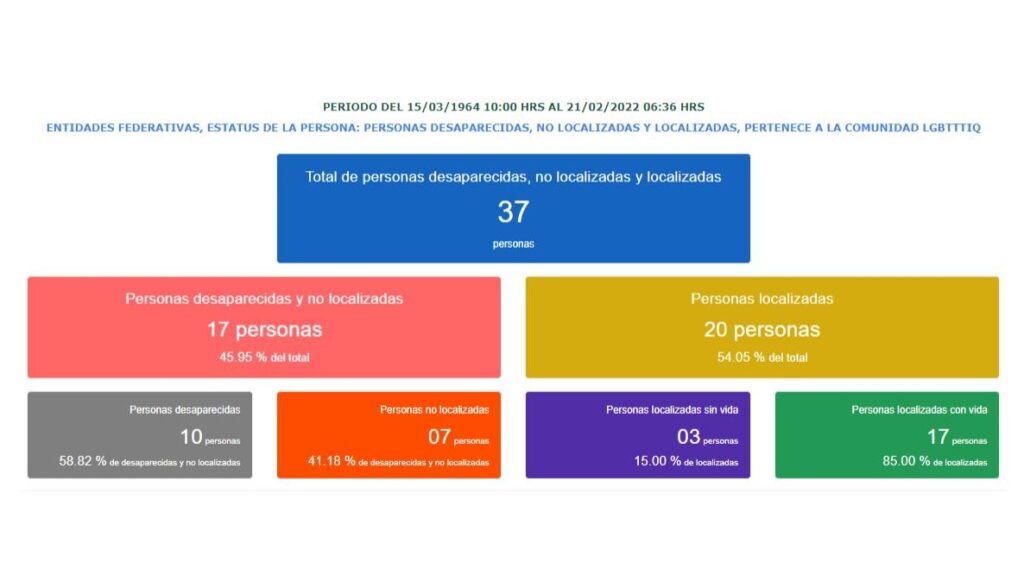
In Mexico, 17 LGBT+ people are missing.
In Mexico, 17 LGBT+ individuals are missing out of a total of 37 reports of LGBT+ people "missing, not located, and located," according to figures disaggregated by differentiated approach from the National Registry of Missing and Not Located Persons. Of that total, 17 were located alive and 3 deceased.
From this search we found that in February 2022 a report was filed for a missing LGBT+ person in Guanajuato and that this was done from the public portal of the National Search Commission , where citizens and public officials can report the disappearance of any person .
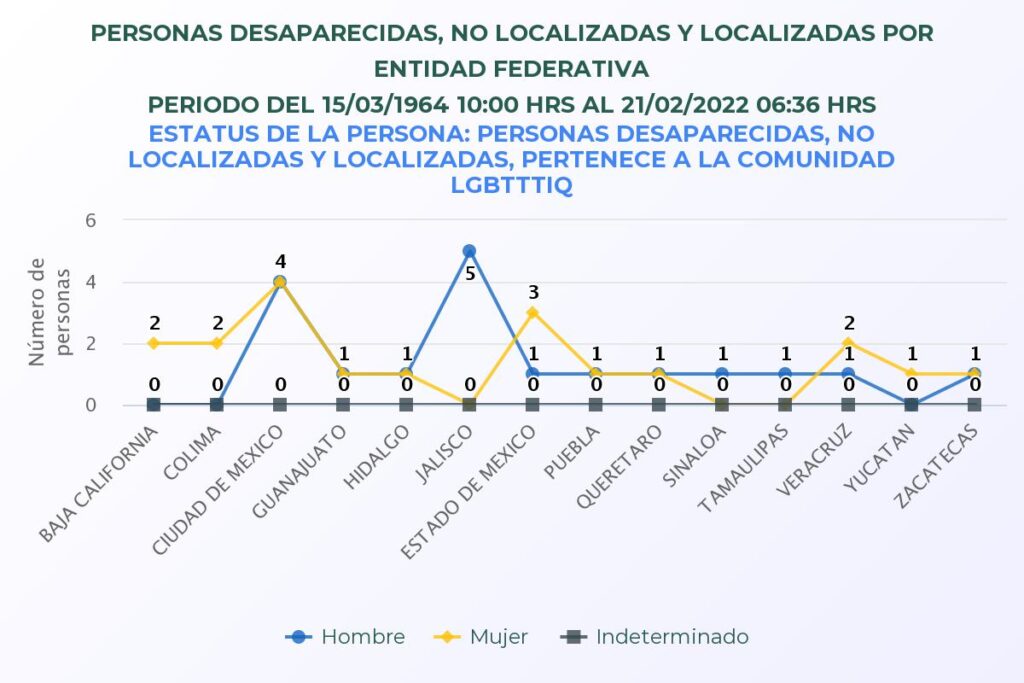
According to our search, Jalisco; Mexico City; State of Mexico; Veracruz; Colima and Baja California are the states where the most disappearances of LGBT+ people have been reported.
“We need to organize ourselves because our security isn't going to come from the government.”
Arturo shares that, since the disappearance and murder of Loren Guzmán, he has perceived an "increased sense of unease" among LGBT people in Irapuato.
“Because of how things happened, because of how Loren was murdered, because of the situation in the state, I can tell you that we in the community are afraid. These past few days, several of us have been talking, thinking about what happened to Loren, and we imagine it and it terrifies us,” the human rights defender commented.
And he adds, “Personally, this affects me; I feel more vulnerable. However, I can’t just sit idly by; I have to take action by raising my voice, continuing the work I do every day, and speaking about this in the places I go—about who we are, what we experience, and what we want—and working together, all of us, and organizing ourselves because our care and safety aren’t going to come from the government.”
In addition to the impetus to generate changes from the community level, Arturo sees it as necessary that, following the murders and attacks against lesbian and trans at the beginning of this year, they be included in the gender alerts that state governments raise due to the increase in femicidal violence.
“It is important that our community be included, and that the violence to which women of diverse backgrounds, particularly trans women, are vulnerable be highlighted by women's institutes, observatories, and gender violence alerts in each state,” concluded Arturo Álvarez.
We are present
We are committed to journalism that delves into the territories and conducts thorough investigations, combined with new technologies and narrative formats. We want the protagonists, their stories, and their struggles to be present.
SUPPORT US

FOLLOW US
Related notes
We are present
This and other stories are not usually on the media agenda. Together we can bring them to light.