

Why do we urgently need a wetlands law?
The bill is not included in the special sessions called by the Executive Branch. Activists emphasize the importance of the law and call for continued efforts.


Share

BUENOS AIRES, Argentina. The Wetlands Law has once again lost its parliamentary status in Argentina. Its consideration was not included in Decree 51/2022 (released on January 25), in which the Executive Branch convened extraordinary sessions of the National Congress.
“The lobby won, and if the lobby wins, unfortunately, we all lose,” journalist and activist Soledad Barruti Presentes
In 2020, 15 Wetlands Bills were introduced in the National Congress. Ten were introduced in the Chamber of Deputies and five in the Senate, following a wave of fires in Argentina, which resulted in the number of hectares burned reaching 1,151,931,054 by .
After arduous work, they were all unified into one project and its debate began in the Commission on Natural Resources and Conservation of the Human Environment , chaired by Leonardo Grosso, in August 2020.
“That single bill was approved in the Environment Committee . When it had to be sent to the Agriculture Committee, it was blocked by the interests surrounding the agricultural sector,” Julián Monkes , a graduate in Environmental Sciences from the Faculty of Agronomy at the University of Buenos Aires and a PhD in Agricultural Sciences, Presentes
Indeed, the Agriculture and Livestock Commission of the Chamber of Deputies, headed by José Aragón, did not debate the project, as it lost its parliamentary status at the end of 2021.
What's happening with the law?
In the recent decree, signed by President Alberto Fernández, extraordinary sessions were convened to continue the parliamentary agenda between February 1st and 28th of this year. This bill was not included in that agenda.
“To let a law die that was worked on for two years, on which so many people worked, where so many specialists, academics, militants and activists invested time and knowledge, is once again an insult to the whole of society,” Barruti stated.
Ivo Peruggino is 31 years old, from the city of Rosario and is dedicated to the rescue, rehabilitation and release of wildlife at the NGO Mundo Aparte .
Furthermore, she is part of the Multisectoral Wetlands Network , which was founded in 2020 amidst the growing awareness of the fires in the Paraná Delta. Last year, the network undertook a historic seven-day journey, in which more than 50 activists set off from Rosario, paddling kayaks to Buenos Aires , where they were greeted by a large demonstration in Plaza de Mayo.
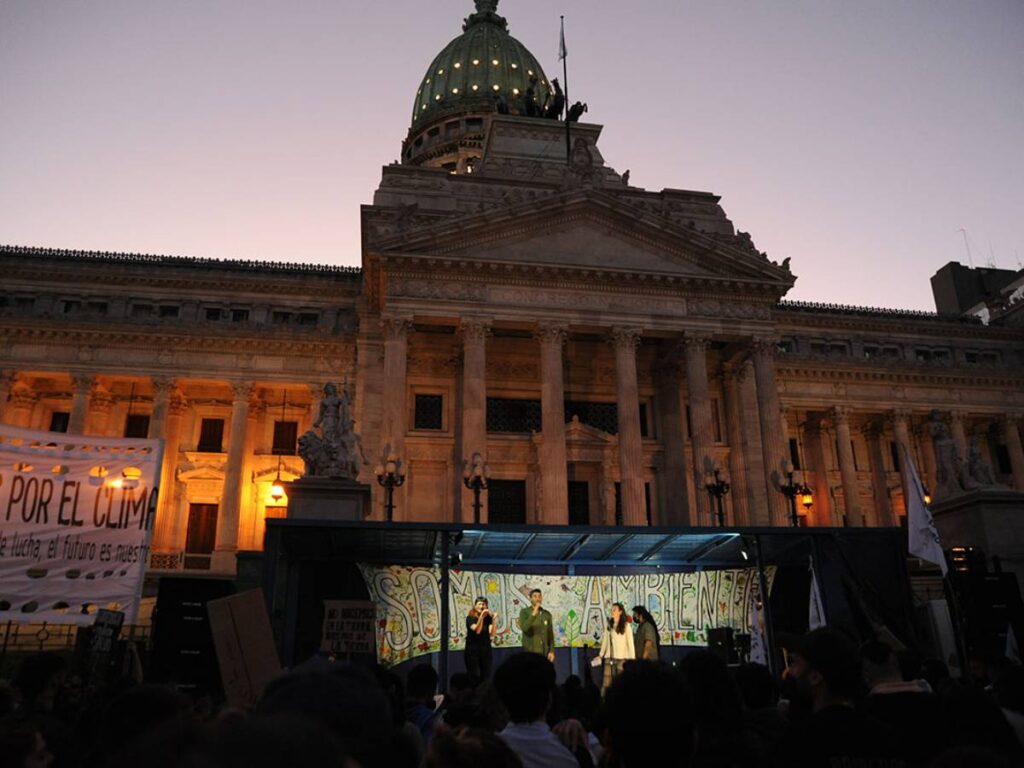
Photo: Ariel Gutraich.
Wetlands and climate change
For Peruggino, “in this historical context of global climate, energy and ecological crisis and in a country where most productive activities are predatory and extractive of ecosystems and the future, a wetlands law is essential to consider the idea of conserving and protecting these important ecosystems.”
“Wetlands somehow act like a sponge that mitigates climate change because they are ecosystems that store carbon,” he said.
He further specified that “they retain floodwaters, prevent flooding, provide habitat and food to thousands of species that find refuge there, are a freshwater reserve, clean the air we breathe, filter the water we drink, among other multiple functions they have for the good development of life, both of human beings and of other species .”
Regarding this, Monkes added that the objective of the bill "is to establish a minimum floor for the conservation of wetlands."
"That is to say, that in all these ecosystems there should be rules on how to use or conserve wetlands. That it should no longer be legal to devastate a wetland, burn it, or fill it with soil extracted from elsewhere to carry out a real estate development. Instead, the ecological functions of the ecosystems themselves must be respected."
The journey of the wetlands law
In Argentina, wetlands cover approximately 21% of the territory, and the country has 23 Ramsar sites . These are wetlands considered to be of international importance under the Ramsar Convention, covering a total area of 5,687,651 hectares.
The graduate in Environmental Sciences, who has been following the law for several years, told Presentes how it was handled in previous years.
“The Wetlands Bill has been around for many years. It began to be discussed in 2010 following the 2008 fires when ash reached the city of Buenos Aires from the Buenos Aires and Rosario Delta regions. That's when the issue was put on the agenda,” he explained.
The first bill was introduced in 2013 by Senator Rubén Giustiniani of Santa Fe province. “It was approved unanimously and practically without discussion in the Senate. It then went to the Chamber of Deputies where it was stalled by lobbying,” Monkes said.
He continued: “This becomes much more explicit with the next stage of the bill, which is in 2016 when Pino Solanas presents it in the Senate. It begins to have a much greater impact on the media agenda, and it is then much more thoroughly discussed in the Senate. Despite that discussion and some negotiations, the bill is approved there, but it gets stalled again in the Chamber of Deputies.”
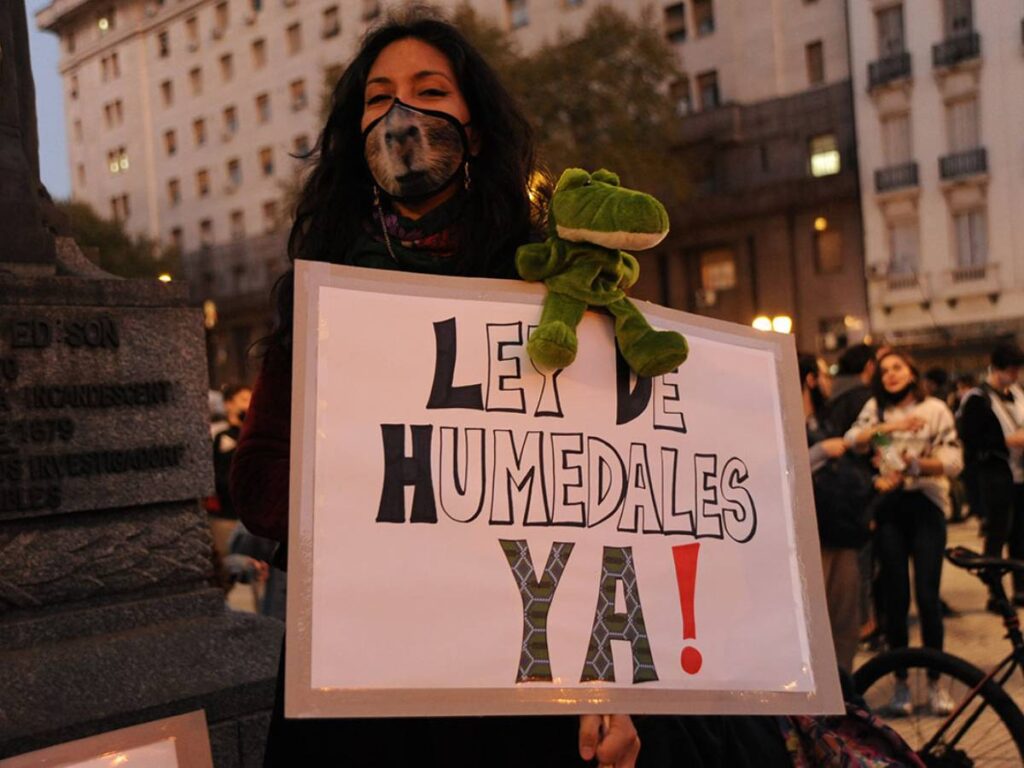
Photo: Ariel Gutraich.
The sector that blocks
The activists point to the agricultural, real estate, and mining sectors as responsible for the failure of the negotiations for the various projects.
“Sometimes we underestimate the actors behind the environmental crisis we are experiencing. They are truly powerful players, capable of knocking on anyone's door and lobbying, as they have demonstrated. Whether they are from the agricultural, real estate, or mining sectors,” the lawyer stated.
“There is no more atrocious situation than the one we are experiencing, where in order to advance the businesses of a handful, they are taking away nothing less than the possibility of extending a quality of life with a good life for everyone else,” Barruti stated.
“We believe that progress lies elsewhere, and in that sense, we know that environmental justice is social justice. In our country, the maps of greatest poverty coincide with the maps of greatest environmental degradation, and the worst consequences of environmental crimes are suffered by the working class, who have always had it the worst,” Peruggino stated.

Photo: Ariel Gutraich.
The fight continues
Given the loss of parliamentary status of the project, Barruti, Monkes, and Peruggino all called for the fight to continue.
“It’s a law that we must continue to advocate for, that we must continue to fight for, and without a doubt, we will continue to do so. In response to each of the abuses that have occurred recently, there has been a loving, active, and very rapid response from the streets, and I believe that this is where we will continue to fight for this,” the journalist suggested.
To his words, Monkes added: “There is no other option but to keep rowing, keep building strength and keep raising awareness of the issue so that sooner rather than later, hopefully, there will be a wetlands law.”
“The health of the wetland is our health,” Peruggino concluded.
Photo: Ariel Gutraich.
We are present
We are committed to journalism that delves into the territories and conducts thorough investigations, combined with new technologies and narrative formats. We want the protagonists, their stories, and their struggles to be present.
SUPPORT US

FOLLOW US
Related notes


We are present
This and other stories are not usually on the media agenda. Together we can bring them to light.