

Aggression and discrimination against sexual diversity are on the rise in Argentina.
In recent weeks, several attacks against the LGBT community have been reported. There is growing concern about homophobic rhetoric.


Share

BUENOS AIRES, Argentina. “Violence has escalated recently,” Pablo Terrera, owner of Maricafé, the bar and LGBT Book Store located at 4200 Honduras Street in the city of Buenos Aires, Presentes
On Sunday, January 16, the premises suffered an attack in the early hours of the morning: two men threw a burning pillow at the doors of the establishment.
Regarding the incident, the workers claim that it was an act of hatred towards sexual diversity because it did not occur in any other store.
“Our community is constantly subjected to aggression, and many incidents go unreported. I decided to report it because I refuse to legitimize this,” Terrera said. He believes the men acted “with malice aforethought” against his business, which he opened in 2018. He filed a report at Police Station No. 2 in the Palermo neighborhood. An investigation has been opened by the Criminal, Misdemeanor, and Petty Offenses Prosecutor's Office No. 1, which specializes in gender-based violence.
The arrival of summer brought with it a wave of violence against the LGBTIQ+ community in Argentina. From the vandalism of the mural at the Mocha Celis Trans High School , the destruction of posters announcing the future Plaza de la Diversidad (Diversity Plaza) in Las Flores, the dismissal of a Rosario Central soccer player for kissing her partner , to the attack on a dancer and two trans femicides in less than a week.
The State Registry
“Complaints have increased,” Victoria Donda, head of the National Institute Against Discrimination, Xenophobia, and Racism (INADI) Presentes , regarding the discrimination cases experienced by the LGBTQ+ community. She continued, “We don’t know if it’s because cases of discrimination have increased or because we’ve been working on this issue at INADI. When we took office in 2019, the statistical system had been destroyed; society was practically unaware that INADI existed.”
Donda believes that hate speech against the LGBT+ community is currently proliferating. She states that this speech “is not only heard from candidates or people in the political system, but also in the media,” and that it constructs “an ideology in which violence is justified.”
Attacks on Mocha Celis
Meanwhile, on January 4, another attack on diversity occurred in the Buenos Aires neighborhood of Once.
Students, alumni, and teachers created the mural for the Mocha Celis Transgender High School during a project that included the participation of Presentes on December 2nd and 3rd. It was a way for the school to welcome the neighborhood in early December. A month later, and under circumstances that are still unknown, the mural was vandalized with hateful messages targeting sexual diversity.
“We understand that violence is a constant and latent presence in our existence, even when what we want is to build. Unfortunately, I must say that it is one of the most common things that happens to us. In recent years, the abuses by the security forces have not stopped, nor have the contempt, the dirty looks, the mockery. This is yet another mark that we are carrying as a collective,” Manu Mireles, academic secretary of Mocha, told this publication at the time.
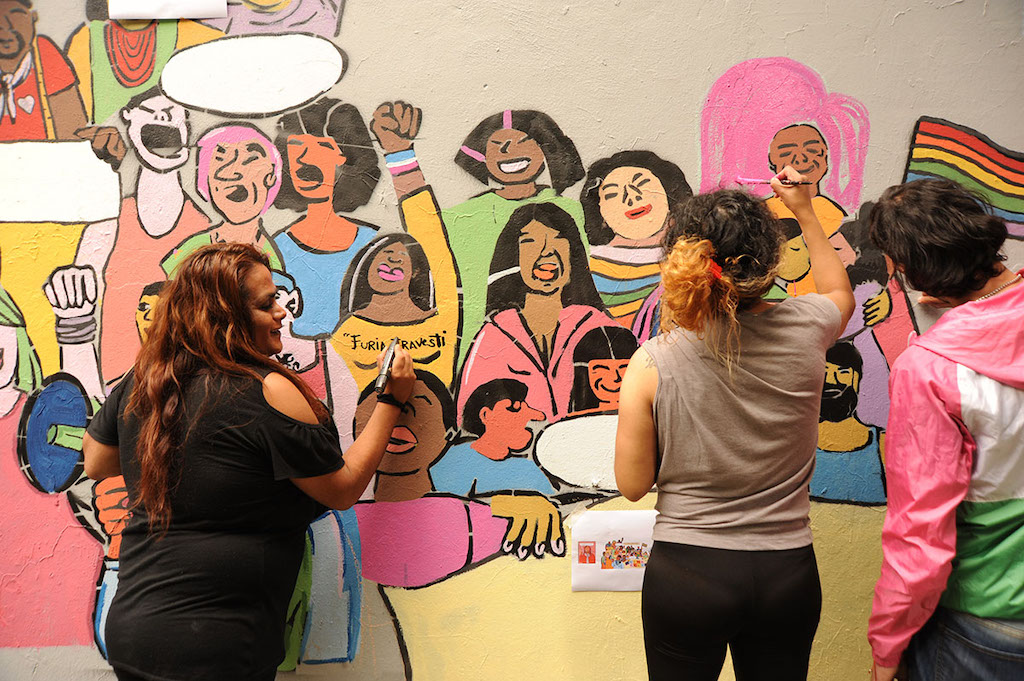
Photo: Ariel Gutraich.
Against diversity
In the town of Las Flores in the province of Buenos Aires, people tore down the sign announcing the construction project of the Plaza de la Diversidad (Diversity Plaza ).
The initiative was approved by the City Council “with the intention and need to have a space that symbolizes recognition of a historically discriminated group such as the LGBTI+ community.” This was stated by the Gender Space Let's Talk , an organization that made the announcement public through its social media.
Furthermore, they reported that the attack occurred just days before the Hablemos Festival , organized “to include and make visible the struggle of the LGBT community”, which will take place on Saturday, January 22nd at the Confitería de La Laguna in the district.
For Mercedes Crego, 28, a Tourism graduate and activist in the movement, “discrimination, violence and hatred towards LGBTI+ people, whether explicit or implicit, is what drives us out of small cities like ours.”
“In light of these events, we reaffirm the need for our activism, to make ourselves visible and to be heard as a collective. As long as these acts continue to occur, we will remain more united and stronger in our struggle,” she stated.
Direct discrimination
In addition to material attacks, serious violence against members of the community was recorded in December and January.
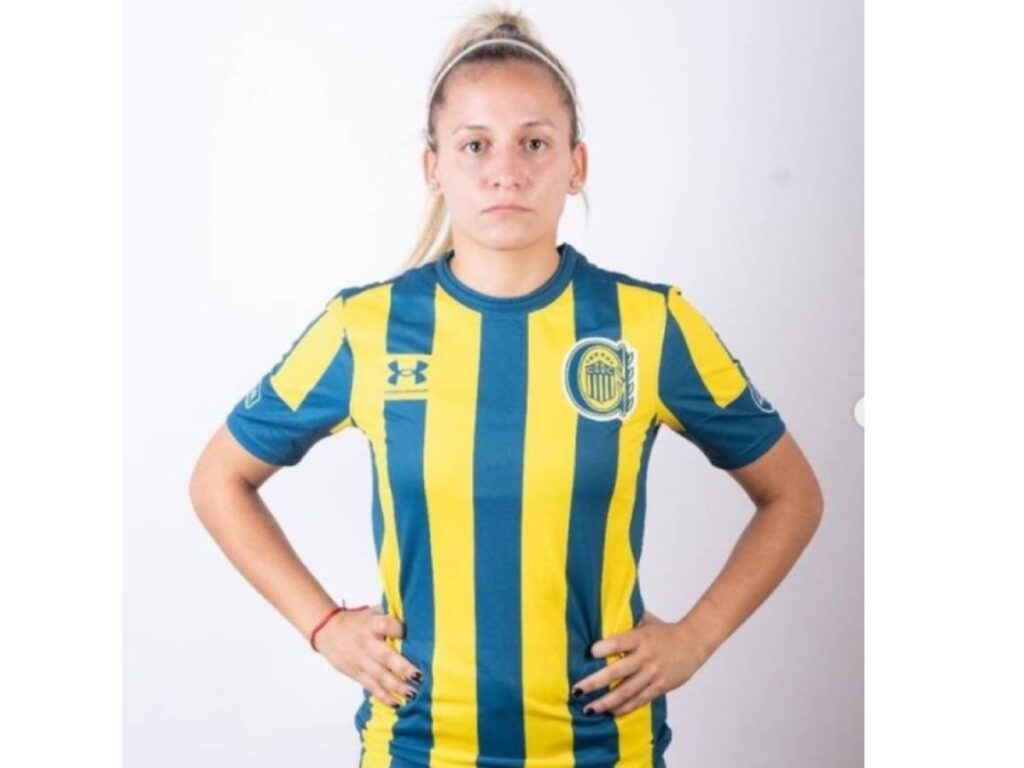
After a meeting with the leadership of women's football and the high authorities of the Rosario Central without good results, the players of the club's women's football team decided to report to INADI in mid-December the multiple abuses they have been experiencing.
The situations range from threats, inappropriate comments and excessive sporting demands, to the expulsion of one of the defenders of the professional team, Maira Sánchez, "for kissing another girl".
“I would love for the club to have truly qualified people in charge of a professional team. Not just for us, but for the little girls coming up behind us,” Maira told Presentes .
Also in mid-December, the Latin rhythms dancer and dance teacher Roberto Tito Costilla, 27, suffered a homophobic attack that broke his leg .
Following a raid, requested by the Criminal Prosecutor's Office 3 and ordered by the Guarantee Judge 2, on December 14, Ignacio Colombo, father and son, were arrested, accused of the crime of serious injuries aggravated by hatred of sexual orientation.
Two trans femicides in 2022
Finally, 2022 began with two trans femicides in less than a week. The figure is alarming considering that in the first two weeks of the year, 20 percent of the hate crimes against transvestites and trans people that occurred in 2021 took place.
In this regard, according to the organization La Rosa Naranja 10 murders of transvestites and trans people were recorded last year .
The first transfemicide of the year was that of Aldana Lorenz , a 35-year-old trans woman, who died on January 4, after having been hospitalized for 10 days after receiving an attack on Christmas Eve in the La Ranita neighborhood, northwest of Santa Fe capital.
Only when his death became known was the police involved and the Public Prosecutor's Office (MPA) notified.
At the end of last week, the second transfemicide of the year was reported in the town of Beccar, in the district of San Isidro, in the province of Buenos Aires.
It was a 46-year-old trans woman who was found stabbed to death in a house in the district.
Currently, the crime is being investigated by staff from the prosecutor's office on duty in the San Isidro Judicial Department, under the direction of prosecutor Carolina Asprella.
“In any process of progress toward achieving rights, there are also moments of setbacks. I believe that, without a doubt, we are witnessing an advance of socially conservative and violent sectors throughout the country. These sectors echo the hate speech produced in think tanks geared more toward electoral campaigns, such as that expressed by Javier Milei or Patricia Bullrich,” concluded the head of INADI.
We are present
We are committed to journalism that delves into the territories and conducts thorough investigations, combined with new technologies and narrative formats. We want the protagonists, their stories, and their struggles to be present.
SUPPORT US

FOLLOW US
Related notes
We are present
This and other stories are not usually on the media agenda. Together we can bring them to light.