

Feminist teachers and LGBT groups reject the "alternative" Comprehensive Sexuality Education (CSE) program promoted by the Chaco government
The law opens the door to religious objection. It was announced as a comprehensive sex education program based on “scientific foundations and values.”


Share

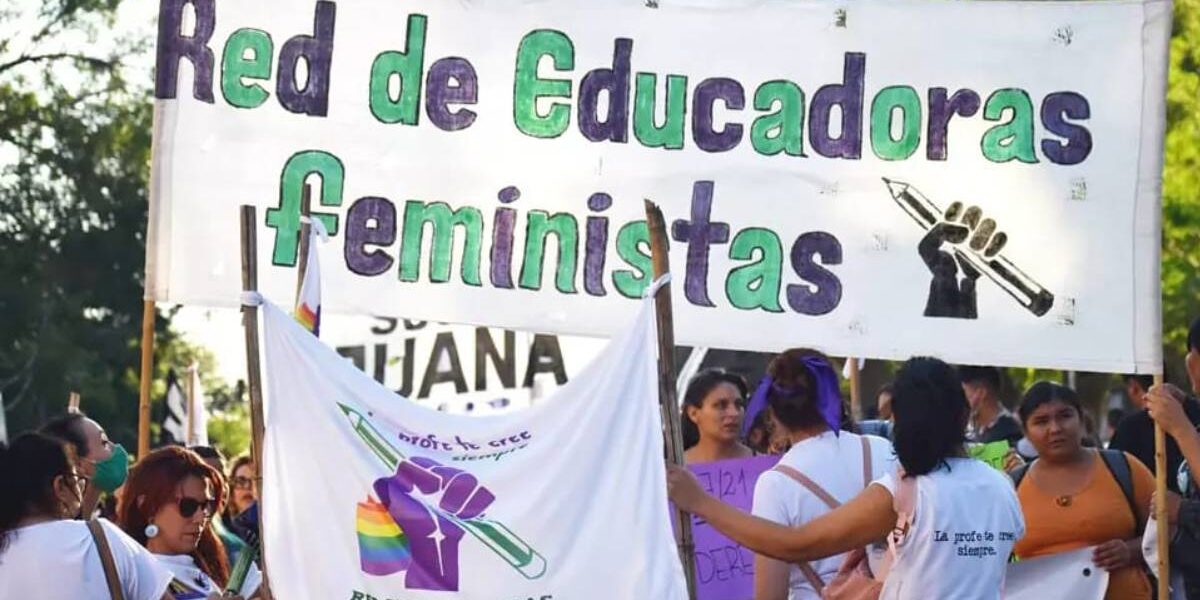
CHACO, Resistencia. With the slogan "There is no alternative Comprehensive Sexuality Education (CSE), there is only one CSE," the Network of Feminist Educators (REF) , the Chaco CSE Front, and LGBTQ+ collectives oppose a resolution by the provincial Ministry of Education that authorizes a Comprehensive Sexuality Education (CSE) "based on values" and "alternative" to that established in National Law No. 26150/2006, which established the National Comprehensive Sexuality Education Program .
For teachers' and LGBTQ+ organizations, the law – issued on the eve of the November 14 legislative elections – is a "conservative and confessional advance" against the rights recognized in the law and related international treaties.
“APPROVE the implementation of Comprehensive Sexual Education programs based on scientific foundations and values from an alternative proposal of teaching, learning and training at all levels and modalities of the provincial Educational System aimed at teachers, students and families,” indicates article 1 of resolution No. 967/2021 signed by Minister Aldo Lineras on November 10.
On the 25th of that month, the resolution was ratified by Decree No. 2633/2021 of Governor Jorge Capitanich. Its preamble mentions international human rights conventions and declarations incorporated into national legislation, highlighting those that enshrine “the right to teach and learn, and to freely exercise one's religion.”
They also invoke Article 5 of National Law 26150/2006, which states that the national, provincial and municipal State must guarantee compliance with the National Comprehensive Sexuality Education Program, but "each educational community will include in the process of developing its institutional project, the adaptation of the proposals to its sociocultural reality, within the framework of respect for its institutional ideology and the convictions of its members."
“Thank God” (and the governor)
The decree by the Chaco government was celebrated by religious sectors that oppose the national ESI law and resist its teaching in their schools.
The pastors of the churches grouped in the Metropolitan Evangelical Council of Chaco (MEM) expressed in a statement: “From the Metropolitan Evangelical Council we express the support of all the organizations we represent, to decree 2633/21 signed by Governor Capitanich through which an alternative teaching of sex education is established with a scientific perspective and with family values.”
On the MEM Facebook page, a flyer proclaims: “I choose Comprehensive Sexuality Education (CSE) with values – Decree 2633 – Province of Chaco.” On the wall of one of its members, Miguel Giménez, a representative of the Schools of Life Foundation, the gratitude was more explicit: “The governor kept his word. Resolution 967/21. CSE respecting institutional principles. God never stops loving us.”
“It benefits the fundamentalist evangelical sector”
From the REF , they stated that "the national law is clear in content and objectives, so no other instrument is required that generates confusion."
In a statement, they denounced: “ The intention of this latest decree is to allow the introduction of another, non-comprehensive, sex education, to the detriment of the rights of individuals, for the benefit of a particular sector , the fundamentalist evangelical sector, which has been striving for years to enter educational institutions.”
, a member of the Network and an educator, warns that with the resolution turned into a provincial decree, evangelical and Catholic churches "will be able to have influence in teacher training, of course in religious schools but even in public ones."
The teacher points out that article 3 authorizes "the presentation of Comprehensive Sexual Education training projects with scientific foundations and based on fundamental social values."
Coronel explains to Presentes that this new regulation “undermines the comprehensiveness” of comprehensive sex education: “The scientific and values-based cuts made in the resolution and decree leave out the gender perspective and attention to diversity. In reality, these sectors take science as something biological, male and female, that's what science is for them. And by not having a gender and diversity perspective, they leave out everything LGBTQ+, for example.”
People from Chaco want comprehensive sex education.
With more than 400 institutional and individual endorsements, the REF presented petitions for the annulment of decree 2633, which ratifies resolution 967/21, to Governor Capitanich on December 2, to Vice Governor Analía Rasch Quiroga on December 20, and to the Provincial Chamber of Deputies on December 22.
In the respective documents, they state that "a decree cannot go against the Law."
The instrument in question is “unconstitutional and arbitrary ,” since it “fails to comply with international regulations, to which our country adheres as a State party, national and provincial laws, regarding a block of rights that includes the Comprehensive Sexual Education Public Policy (National Law No. 26,150 and Provincial Law No. 1,502-E).”
“They deny gender and diversity”
According to Miguel Szabó, a teacher, union activist, and spokesperson in Chaco for the organization One Hundred Percent Diversity and Rights , “by talking about an 'alternative,' they are opening a window for these ultramontane, conservative, and very patriarchal sectors to have the right to say: 'We teach Comprehensive Sexuality Education (CSE) the way we want.' In other words, churches will have the opportunity to train their teachers in an alternative CSE that denies the gender perspective, diversity, or sexual dissidence.”
“The values of Comprehensive Sexuality Education (CSE) are related to respect: respect for decisions, respect for the body, respect for others… A whole series of values that are enshrined in the law and in the materials. This resolution, by speaking of values, allows for the inclusion of religious values that are not within the law, because the law is based on freedom and scientific foundations. If an alternative CSE is allowed, myths, prejudices, legends, and issues that are not scientifically grounded come into play,” Szabó adds.
With faith placed in the ballot boxes
Feminist and LGBTQI+ organizations believe that Resolution 967 had an electoral purpose that allowed the ruling party to reverse its defeat in the PASO primaries, when the Chaco Cambia + Juntos por el Cambio alliance won with 44% of the votes against the 35% of the Frente de Todos.
In the legislative elections of November 14, the Frente de Todos obtained 44.12% in Chaco against 42.92% for Chaco Cambia + Juntos por el Cambio.
“It’s not publicly stated, but these sectors copied the Latin American context. We can’t ignore that in Brazil, Jair Bolsonaro came to power thanks to ultramontane groups, but even more so thanks to evangelical groups, which have a lot of power in that country, and are now gaining power in the Chaco region . These pastors pressure and instruct their followers to vote,” Szabó maintains.
“Those of us who have been involved in teaching and union and social politics for many years cannot be naive. This decree gave these sectors free rein to continue advancing in a sphere that doesn't belong to them: the social and political. They are legally entitled to practice their faith and have their followers. The problem is when they impose that on the rest of society and try to force it,” Szabó stated.
“The decree validates this action against the rest of society. Society is not a large temple. Within society are those of us who prioritize freedoms, rights, and the free choice to have or not have faith. That is why we prioritize secular, free, and state-run education.”
A pact in exchange for support for their candidates
Furia Travesti Chaco Movement , opposed the resolution and then the decree of the “alternative” ESI , despite being the director of Diversity, Sexual Dissidence and Gender Identity of the Secretariat of Human Rights and Gender of the Province .
“From Furia Travesti, as an organization with a focus on gender, dissidence, and ethnic identities, we see this as a setback in terms of rights and an advance for the fundamentalist right,” Sabarece tells Presentes .
“The Comprehensive Sexuality Education (CSE) law has been in place for fifteen years, and we have been working tirelessly to ensure its implementation in all educational institutions, both public and those under public-private partnerships,” she states. “During these years, CSE has been a fundamental tool for young people and children, enabling them to recognize themselves and when abuse has occurred. It has also allowed them to discuss certain issues that are sometimes not addressed within the family. Schools provide a platform for these discussions, preventing the normalization of abuse and aggression in childhood.”
What could happen with this resolution in schools in Chaco?
According to the activist and official, there are very few schools in the province where teachers implement Comprehensive Sexuality Education (CSE) or carry out teacher training with the support of principals and supervisors.
“We are very concerned, especially when we go to the more remote towns of Chaco and see that Comprehensive Sexuality Education (CSE) is not being taught. We must defend it and fight for it. At Furia Travesti, we are worried and prepared for the possibility that at some point we may have to take to the streets or be present—as we always are—to wage this cultural battle in all schools. Together with the students, who are a fundamental pillar.”
Sabarese was not consulted regarding the resolution and the subsequent decree. “ There was no consultation. At least, not with us in the department, and I don't think with the Undersecretary of Gender, Diversity and Dissidence, Delia 'Choni' Pérez, either, because when we found out we were extremely outraged,” the official recalls.
“The governor’s actions don’t surprise me personally, because I know his ultra-religious Catholic stance and that he aligns himself with all the other right-wing religions. What did surprise us was that the minister issued this without consulting the organizations and the teachers. In my opinion, I understand that this resolution and decree were requested by religious organizations that wield a lot of power and money, and that behind this there is a pact in exchange for support for their candidates .
With a gender and diversity perspective
Law 26150 establishes that “all students have the right to receive comprehensive sex education in public, state-run and private educational establishments in the national, provincial, Autonomous City of Buenos Aires and municipal jurisdictions. For the purposes of this law, comprehensive sex education is understood as that which articulates biological, psychological, social, affective and ethical aspects” (Article 1).
To that end, it creates within the Ministry of Education, Science and Technology the National Comprehensive Sexual Education Program (article 2), whose development of curricular guidelines “will be advised by an interdisciplinary commission of specialists in the subject.”
Meanwhile, Resolution 340/18 of the Federal Council of Education states that Comprehensive Sexuality Education (CSE), addressed in specific spaces and/or in a cross-cutting manner, must consider five conceptual axes: “taking care of the body and health; valuing affectivity; guaranteeing gender equality; respecting diversity; exercising our rights.”
However, for feminist and LGBTQ+ organizations, the weakness of this law lies in Article 5, which, based on the "institutional ideology" paradigm, allows private religious schools to raise a kind of conscientious objection against Comprehensive Sexuality Education (CSE). "That's the trap, and that article is something that will have to be reviewed in the future," they agree.
We are present
We are committed to journalism that delves into the territories and conducts thorough investigations, combined with new technologies and narrative formats. We want the protagonists, their stories, and their struggles to be present.
SUPPORT US

FOLLOW US
Related notes
We are present
This and other stories are not usually on the media agenda. Together we can bring them to light.