

Nasa woman, caretaker of the territory and weaver of life
The women of Cauca, Colombia, are supporting the liberation of Mother Earth. The story of struggle and organization shared by Flavia Largo, a leader in her community.


Share

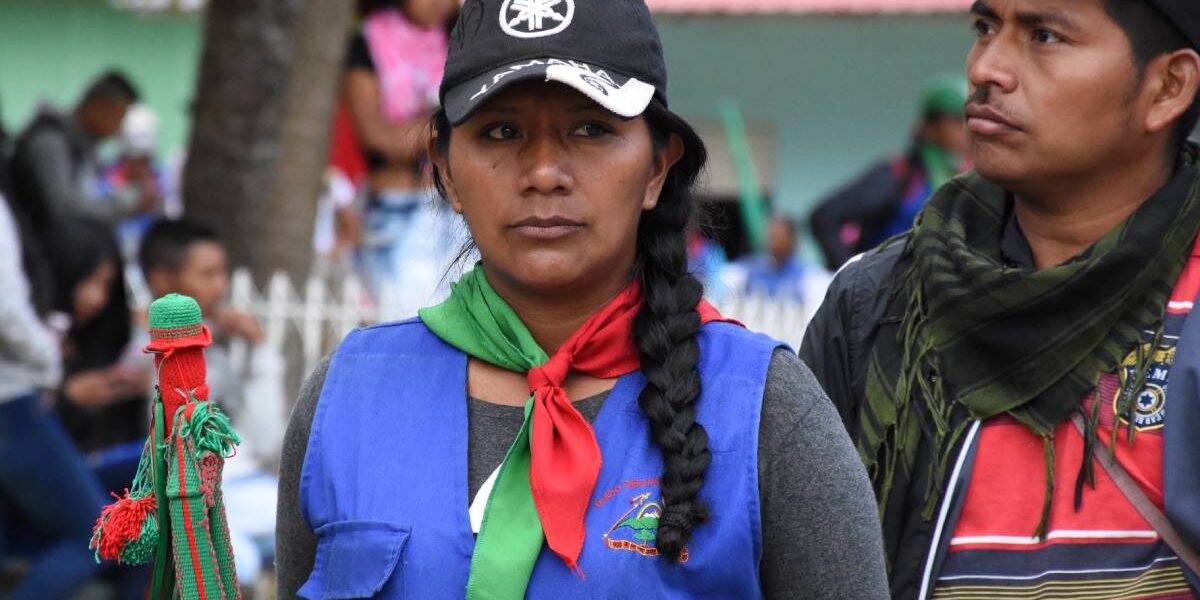
COLOMBIA, Bogotá. Indigenous women of the Nasa people , in southwestern Colombia, guide and accompany the community process they call the liberation of Uma Kiwe (Mother Earth in the Nasa Yuwe language).
For them, it is the struggle that seeks to heal their territories from everything that sickens and enslaves them, such as sugar cane monocultures, illicit crops like marijuana and coca, and the different actions of armed groups, both legal and illegal.
One of those women is Flavia Largo, 35, who, from her work as Kiwe Thegna (indigenous guard) in the Nasa Reserve of La Cilia La Calera, located in the municipality of Miranda , department of Cauca, ensures that the mandate of the communities to protect, conserve and free the spaces of life for the harmony and balance of Mother Earth is fulfilled.
“Kwe'sx Uma Kiwe wêth wêth ûsja'dame' kwe'sxpa wêth wêth fxî'zeya ewumedkha'w (As long as our Mother Earth is not free for life, neither are her children free),” says the declaration made in 2005 by the Nasa people and the 22 indigenous reserves located in northern Cauca.
In that declaration they opted to recover lands from farms and estates, which according to the stories of their ancestors, were taken from them since colonization.
Another mandate of the community, according to Flavia, is to reject the actions of legal and illegal armed groups in their territories, as they did with the former FARC guerrillas, the Revolutionary Armed Forces of Colombia.
The liberation of Uma Kiwe continues in 2021. According to Flavia, her territory is currently experiencing “disharmony” due to new armed groups vying for control of drug trafficking routes , as has also been publicly denounced by the Association of Indigenous Councils of Northern Cauca, ACIN , and warned about by the Ombudsman's Office with early warnings, including 007 of 2021, which reported on clashes between the public force and a “dissident faction of the Dagoberto Ramos Mobile Column, of the former FARC”, in indigenous reserves in Caloto and areas of northern Cauca.
Furthermore, the communities continue to reclaim their ancestral lands. “Our work consists of being Kiwe Thegnas. Women, men, boys, and girls all care for the territory and free it from all the disharmonies that sicken it,” says Flavia.
In the Nasa reservation of La Cilia La Calera, there are 110 Kiwe Thegnas, and of those, 55 are women. In the 22 indigenous territories, there are 2,600, of which 1,240 are women, including girls, young women, and elders, according to data from the Association of Indigenous Councils of Northern Cauca (ACIN).
Process of liberating Mother Earth
Flavia explains that the Nasa people have many ways of freeing the land. One is to let the areas where rivers and streams originate "rest," that is, not to cut down trees or cultivate them; "there we must plant more trees and take care of the water."
Another way is to defend the territory from political and operational positions. According to Flavia's account, the Indigenous guards carry out "territorial control" work; as she explains, this is the control they exercise on the roads and paths of the reservation to prevent the presence of illegal armed groups.
“It is a process that we are pursuing very strongly regarding the issue of armed groups, and as women we have said no more, because it is our children who are being taken to war, it is our children who are being killed.”
They also support the "land liberation" families with mingas, or collective work projects. These are the families who have "recovered" the farms and estates that, according to traditional Indigenous authorities, were invaded by the sugarcane agribusiness for its monocultures. The farms are located in the Corinto and López Adentro Indigenous reserves ( municipality of Corinto ) and Huellas ( municipality of Caloto ).
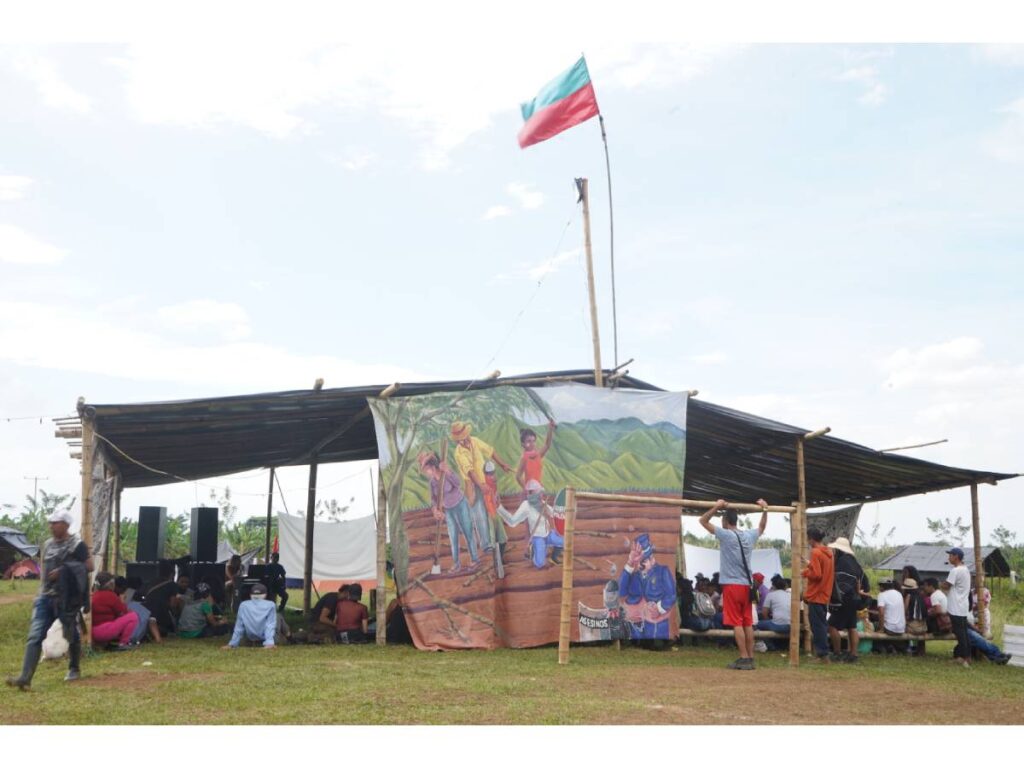
Photo: ACIN Communication Network.
For the national government, this last way of recovering the land is to occupy it illegally, which is why there have been evictions and clashes between indigenous communities and the Police, as Oveimar Tenorio, coordinator of the Kiwe Tegnas of the ACIN, explains.
“The land is not ours, we are part of it and that is why we have proposed to carry out the process of liberating Mother Earth, which is not only about going to cut down the sugarcane and confronting the ESMAD (Mobile Anti-Disturbance Squadron) but a political, cultural and social process,” Oveimar emphasizes.
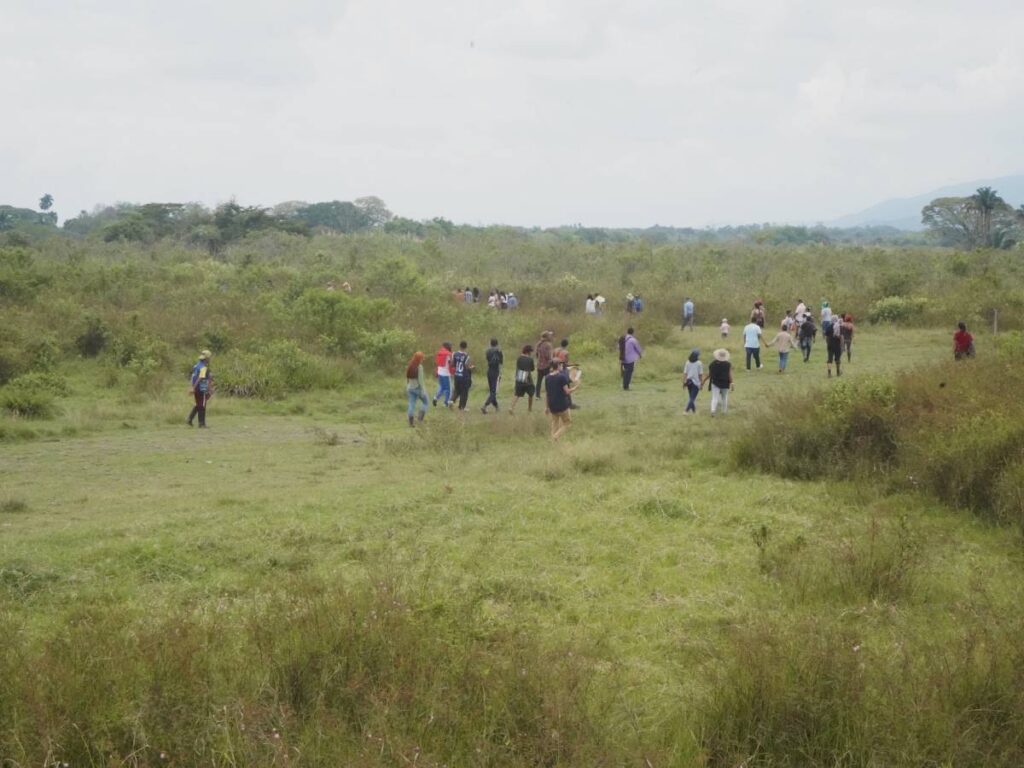
Photo: ACIN Communication Network.
Between 2005 and 2019, 14 "community members" (indigenous people) died in the struggle for the liberation of Mother Earth and in social mobilizations, according to data provided by the ACIN's Tejido Defensa de la Vida y los Derechos Humanos (Weaving Defense of Life and Human Rights) program..
For Nasa women, liberating Mother Earth also means returning to their roots and reclaiming their cultural identity. Therefore, they are recovering knowledge such as their native language, Nasa Yuwe, music, weaving, and gardening (or tul), in order to move towards the dream of autonomy called Wët Wët Fxincenxi (Good Living).
In strengthening these customs, they play a very important role because they are considered weavers and transmitters of traditional knowledge and customs.
Regarding the role of the female guard, who also wields the chonta staff, which represents authority in the territory, Oveimar highlights Flavia for her leadership.
“Our colleague Flavia has been one of the driving forces behind this space, accompanying the processes at the release points and also providing guidance from the community and family, carrying that voice of awareness and leadership,” she says.
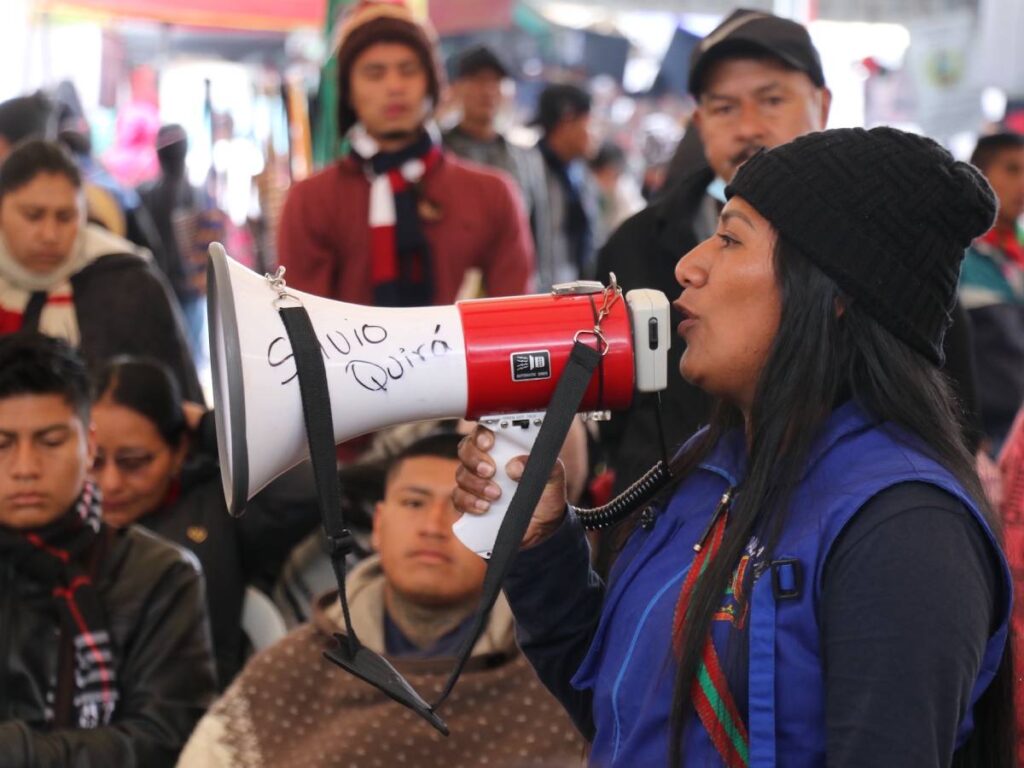
Photo: ACIN Communication Network.
Uprooting and return
The struggle of women to heal Mother Earth also involves caring for their families and children and healing their bodies and minds.
The indigenous Nasa people have been spoils of war, have suffered displacement, recruitment and humiliations, the latter considered “disharmonies” and damages against the territory.
Flavia narrates her life experience, since from a very young age she has had to face the realities of the armed conflict that Colombia has suffered for more than 50 years.
Her words allude to her origins. First, she mentions that her umbilical cord is planted in the warm lands of her reservation in Miranda. In the Nasa people's culture, the umbilical cord of children is planted at birth in their territory as a way to ensure they never leave it and always remain connected to Uma Kiwe (Mother Earth). Then she speaks of her family, which consisted of her father, her mother, four sisters, and two brothers.
Her childhood memories are sad. Flavia recounts that in 1997 her family's financial situation was quite difficult, and despite her age, 11 years old, she was aware of it. Therefore, she decided to leave in search of a job that would allow her to financially support her family.
“I saw that my mom and dad had enough money, so all I did was drop out of school and go to work. I left home when I was 11, and that's when I started working; first in a nursing home taking care of an elderly woman, then I went to work for a family where I did domestic work. The little I earned was from helping out,” Flavia recalls.
He spent a year (between 1997 and 1998) away from his family and his homeland. Upon returning, he encountered an unexpected situation.
“The year I returned, I realized my brother wasn’t there. I always asked about him, but they never answered. Later, I found out he had joined the armed group (the FARC guerrillas) because of the hardship my sisters were going through, sometimes there was enough for one and not for another.”
She also recounts that her love for her family, at the age of 12, led her to go out and look for her brother.
“It was a very difficult decision, because it wasn't just a matter of saying, 'I like it, so I'm leaving.' I think my goal was to find my brother, so I didn't think twice. From then on, I got involved with the armed groups. It was a bad experience. I was there for eight years, which were lost, but I learned to be a woman, I learned to value myself, and that's what I understand now. I was a different woman. I found my brother three years later; he was a nurse there. I stayed with that group for eight years, then I asked to leave, and I was fortunate enough to get it. My brother, however, stayed and died in a minefield.”
This situation completely changed Flavia's life, allowing her to see a path: to return to the territory to help change the reality that had taken her away from her homeland.
At 20 years old she returned to her refuge, to the same place where her navel is planted, as she says, to "put down roots again".
However, he encountered many obstacles there, the first being his family.
“It’s complicated at first because you’re a complete stranger in your own home. They see you as different, they push you aside. I experienced that, and from there I learned that we often say family is everything. But there can be situations where that’s not true, where it’s your own family that turns its back on you. About 15 years ago, I left that group (the armed group), and it hasn’t been easy to win back my family and for them to trust me again. I haven’t had the chance to sit down and explain everything to them,” she says, her voice breaking, her gaze fixed on her restless hands.
Back in her homeland, Flavia decided to participate in various activities within her community. She became captain of the soccer team, president of the village sports committee, and finally, Kiwe Thegna (a community leader). It was in this last role that she found her true mission: to "liberate the land" and, in particular, to protect children from forced recruitment.
“When I returned to the territory, I did so with a different mindset, a different vision for those children. I always said that I wouldn't want to see a nephew or one of my children in that place because I lived through it and being there is very hard,” he says while touching his long black hair.
The communities had to learn to look at Flavia from her experience as a fighter and caretaker of Mother Earth and not from her past.
“Our colleague, like everyone involved in the process and in society, has been a victim of the armed conflict and the social conditions we live in today in the territory. She was part of the former FARC, but after a period of reflection, she reintegrated into the community and began to do more political work by supporting the communities of Miranda,” says Oveimar Tenorio.
Many people judge her and criticize her leadership. However, that doesn't stop her on this path of defending life and territory.
“When I started in the guard, I felt very discriminated against (…) and when I sit down to talk to the community, I tell them that here it doesn’t matter who is who, because in the guard we live through a very complex situation. For example, one of us (in my case) was a guerrilla fighter, another was a soldier, but here we are, because in one way or another we have tried to come and change that scenario that we were part of and that we don’t want others to experience. We want to see this really change.”
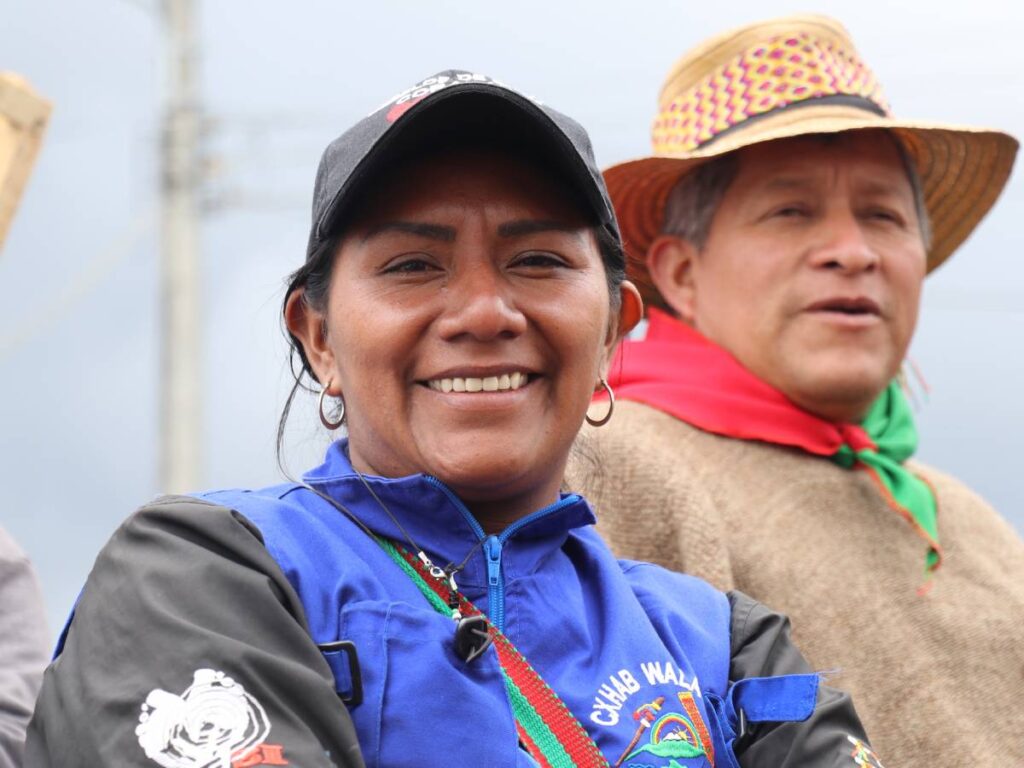
Photo: ACIN Communication Network.
The questions
As a result of so many accusations within her shelter, Flavia or Fabi, as she is affectionately called, began to question the process she was leading.
“At that time I would say, ‘Is this not my path? Am I wrong? Can’t I teach the boys to look beyond and try to prevent them from taking that space?’”
These were the questions that constantly ran through Flavia's head, painfully stirring up memories of her childhood, but reaffirming the dream of freedom for which she had started a new life.
According to Flavia, this change also came after two of her nephews, a 13-year-old girl and her 15-year-old brother, disappeared after joining an illegal armed group, a situation that led her to fully integrate herself into the Kiwe Thegnas process.
The call of others
Flavia is the first woman to reach the coordination of the indigenous guard in her territory, a rather big challenge, also because she has felt the machismo that exists within the communities themselves.
At the beginning of his appointment, several men disagreed, but despite all the fear, he decided to accept the call of the community assembly.
“The day it was my turn, I simply said: if you want me to accompany this process, I will. I know I'm not the perfect woman for this position, but you learn from your mistakes, and here in this scenario is where you have to give it your all,” she says.
“In 2019, she was appointed coordinator of the indigenous guard in the Cilia La Calera territory, and she began a process of youth participation and women's empowerment. We highlight her work in convincing many women to participate in this organizational process ,” Oveimar Tenorio points out.
She currently accompanies 60 Kiwe Thegnas women from the ACIN's Tejido Mujer program, a space for political and human rights training.
Flavia, a mother of two (a 13-year-old boy and a 5-year-old girl), has dedicated herself to learning about the struggle of the Nasa people, and accompanies women, emphasizing the importance of maintaining communication with their sons and daughters and, above all, not being afraid to confront armed groups in defense of their children, since they "did not give birth to their children for war."
“I always tell the girls not to be ashamed to speak up, even if it’s just to say their name, because that’s where the process begins, that’s where you start to see what each person’s capabilities are. All women have a beautiful strength,” she reflects with a smile that lights up her face.
Flavia is aware that her work involves risks. In June 2021, the ACIN's Tejido Defensa de la Vida y los Derechos Humanos (Weaving Defense of Life and Human Rights) program issued a statement informing the public about threats received by coordinators of the indigenous guard and authorities in the northern Cauca region, including Flavia.
“Our colleague had to travel that same night from her home to the town center of Miranda. Our colleague Flavia had received threats in previous years, and just this week armed individuals had been seen loitering near her home,” the statement warned.
Despite all the intimidation, Flavia is not afraid and tirelessly, whether hungry or cold, she continues to travel the territory fulfilling her purpose of seeking the freedom of Uma Kiwe.
The struggle she fell in love with has its roots in the land, "in the dreams of freedom with which the elders opened a dignified path that seeks for all of us to return home (to the territory) and from there live beautifully and deliciously."
She will continue to tell her story as many times as necessary, to bring every boy and girl back to their communities. Her dream remains focused on recovering every child who has joined the guerrillas with a weapon and giving them a staff, so that they may rise up in defense of life and territory, and so that the land may be freed from all disharmony and harm.
“The community is our right hand as Kiwe Thegnas and gives us strength to continue defending our territory, and collectively we are going to make a change to transform all of this,” Flavia concludes.
Note. This story is part of the journalistic series Paths for Pachamama: Andean Communities in Reexistence!, and was produced in a co-creation exercise with indigenous and non-indigenous journalists and communicators from the Tejiendo Historias Network ( Rede Tecendo Histórias ), under the editorial coordination of the independent media outlet Agenda Propia .
We are present
We are committed to journalism that delves into the territories and conducts thorough investigations, combined with new technologies and narrative formats. We want the protagonists, their stories, and their struggles to be present.
SUPPORT US

FOLLOW US
Related notes
We are present
This and other stories are not usually on the media agenda. Together we can bring them to light.