

Excluded from education: other forms of violence against trans people in El Salvador
Without a gender identity law, transgender people cannot study with dignity. Their names are not respected on diplomas. Some don't even finish basic education because of the discrimination they experience in classrooms.


Share

San Salvador, EL SALVADOR . When Amalia Leiva managed to get the San Salvador education department to threaten to sanction the principal of the public school who wouldn't let her enroll in night school to finish seventh grade, the teacher—she says—used gang members to intimidate her. It was 2015, and Amalia was starting her life in the capital. Five years earlier, her family had kicked her out of the house for finding a makeup kit in her possession. Then, the life of that girl, who had spent her early years in Catholic schools and experienced her parents' economic hardship but always had their attention, changed.
Amalia recalls that her father threatened her from the United States because of the female gender identity she was discovering. Her mother turned her back on her. She sought refuge in her paternal grandfather's house, where she learned to cut sugarcane and became aware of the inequality faced by farmworkers. It was around this time that she also became involved in activism.
Away from home
Amalia had arrived in the city eager to study . Although it was April and the school year had started three months earlier, a teacher allowed her to fill out her registration form and resume seventh grade, she says. Things, she says, weren't easy from the first day: the school principal took her out of class under the pretext that she had registered late.
Amalia recounts that she filed a complaint with the education department , and when, with their support, she managed to get the principal to meet with her and the teaching staff to discuss the matter, he began by asking her if she believed in God. He again justified himself by saying that she couldn't study because she had registered after the deadline.
Amalia insisted on her right to enter the school and recounts that the principal snapped at her, saying he preferred gang members to study there rather than a girl like her..
The school's refusal
The meeting was recorded on Amalia's phone. She presented the audio to the education department, which sent the teacher a letter threatening him with sanctions if he did not admit her to the school. The letter cited Amalia's rights, which, according to the Constitution, the principal was violating. It specifically cited section 20 of article 56 of the Teacher Career Law, which considers it a very serious offense for a teacher to refuse admission to students for various reasons, such as social, racial, political, or "other" differences.
The principal, meanwhile, ended up taking her out of school with gang members, she says. The Human Rights Ombudsman's Office (PDDH) followed up on this complaint, but there is no legislation in El Salvador to protect her status as a transgender person.
Amalia, however, tried again to complete her seventh grade. This time through distance learning. At school, they tried to force her to pose for a photo with her hair tied up. She refused, and the school deleted all her information from the system.
“In El Salvador, Amalia only has a seventh-grade education. And I’m not ashamed to say it, because it’s a struggle that has brought me many rewards and many life lessons,” she says. Today she is an activist for the rights of the LGBTIQ+ population.
There is no progress on gender identity issues
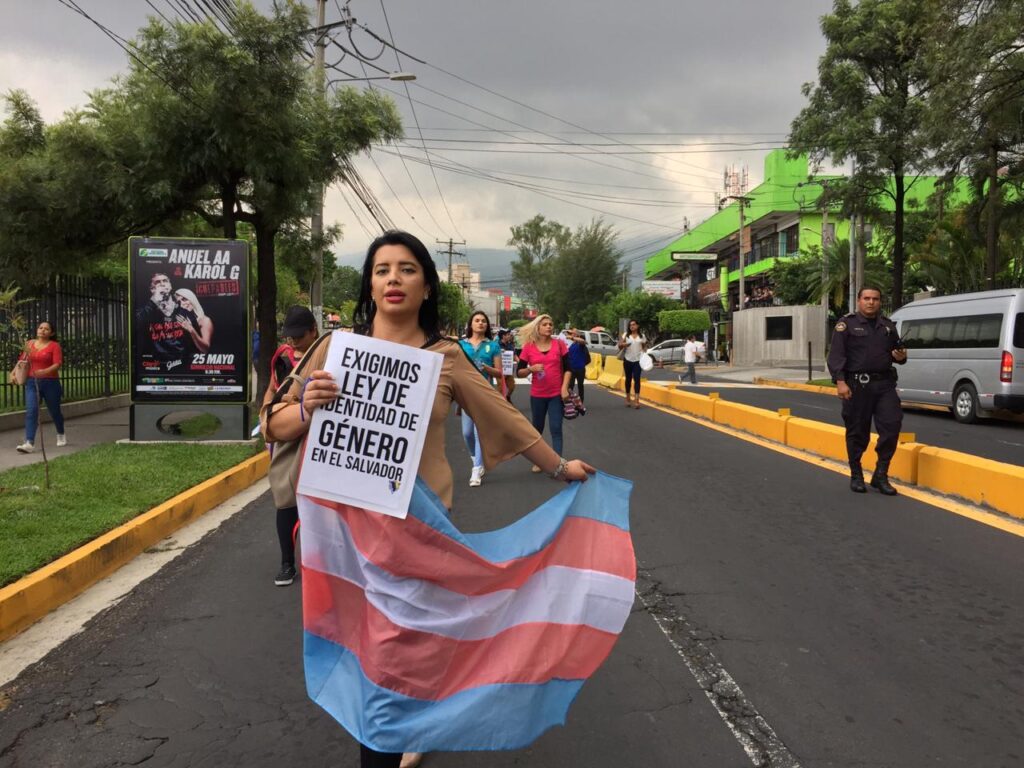
The LGBTIQ+ community lacks laws that protect its rights. The only legislative progress occurred in 2015, when members of parliament approved harsher penalties for threats and hate crimes in the Penal Code.
The Ministry of Education, Science and Technology of El Salvador (MINEDUCYT) has a Gender Unit and a gender policy, which is not disseminated to teachers, according to Amalia.
And in the case of universities, the University of El Salvador (UES, the state university) and the Central American University José Simeón Cañas (UCA) are the only ones that respect the right to identity of trans people, says the activist.
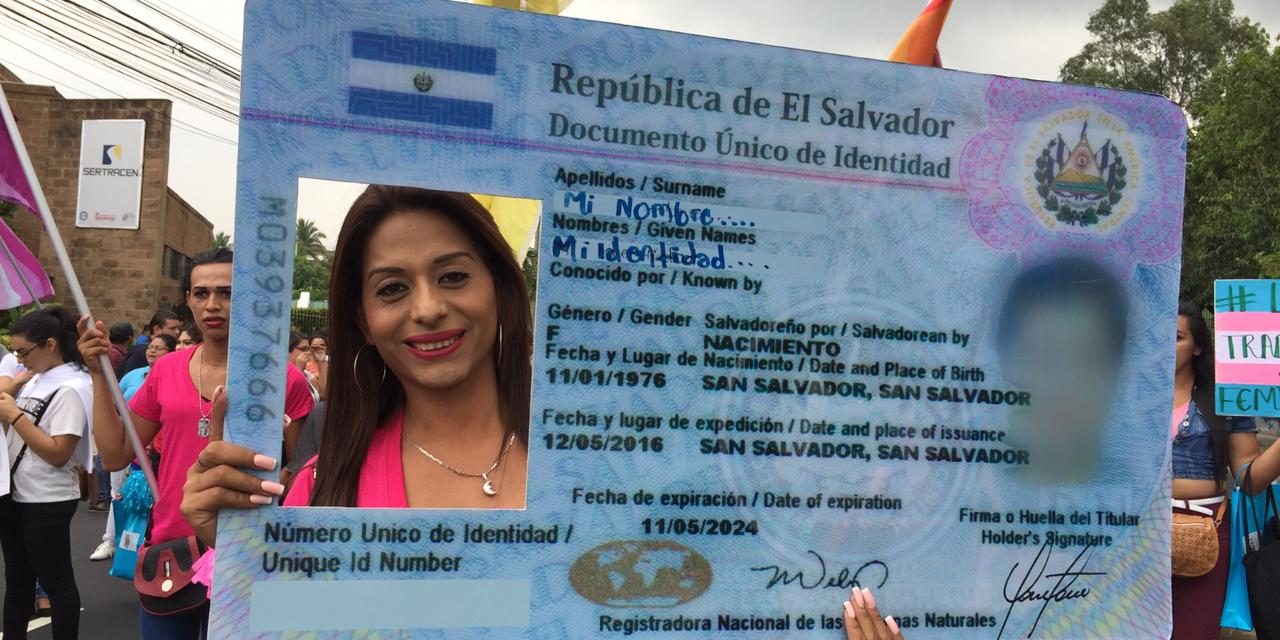
But these institutions, like all those in the public and private education system, can issue certificates of recognition with the name chosen by transgender people. However, they cannot issue degrees, because in the absence of a Gender Identity Law, transgender people, for the Salvadoran state, will continue to be referred to by the name on their official documents.
This year, the deputies of Nuevas Ideas, the party of President Nayib Bukele, shelved several bills presented by civil society, including the Gender Identity Law.
One of the pro-government members of parliament described them as “obsolete and out of touch with reality.” LGBTIQ+ organizations submitted another initiative last August, which has not yet been addressed.
The diploma yes, the degree no
Brenda Rosales is a sculptor who, in 2006, without having made her transition, graduated from the Fine Arts program at UE S and a few days ago was recognized by the university as one of its outstanding alumni and professionals.
The certificate of recognition bears his chosen name, but the university degree retains his name according to his identity document.
Rosales, however, considers this recognition significant because the university has acknowledged her gender identity.
The same applies to her workplace, the Ministry of Culture, where she has been allowed to use her employee ID card with her chosen name.
“It’s awkward to arrive at a place where people suddenly don’t even know how to address us, because they’re relying on a document. Many are ethical when it comes to asking how they want to be called. I admire their willingness, but others either don’t do it intentionally or don’t know how to address us,” the artist maintains.
Despite decree 56, there is still a lack of support.
Within the Ministry of Culture is the Gender and Diversity Unit, to which the Bukele government assigned the functions of the Secretariat of Social Inclusion, which he and his cabinet eliminated at the beginning of his administration in June 2019, and whose objectives included ensuring the application of Executive Decree 56.
This prevented discrimination based on sexual orientation, expression, or gender identity , and planned awareness talks on issues of sexual diversity for staff working in agencies belonging to the Executive branch.
Rosales is a Technician and Specialist in that unit, but in this interview she does not want to elaborate on the work of the agency, because she says she is new to the area.
Amalia points out that, of all the ministries, MINEDUCYT was the most reluctant to implement Executive Decree 56. Currently, the implementation of this decree is one of the most frequent criticisms made by LGBTIQ+ organizations, because it remains in effect, but the work of the Gender and Diversity Unit is not visible to the public.
Agencia Presentes requested an interview with those in charge of the Gender Unit of MINEDUCYT, but at the time of writing, there was no response.
Universities without policies against LGBTIQ+phobia
Danilo Ramírez is the unpaid director of the Center for Gender Studies at the University of El Salvador (UES). This university has a gender equity policy, but no gender unit. Next year, the policy will be updated to include actions in support of LGBTQ+ individuals.
Because of the fear of the LGBTIQ+ population to make their gender identity and expression visible in spaces that are not of their trust, these study centers do not keep a record of the number of diverse students they have.
According to Ramírez, the UES is still planning an internal census to count them, taking into account that one of the errors of the census would be that many prefer that their sexuality goes unnoticed.
Discrimination, a persistent evil
The First Situational Report on the LGBTI Population, published by the Human Rights Ombudsman's Office (PDDH) in 2017, indicated that 52.5% of trans women in El Salvador have received death threats or experienced violence. This is primarily due to transphobia, and secondarily, to extortion imposed by gangs on those who engage in sex work.
Given the lack of a protocol for addressing cases of discrimination, Ramírez mentions that what he does is accompany the victims to file complaints with internal university bodies.
But without protocols for action endorsed by university authorities, the complaints are shelved.
From the Center for Gender Studies, she says, they work on awareness training on issues of sexual diversity, which began with the teachers, students and administrative staff of the Faculty of Medicine , from where, at the time, they received complaints of discrimination from a trans girl who has already graduated.
University education
The UCA, for its part, internally respects the gender identity of transgender people: it allows them to take courses, diplomas, or workshops using their chosen name. Amalia is about to graduate from the university's School of Political Formation.
So far, the university has only received one complaint, from a Canadian trans woman who was unable to enroll in a program under her chosen name due to the lack of a Gender Identity Law in El Salvador. Ultimately, she had to register using the name that appeared on her official documents , explains Omar Serrano, head of the Vice-Rectorate for Social Outreach at this Jesuit university.
According to the academic, UCA includes non-discrimination among its “principles and values.” It does not have a Gender Unit, only policies against sexual harassment, workplace harassment, and discrimination, as well as ethics committees that receive complaints.
In cases of discrimination based on gender and sexual orientation, self-censorship occurs: people don't report the discrimination they suffer because they know their complaint will be fruitless , Serrano says. “I think one of the consequences of impunity is that people don't report it. I'm referring to all levels,” she points out.
Amalia's Path
Amalia is 25 years old and is about to publish a book of poetry. She continues her fight against the system that excluded her and has pursued courses, diplomas, and workshops of all kinds, from law to medicine.
She hopes to reach the age where she can go to the National Registry Center and have her poems registered under the name she has chosen.
But this is her decision: “I’m not going to live with a title that doesn’t reflect who I am. I know very well that if I don’t continue my education, the years will keep passing, but I’m prepared to die with dignity.”
We are present
We are committed to journalism that delves into the territories and conducts thorough investigations, combined with new technologies and narrative formats. We want the protagonists, their stories, and their struggles to be present.
SUPPORT US

FOLLOW US
Related notes


We are present
This and other stories are not usually on the media agenda. Together we can bring them to light.