

Cuesta del Ternero: Mapuche women explain why it is an ancestral reclamation
Indigenous women are a crucial part of the resistance in the Lof (community) Quemquemtrew. Chronicle of a territorial reclamation in Patagonia and a death foretold. A month later, they receive an eviction notice.


Share

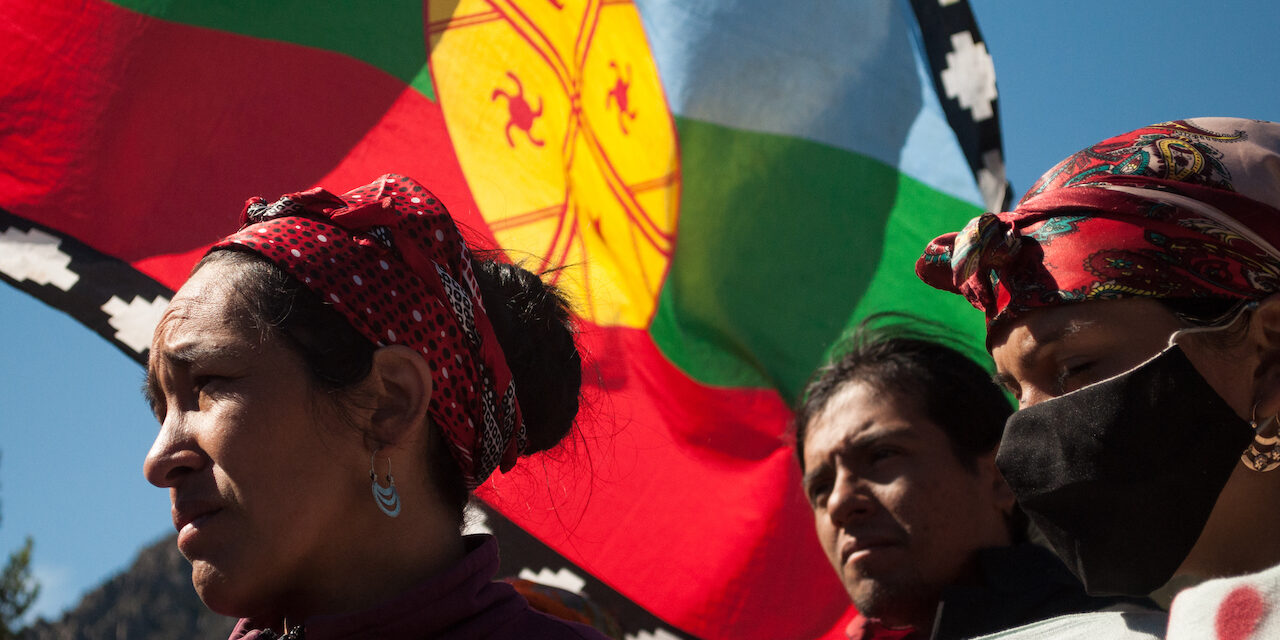
Cuesta del Ternero is a site in the province of Río Negro (Bariloche department) where, on September 18, the Mapuche people began a land reclamation effort. Since the Mapuche flag was planted, the Lof (community) Quemquemtrew has been in the news, first because the alleged landowner filed a complaint against them for trespassing. Then because police and judicial harassment escalated. And finally, on Sunday, November 21, two people shot two young men from the community. Diego Ravasio and Martín Feilberg are in custody and accused of murdering Elías Garay Yem and seriously wounding 25-year-old Gonzalo Cabrera.
Just when it seemed that, paradoxically, the death of young Garay would bring some relief to his community, on December 15, Judge Ricardo Calcagno reaffirmed the charges against the four community members for the crime of trespassing . He also upheld the precautionary measures restricting access to the property for two Mapuche women, Romina Jones and Ariadna Mansilla.
On December 16 , at a hearing requested by the plaintiff (Ernesto Saavedra, representing Rolando Rocco, who claims to be the landowner), the court ordered the forced eviction of the community by December 23. It was like starting from scratch, but with one person dead and another seriously injured.
On December 21, the one-month anniversary of the murder and in response to this order, the encampment supporting the Lof Quemquemtrew community was re-established. "We will not leave here until the eviction order is lifted. We ask for visibility and support for the territory. The struggle is one and the same; if we are not present in these territories, extractivism will continue to advance," stated the Indigenous Women's Movement for Good Living.
“We are not owners, but part of the land”
Cuesta del Ternero is reached via a dirt road that runs for fourteen kilometers from Route 40. On one side, the native forest remains burned by the wildfires that ravaged the Andean region a few months ago. On the other, pine plantations are nestled among valleys and mountains. This is Route 6, which connects El Maitén with El Bolsón.
“We are not ignorant, we know what we want. We are not terrorists, we are defending what our ancestors left us because they weren't given the chance. They were killed, burned, their tongues were cut out,” María Luisa Huincaleu, a 72-year-old woman Presentes. She is the mother of Gonzalo, the young man who was wounded on November 21st when two lead bullets struck him in the abdomen.
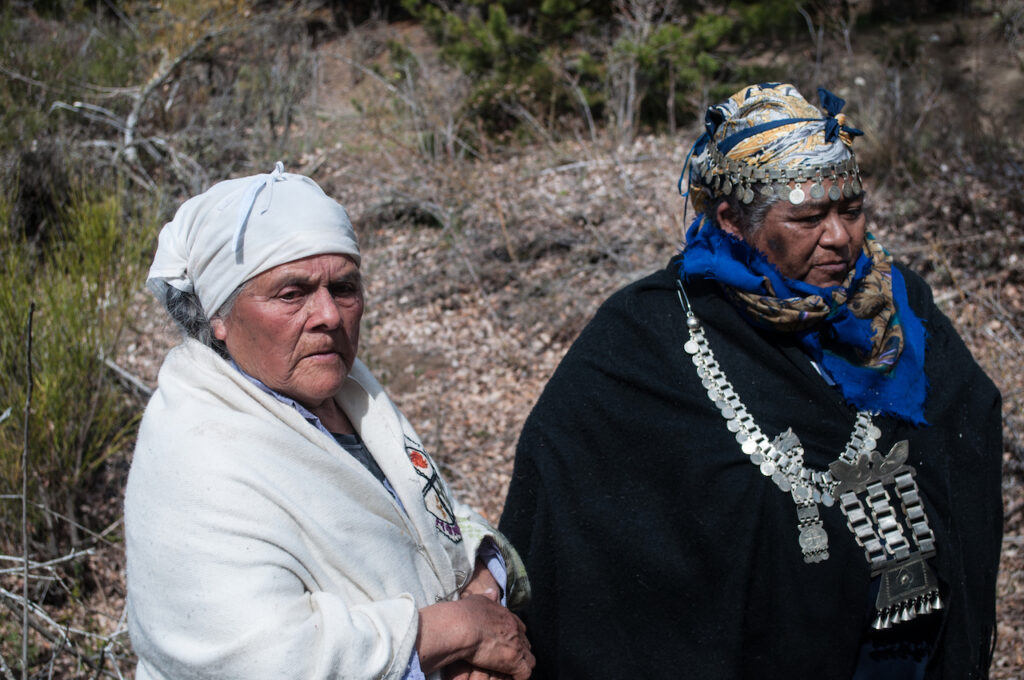
Maria Luisa was there at the Lof, just meters from her son, but they wouldn't even let her get in the ambulance with him to take him to Bariloche, where he remained hospitalized for weeks. In early December, Gonzalo's drain was removed, and he began to improve. As the days passed, he was discharged and started focusing all his energy on his testimony, which was crucial to the case investigating the murder of his friend Elias.
“My son came to Mapuche territory; he was building his house. This is a peaceful struggle that has lasted for years. But they are forcing us to react,” says María Luisa. She is a pillan kuse (she can officiate ceremonies), was born in Costa de Lepá (Chubut), and has her territory in Gualjaina , also in that province. She had traveled from there to Cuesta del Ternero with one objective: “To support all our brothers and sisters. It is a struggle for everyone. We are rising up, as our grandparents used to say. Since Chief Inacayal (who resisted the Conquest of the Desert) arrived in his territory, the kume (good people) began to rise up little by little.”
Why ancestral recovery?
In her voice and in the voices of other women werken (spokeswomen) and weichafes (warriors), the same historical demand is powerfully expressed, as is the strength of this resistance, which has maintained a camp for over three months. And it goes far beyond the Western idea of “land conflict.” “The State knows that the territories are ours by pre-existing right. My grandparents were driven from Junín de los Andes; we are not owners, but rather part of the Mapu,” says María Luisa .
The Lof Quemquemtrew had decided to return to that part of the Andean Region to reclaim their ancestral territory and live there as part of the land, as guardians and caretakers. María Luisa recounts that from the first day of this reclamation, the police cut off their ability to bring food and shelter to those camped there. They also blocked access to see them. “They had them surrounded and supposedly weren't letting anyone through. So how could these two criminals have come to 'hunt' them?” she asks.
This refers to what the two men accused of killing Elías and wounding his son said when they gave their statements to the court. They claimed they believed the Mapuche people were armed when they saw “a black shape,” and that they entered the property to see if they could “hunt some hares.”.
Chronology
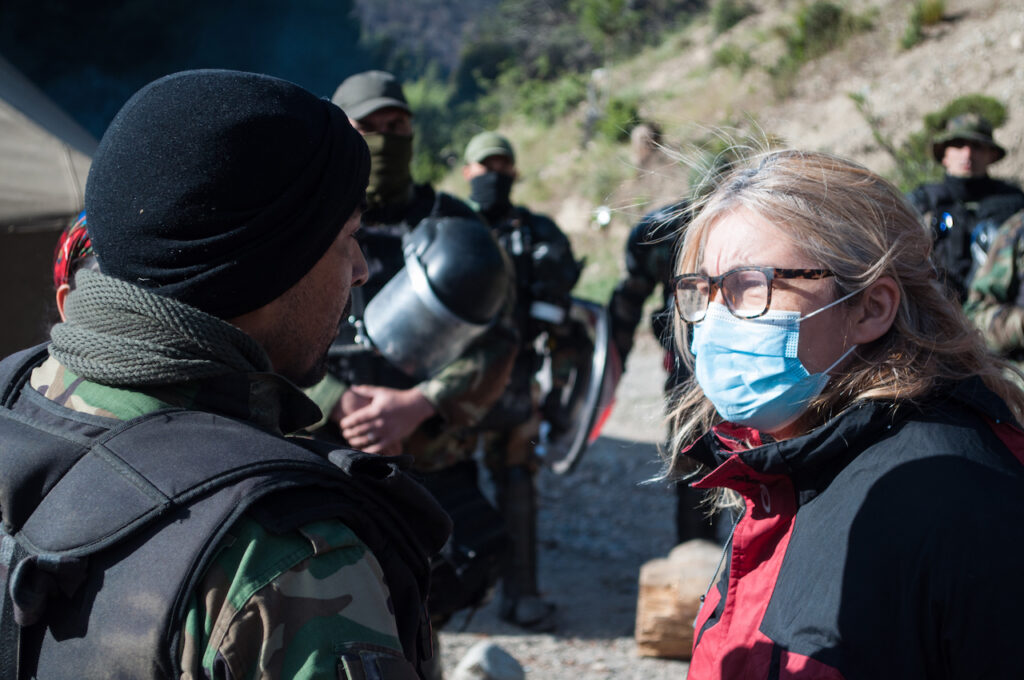
- The situation at the Lof Quemquemtrew solidarity encampment was tense from the very beginning, with police patrolling the area. Those who participated in this solidarity action said that at night, drunken police officers fired shots into the air, preventing anyone from sleeping. The women recounted that members of the COER (Regional Emergency Operations Center) followed them to the makeshift bathroom located outside the encampment, observing them. There wasn't a single woman among the uniformed personnel. Shortly after the land reclamation began, the community asked prosecutor Francisco Arrien, based in El Bolsón, to put an end to the police harassment.
- On Tuesday, September 21, Prosecutor Arrien held an exchange with the Lof. He committed to waiting for a trawun (meeting) of communities, after which the decision adopted jointly would be communicated on Monday the 27th.
- However, Bariloche's chief prosecutor, Betiana Cendón, requested an order from Judge Ricardo Calcagno to identify the individuals. This led to the violent eviction in the early morning of September 24, when fifty police officers entered the Lof. Members of the COER (Special Operations Group) and the Río Negro police participated in the operation, acting on orders from the court of Ricardo Calcagno, the same judge who had issued the eviction order days earlier.
- On November 28 , social organizations, human rights organizations (including Nobel Peace Prize laureate Adolfo Pérez Esquivel and the Permanent Assembly for Human Rights), and indigenous peoples formed a humanitarian corridor.
- Those who resisted the eviction were trapped, without food or clothing. A commission attempted to bring them supplies and shelter, but they too were besieged and repressed. The aid never reached its destination. In Patagonia, the bad habit of breaking promises made in agreements with the Mapuche is repeated.
Who claims the lands
Rolando Rocco is claiming ownership of those lands. He is the public face of a business network that obtained “a generous permit to exploit that property for 90 years, debt forgiveness, and non-reimbursable financial support for the clear-cutting of the native forest and the planting of pine trees,” as Gustavo Figueroa explains in Wallmapu, Journalism from Sea to Sea . Figueroa asserts that Rocco is claiming ownership of that area. And he made it clear: the land recovered by the Mapuche people does not belong to the Rocco family, but is state-owned land.
“Rocco has no title to the land; he has been seizing territorial spaces in Cuesta del Ternero for over 30 years. He only has a permit to plant pine trees,” said Mapuche spokesperson Soraya Maicoño. The Coordinating Committee of the Mapuche Tehuelche Parliament of Río Negro confirmed her statement, while solidarity organizations decided to camp a few meters from the police cordon.
In 2017, Soraya Maicoño was a spokesperson for the Mapuche land reclamation in Cushamen, where Santiago Maldonado disappeared and was later found dead. She is not speaking out again this time because of any "anarcho-environmental-Mapuche-terrorist" conspiracy, as some media outlets have stigmatized it, but because the Lof Quemquemtrew community needs an interpreter to bridge their worldview with that of the huinca (as they call the white invaders).
“At that time, the prosecutor gave his word that the police wouldn't intimidate or harass us, that they would wait for us, and that we would go to the conciliation hearing on Monday. However, the police were shooting at night, and finally, more than 50 officers entered, firing their weapons. They arrested three people (Alejandro Morales, Mauro Vargas, and Lautaro Cárdena), as well as a sister and her son, who was beaten and dragged by his hair.” Soraya describes the operation ordered by Bariloche's chief prosecutor, Betiana Cendón, supposedly to identify people on the “usurped” property. In reality, they confiscated all their belongings and left a permanent police cordon.
“We need territories suitable for living a life”
Romina Jones and her family were in their ruka (house) set up within the reclaimed territory on September 24th , along with her husband, who was arrested and charged with trespassing, and their 8-year-old son, Antu. She is the cousin of Facundo Jones Huala, the lonko (chief) of Cushamen, who is imprisoned in the Chilean jail of Temuco, after being extradited from Argentina at the request of the Argentine justice system. He is accused of starting a fire, which he claims he was never involved in.
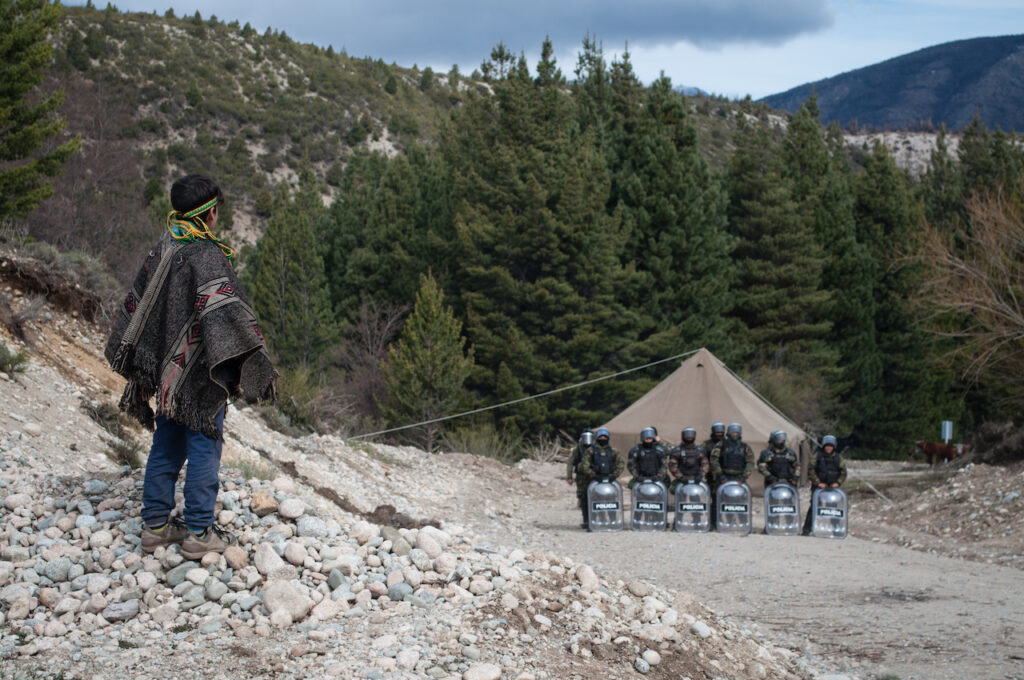
Romina recounts: “On the day of the eviction, they came in shooting and told us to get on the ground. They put a knee on my back. I wanted to say, ‘Never again,’ and that they should give us back all the land that was stolen.” The boy described the moment they dragged him by his hair and pressed his head against the ground so he couldn't see. His voice circulated on some websites along with the first statements from the Coordinator of the Mapuche Tehuelche Parliament of Río Negro.
Romina recalls that in that violent operation they took all her belongings: blankets, mattresses, coats. “We are not criminals. We are fighting for what was stolen from us more than 130 years ago, and the Argentine state and the provincial governments have never taken responsibility. We have to take direct action to return to our lands and reclaim them. They are not in the hands of a poor farmer with a few animals, but of a powerful group,” she says.
“We stand firm. We are guided by our ancestors, the forces of nature, and many people from different communities who have come to support us and give us newen (strength),” says Romina Jones.
“We learned their language, their laws. Let’s sit down and talk; we have so much to say. They don’t want to. They have a historical debt to the Mapuche people that they have never wanted to pay. Because our grandparents died knocking on doors to demand the return of their territories, suitable and dignified. Not a rocky wasteland, a sandy wasteland where not even a blade of grass grows. We need territories suitable for living and raising our children in contact with nature.”
Elias Garay and Rafael Nahuel: the plans of two murdered young men
Romina Jones had been arrested and injured in the mouth by a rifle butt during the repression on July 31, 2017, in Bariloche, the day before Santiago Maldonado disappeared in Cushamen. “We remain firm in our convictions; this isn't just a recovery by chance, it stems from our spiritual need,” she says.
When Mapuche women, mothers, and fellow activists reconstructed this story, they mentioned that a similar episode occurred in the Lafken Winkul Mapu community of Lago Mascardi, where four years ago the young Mapuche man Rafael Nahuel was murdered. It happened during an eviction operation where children, women, and the young machi (a traditional healer and spiritual authority in the Mapuche worldview) Betiana Colhuan were arrested. The police also forced her to eat dirt.
Both Elías and Rafael Nahuel were going through a process of recognizing themselves as part of the Mapuche people. They wanted to build their ruca (house) on reclaimed territory where they could connect with Mapu, Mother Earth, something impossible in the cities.
“We are alive, we are not the past”
In Cuesta del Ternero is School 211, an intercultural school that has been converted into a police outpost. “Our Mapuche people used to live there. We’ve known for years that a community is going to be established, that our leaders are returning. We are alive, we are not the past. We want to farm, raise our animals, be well psychologically, spiritually, and emotionally, and raise our children as the people of the land that we are,” says Ariadna , from the Pu Folil community in Comodoro Rivadavia, who was at the encampment to show solidarity.
Beside the nylon tents, poles, and flags, adorned with dreamcatchers made of willow branches, logs were stacked for firewood at nightfall. Nearby flows a crystal-clear stream, but its waters are undrinkable because sewage from the military outpost flows into it. From the encampment, a small Mapuche flag can be seen atop the hill, marking the site where the peñi and lamien (brothers and sisters) resist. Each day, they come down to receive support from their families and other compassionate individuals. Among them are a history teacher from Epuyén, a member of the Assembly for Water and Land, and a yoga instructor who survived the dictatorship. They seek to break the silence, approaching to donate fruit, water, or a piece of plastic sheeting, in the Patagonian spring that alternates windy, snowy days with sunny afternoons.
“The governor of Río Negro, Arabela Carreras, is anti-Mapuche. The prosecutor and everyone else broke their word. We can’t leave until they demilitarize the area. If we leave, we shouldn’t complain when there’s another death. I don’t want any more Santiago Maldonados or Rafael Nahuels,” said Claudina Pilquiman , a member of the Mapuche community of Cushamen, days before two men shot Gonzalo and Elías. Her words proved prophetic in the camp, where most of the residents are women. They prepare water for mate and bake fried cakes in a clay oven, while chatting amongst themselves and with visitors.
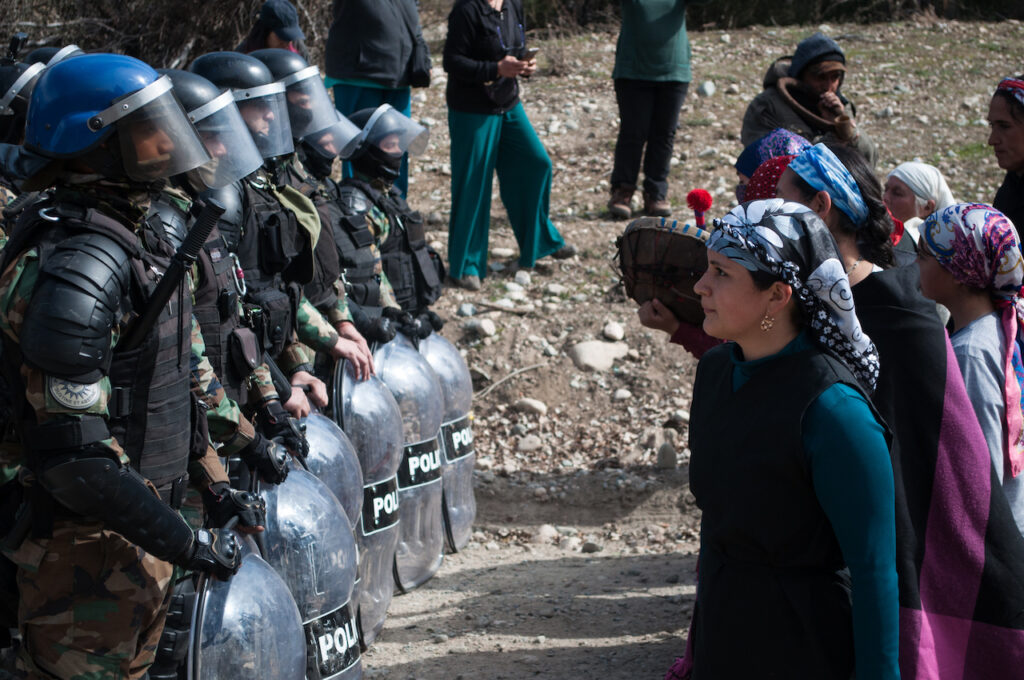
The few men wear hoods to avoid being criminalized. Antú and other boys are playing ball. The school van had to pass through two police checkpoints. Antu is escorted by the police when he goes to school. The Gendarmerie officers who patrol the streets of El Bolsón are not friendly either, and they bring back bad memories.
Between October and November, in the midst of the election campaign, arson attacks occurred in the area, and provincial authorities—led by Governor Arabela Carreras and the mayor of El Bolsón, Bruno Pogliano—attributed them to the Mapuche people, without presenting any evidence to support the accusation. These attacks served as a pretext for Governor Carreras to request that the national government send federal forces to combat the alleged “terrorist acts” of the “Indians on the attack,” as they were dubbed by the program Periodismo para Todos (Journalism for Everyone) on Channel 13 in Buenos Aires.
Chronicle of a Murder Foretold
On November 21, a few hours after the tents were taken down but while the COER (Special Operations Group) and provincial police were still present, a drone flew over the Lof (Mapuche community). Shortly after, two men appeared, claiming to be hunting. Elías and Gonzalo approached them to tell them they couldn't advance any further, and the men opened fire without warning. The provincial government insisted that the local police were not involved in the incident but did not explain how the attackers entered the area, which had been under guard for almost two months. Elías died almost instantly from point-blank shots. His friend survived.
“When I arrived at the hospital, Gonzalo had already undergone surgery, but his memory and his mind were working. He saw who shot him, and another man saw him too,” María Luisa recounts in a video filmed by Sergio Maldonado, Santiago’s older brother. Doctors at the El Bolsón hospital told her that her son had a perforated stomach and part of his intestines.
On Tuesday, November 23, a caravan of vehicles set out for the hill where Elías's body lay, following an alleged agreement between judicial and police authorities and human rights organizations. Members of Indigenous communities had requested the withdrawal of uniformed officers. The young man's family made it clear: the funeral procession would not cross any checkpoints.
The young man's body lay for three days in the same spot where he had been murdered. “We are going to pass because it is our right. Kill us, there is a decomposing body. There is a mother crying. You are always at the service of foreigners, you rape and murder our people!” shouted Moira Millán and other Mapuche people standing in front of the police cordon that prevented them from advancing.
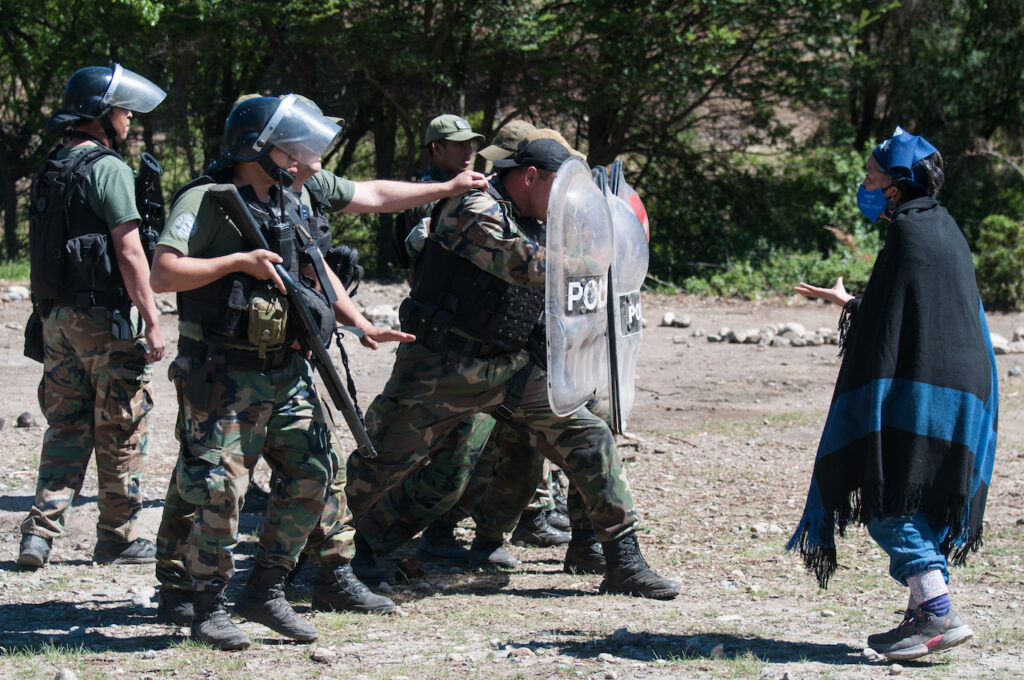
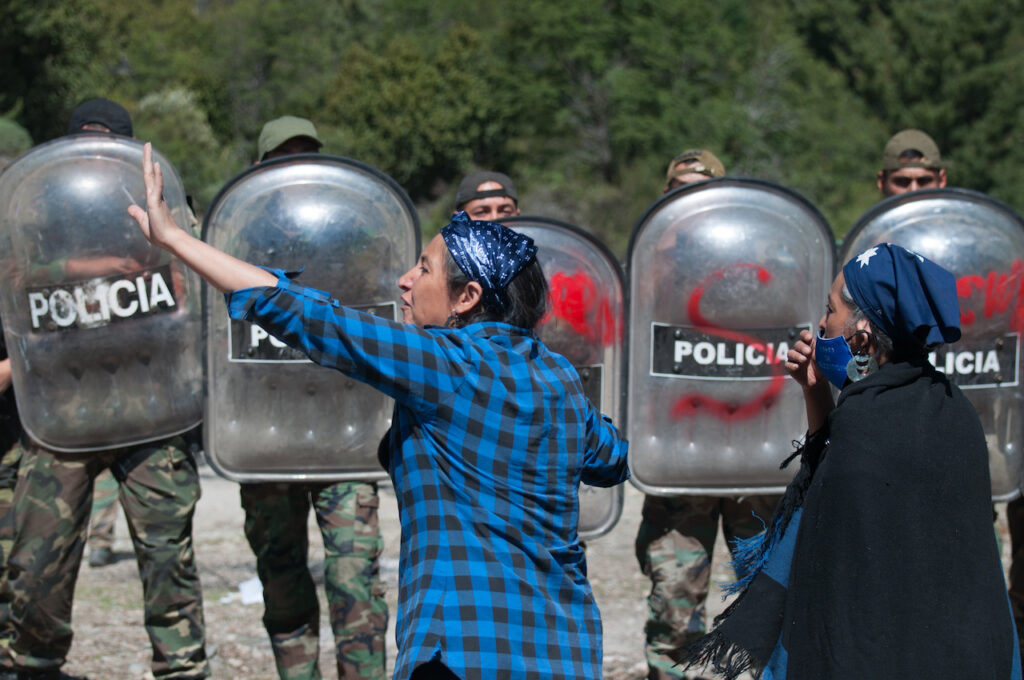
A hail of rubber bullets and demands for identification shattered the fragile pact. “The police started shooting, we ran because they were really out of control,” said Evis Millán, who had already taken cover. The intervention of the community's lawyer, Andrea Reile, calmed tempers, and the group was able to pass.
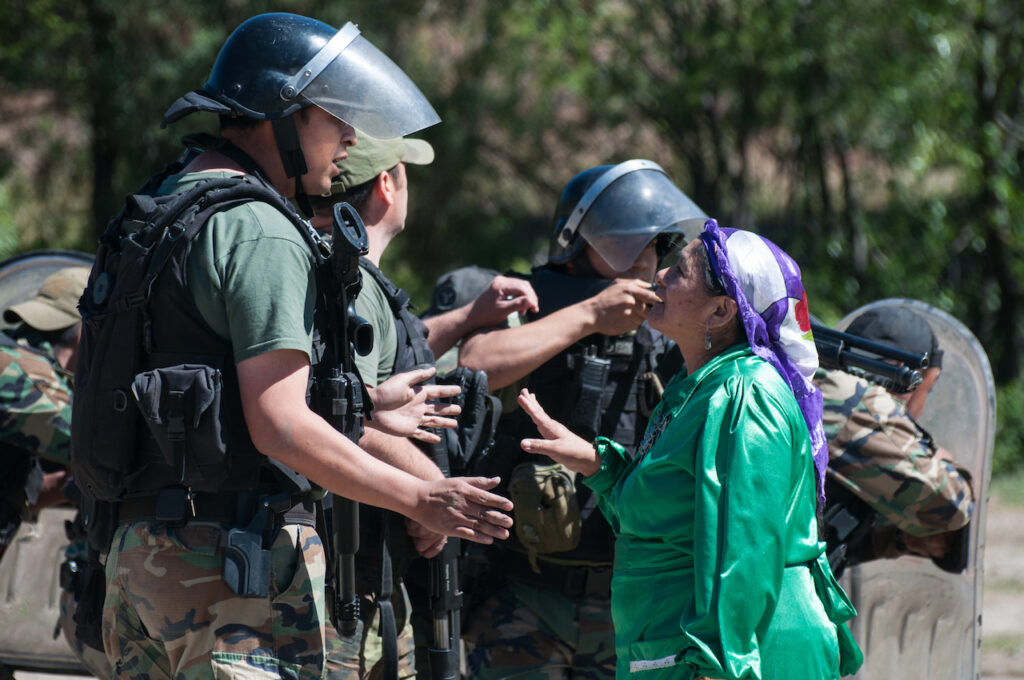
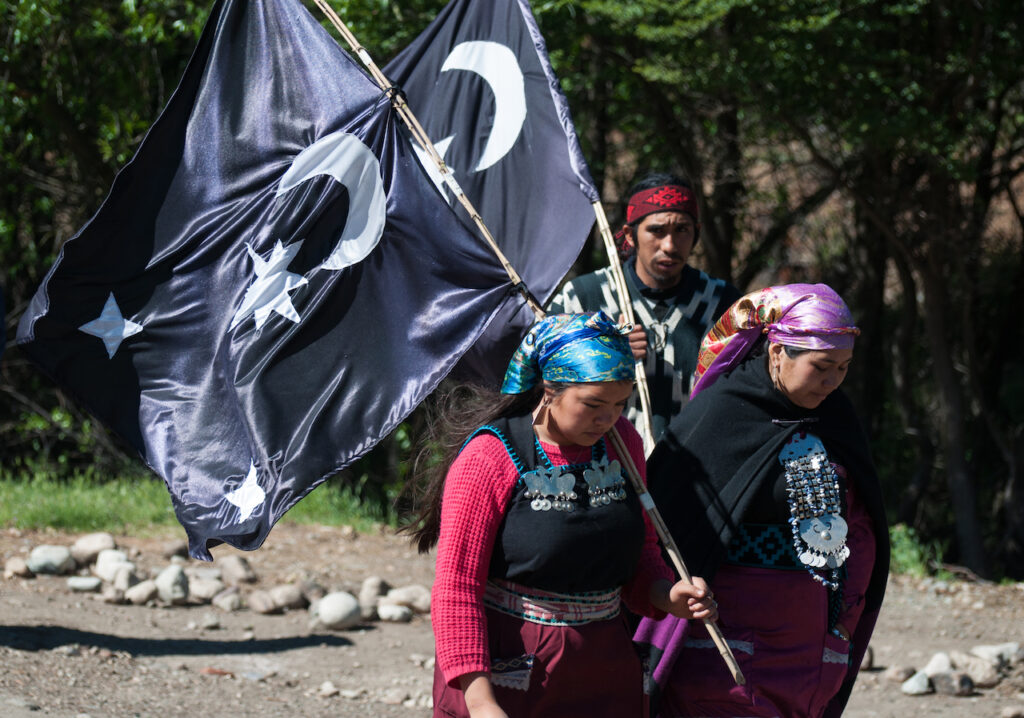
The Mapuche performed their ceremony—using maqui, maitén, branches of native trees, and sacred seeds—while the wenüy (white friends) waited at the gate. Meanwhile, prosecutors Martín Lozada and Francisco Arrien used these incidents as a pretext for not conducting an on-site investigation.
Independent reporter Denali DeGraf witnessed Elias's farewell. “We heard the afafán (battle cries) from afar. The community arrived, along with people from other lof, carrying their comrade on a stretcher made of branches. Black flags waved, and the kultrunes (ceremonial drums) never stopped. The hearse's truck drove away amidst a chorus of marici weu (we will win ten times).”.
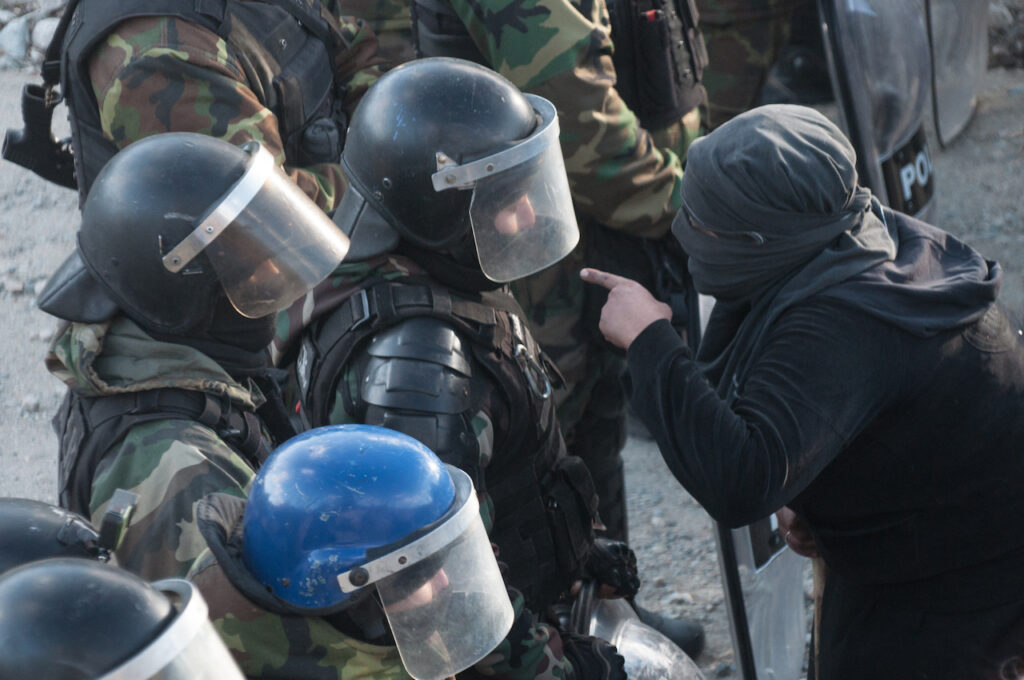
“The gates are open for anyone who wants to pass, this continues,” said those who spent two months on the hill, the authorities of the Lof Quemquemtrew: the machi, the werken, the weichafe and the lonko.
When the ceremony ended, upon reaching Route 40, they had to stop at a provincial police checkpoint where officers demanded their information to identify those who had participated. “The territory remains militarized, and the agreements are not being honored,” Millán denounced. On the day of the murder, a group on horseback charged, shouting “Long live the homeland!” and “Long live Argentina!” while cracking whips at the people waiting outside the hospital for news about Gonzalo’s surgery.
One month later: how the case of Elias' death is progressing
Through forensic analysis and after interviewing survivor Cabrera, witnesses, police officers, doctors, and local residents, the Public Prosecutor's Office identified the alleged perpetrators of the attack. Businessmen Martín Cruz Feilberg and Diego Ravasio have been in custody since November 25. They are accused of homicide and attempted aggravated homicide with the use of firearms against the young Mapuche men Elías Garay and Gonzalo Cabrera . The case is being handled by the chief prosecutor of Río Negro, Betiana Cendón, who is investigating alongside the prosecutor of El Bolsón, Francisco Arrien.
When he was arrested at his front door, Ravasio had the red and black Fiat Duna with which he had entered the lof four days earlier with his "partner".
During the raid on his home, they found a bag packed as if for a trip. Furthermore, the vehicle's license plates had been painted over, which prosecutors consider an indication of tampering to facilitate a possible escape. Meanwhile, Fielberg took his family nearly 800 kilometers from his home in Esquel. On Thursday, November 25, after learning that his friend had been arrested and knowing he was wanted, he turned himself in at a police station in Comodoro Rivadavia, also in Chubut province.
The notice of forced eviction to the Quemquemtrew
In another area of the justice system, the accusation of trespassing and the order for forced eviction are proceeding until December 23. Judge Calcagno wrote: “The community took possession of land that the province had granted to Mr. Rocco, and it was forcibly removed by the Quemquemtrew community (…) I am going to grant the measure requested by the plaintiffs for forced eviction .” He gave them one week “to leave voluntarily.” And he clarified: if this does not happen, the eviction will proceed by force.
At the same hearing where this one-week deadline was set, Romina Jones asked to speak. She did so after the judge again referred to her as "Ms. Huala," acknowledging that he "associated" the surnames "because I've read so much" about the matter (referring to Facundo Jones Huala). "I am Jones. Not Huala. I've told you this many times. I don't accept your apology," Romina said. She added, "You are xenophobic, racist, and an employee of the judiciary. You defend the rich, the powerful, and murderers. Elías's murderer is Rocco's partner. I am not a criminal, and neither is my 8-year-old son, as he has been treated all this time."
Defense attorney Andra Reile announced that she will request an appeal of the ruling and the recusal of Judge Calcagno due to "a recurring flaw," "adverse animosity," and "prejudice" toward her clients. She emphasized, "A judge must be impartial.".
Meanwhile, the encampment that began yesterday proclaims: "Elias Cayicol Garay lives in Quemquemtrew! No pine monoculture or mining in Wallmapu!".
Production and collaboration with the research: Gioia Claro, from Río Negro.
We are present
We are committed to journalism that delves into the territories and conducts thorough investigations, combined with new technologies and narrative formats. We want the protagonists, their stories, and their struggles to be present.
SUPPORT US

FOLLOW US
Related notes

We are present
This and other stories are not usually on the media agenda. Together we can bring them to light.