

An anthology gathers the voices of queer poets from Colombia
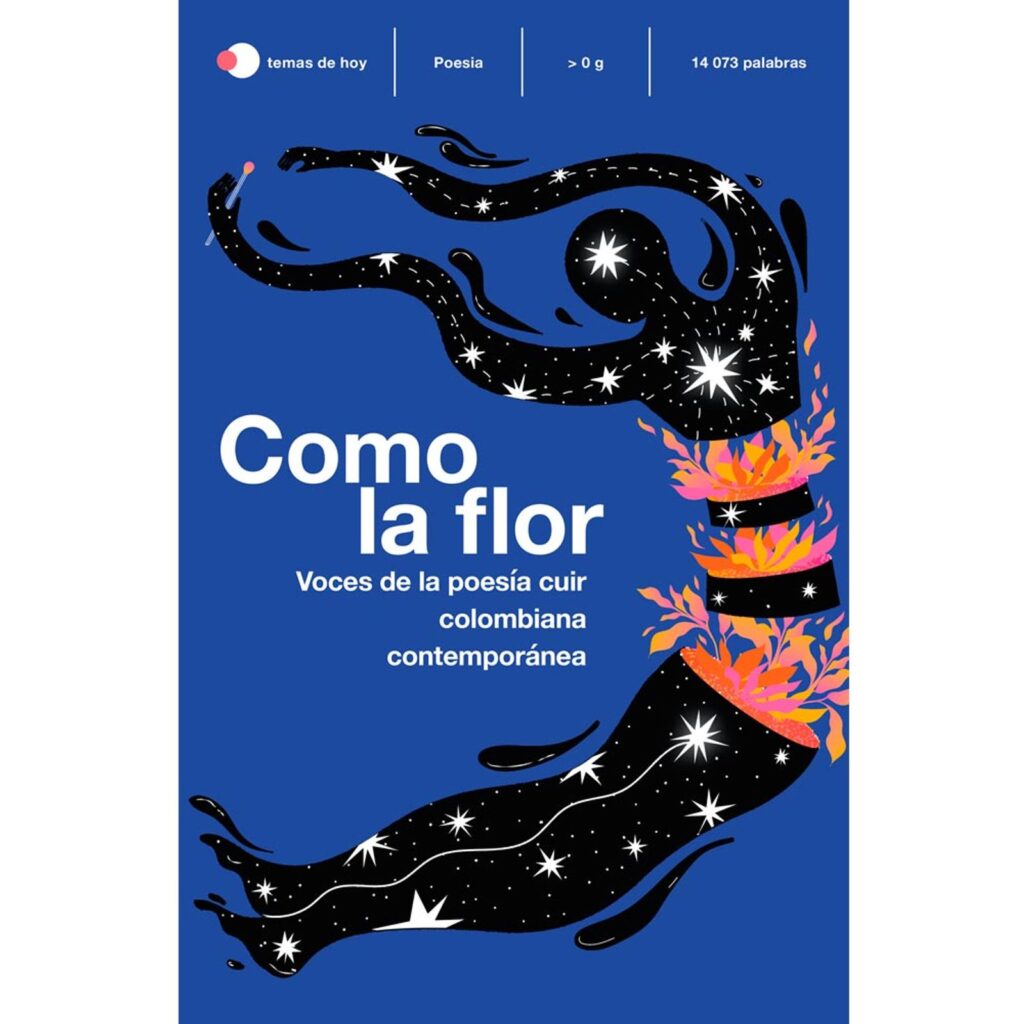
"Like the flower, voices of contemporary Colombian queer poetry" collects 50 texts from 30 authors who share their own experience about the queer experience in Colombia.



Share

“The change that takes place in our bodies / is the mutation of an era,” says a poem by the Colombian poet Carolina Dávila. In reality, the words belong to the first part of Testo Junkie , a book by the philosopher Paul B. Preciado. What Carolina did was take fragments from this book, set them in verse, and change the first-person singular to the second-person singular and plural. The result is a poetic collage she titled “Paul B. Preciado Dixit.”
This initial disruptive exercise in language is similar to that proposed by the Argentinian poet Tálata Rodríguez in her TED Talk, “How to Create Poetry by Cutting and Pasting .” She would call Carolina Dávila a DJ poet, someone who selects, omits, mixes, experiments, and decides. A poet who, starting from something that already existed, creates a completely new text. This continuous movement toward the eccentric, toward the decentered, is what the anthology Como la flor, voces de la poesía queir colombiana contemporánea (Temas de hoy, 2021) proposes. A collection of poems that gathers 50 texts by 30 authors who share their own experiences of being queer in Colombia.
“One of the narratives that emerged when we received the poems was that of the expression of plants and nature as an expression of queerness,” says Alejandra Algorta, editor and compiler of the anthology, and founder of the Cardumen publishing house. “We felt it was an opportunity to reformulate what we understand by nature, which is not binary but presents a breadth of expressions that we in the West have failed to see or have suppressed. Hence Elina Hernández’s poem, which speaks of the sexuality of orchids,” she explains.
The anthology's title comes from the poem "Orquídea Catatesum," in which Hernández writes: "There, where the flower's form / doesn't know how to guide it / instead of going, it attracts / instead of going, it lingers / like the flower of the borrachero, / like that of the broccoli, / they exemplify a task / unthinkable in other realms: / to move without going / toward what you desire." "Like the Flower is a collection of poems that speaks about the words assigned to us to describe what lives and the words we have chosen to use instead," explains the prologue.
QUEERIZING POETRY IN COLOMBIA
“Being queer in Colombia has very different implications depending on where you are and the social class you belong to,” Algorta explains. “Undoubtedly, being queer in Bogotá is not the same as being queer in Guaviare. However, there are forms of violence that anyone who doesn't fit into heteronormativity can experience to a greater or lesser degree. The implications are as diverse as the groups involved, but the constant is the desire to have the same rights as cisgender heterosexual people.”
The poem "Signs," by the poet Alejandra Lerma, explores how this cisheterosexual norm is instilled as a lesson from early childhood: "The girl wears her hair short, a sign that she wants to be a man / The boy wears his hair long, a sign that he wants to be a woman / His womb is only good for bleeding, a sign that it has been ruined (...)." As the Argentine lesbian poet Gabriela Borrelli explains in her book Feminist Readings II. Literary Constellations (Futurock, 2021), "poetry has a dual function: in its canonical dimension, it participates in this normalization as another institution, but, on the other hand, it opens a window to vestiges, revealing this hidden language when it can itself join the battle by breaking down normalized language."
POETRY IS THE GENRE OF THE STRANGE
For Algorta, contemporary poetry is itself a form of queer expression. “It’s the genre of the strange, of the free, an umbrella that doesn’t fit, and in that sense, it’s the most genuine way we try to narrate a small part of the current queer experience in Colombia, which is boundless,” she explains. Speaking of queer instead of using the Anglo-Saxon term “queer” is, as Val Flores expresses, one way among many to contest, in the realm of language, a discontent with hegemonies that are not only identity-based but also geopolitical. To speak of queer is to demand a “Latin Americanization” of this term.
“With my mouth on your sex / or your sex on my mouth / the language in which living organisms / encode themselves becomes, at last, intelligible,” proposes the poet Juan Diego Otero in the poem Another Language. Thus, we could say that in this anthology, queerness appears as dispossession and freedom from the preconditions of an assigned gender; as an expression of love in its various forms; as every portion of the social that clothes the natural, and vice versa. Queerness, as Algorta proposes, “as the potential to navigate the possibilities of our world without hurting anyone.”
“Many of the poems in this book are arranged from the inside out. The inside represents home, a bar, a party, but also language and the body. The outside, on the other hand, is a place of struggle, reform, rage, and confrontation,” the editor explains. “So we wanted to arrange them this way, bringing the poems from their most genuine interiority to that more violent outside.”
We are present
We are committed to journalism that delves into the territories and conducts thorough investigations, combined with new technologies and narrative formats. We want the protagonists, their stories, and their struggles to be present.
SUPPORT US

FOLLOW US
Related notes
We are present
This and other stories are not usually on the media agenda. Together we can bring them to light.