

Gloria, a Mapuche human rights defender, was acquitted: the judge acknowledged that the justice system ignored her complaints.
The Esquel court acquitted Gloria Colihueque Catriman, a Mapuche-Tehuelche human rights defender, and her uncle Gregorio. The judge acknowledged that there was no evidence against them and that, since the justice system did not listen to them, they acted in defense of the territory they inhabit.


Share

This morning, the Esquel court acquitted Gloria Colihueque Catriman, a Mapuche-Tehuelche human rights defender, and her uncle, Gregorio Cayulef. A group of business owners had brought them to trial. Gloria was accused of threatening Alejandro Samame, Nahuel Serra, and their employees with firearms, as well as of unlawful detention. Gregorio was accused of threatening them with a knife. However, this morning Judge Carina Estefanía acquitted Gloria and her uncle of all charges.
“There is not a single fact that proves Gloria’s co-authorship in the reported events,” she stated at the hearing held in Esquel (Chubut). She added, “Neither aggravated threats with the use of a weapon, nor unlawful deprivation of liberty.” The judge proved that, as she put it, “they exercised control (of the territory) beyond any doubt.”
The judge also acknowledged the lack of cultural and gender perspective within the justice system, which had ignored each of Gloria's complaints regarding the violence she had been suffering. She stated that "they were killed and treated with arrogance." "Gloria decided to exercise legitimate self-defense because she received no response to her complaints, given the lack of response from the State and its refusal to investigate them. They are members of the Mapuche people and do not need to prove it," said Carina Estefanía.
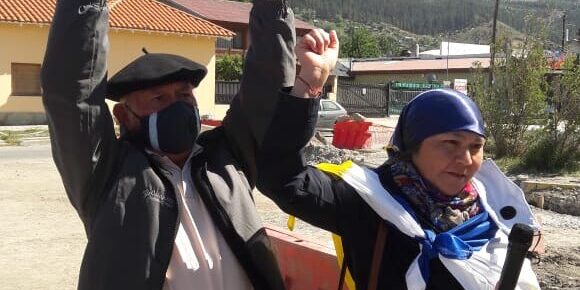
As they left the courthouse, Gloria and Gregorio embraced their sisters, brothers, and members of various groups who had come to support the trial. The acquittal was celebrated with raised fists and arms. “We are happy about the acquittal ,” said Gloria, but she cautioned, “There is still a long road ahead. We have recently received threats in the community, and I am requesting protection for my mother and for everyone. These are very powerful people.”
“We have triumphed as a people; justice has been served. This is a landmark ruling,” said Moira Millán, a Mapuche weychafe (warrior) and member of the Indigenous Women’s Movement who accompanied the trial. She highlighted several points, including that in her ruling, “the judge told the prosecutors that they should not have acted as they did, with arrogance, toward our lamien ( ). That it was important to recognize the rights of Indigenous peoples, that it is not necessary to prove one is Mapuche. And she pointed out that it was very important to recognize gender rights within the structure of the justice system.”
Millán told those celebrating the ruling outside the courthouse in Esquel that “the collusion between the agencies and the Rural Society was clear. And how the IAC enabled this situation of conflict and tension. They chose to operate with violence and impunity. The judge's ruling demonstrated that Gloria and Gregorio acted in legitimate self-defense of their territory, since they were the ones suffering the threats.”
“There is no access to justice for the Mapuche people”
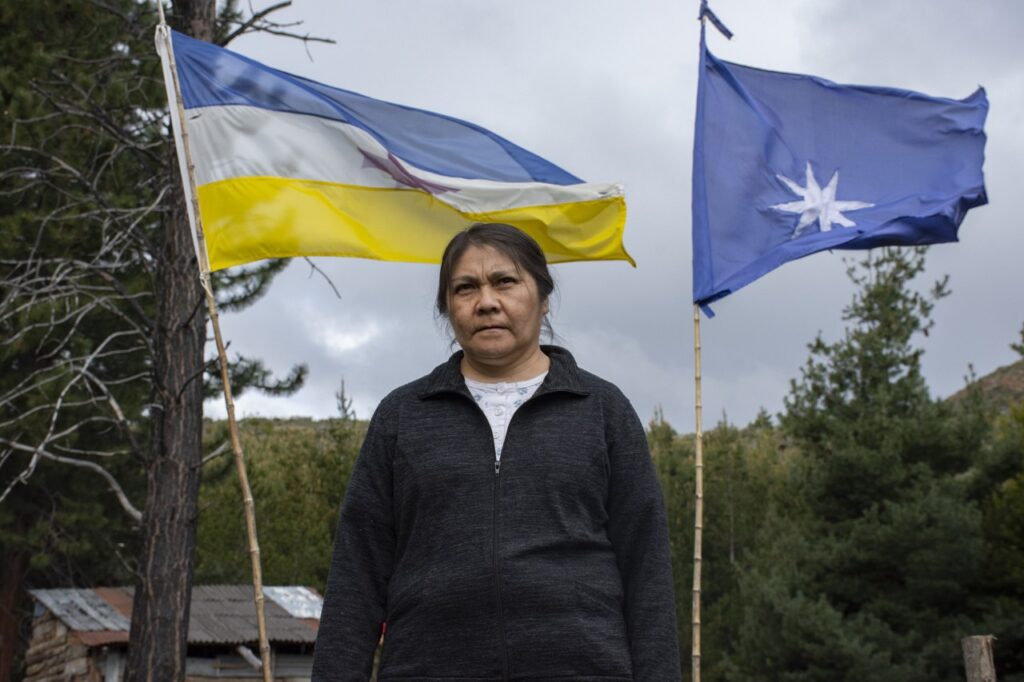
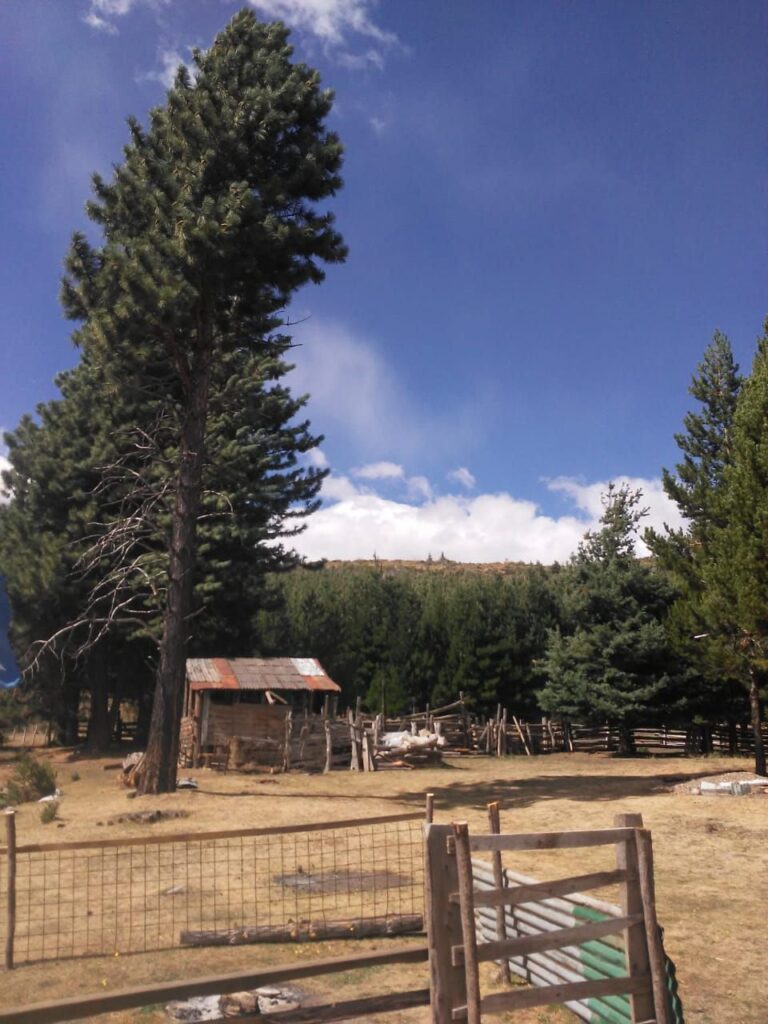
The events that led to the legal proceedings took place on April 20, 2020, when Gloria, who was traveling in a truck driven by San Román, encountered Alejandro Samame, who was driving in the opposite direction. It was a single-lane road, also used by two other pickup trucks carrying at least six more people. One of the questions the situation raised in the area was: what were these people doing there, on the land where Isabel and her family have lived for twenty years, in the midst of a pandemic with strict movement restrictions?
We had the opportunity to meet with Gloria at a trawn (parliamentary meeting) this weekend at the encampment for the Lof Quemquemtrew, another community and territory in conflict in the neighboring province of Rio Negro. Gloria was there “because we support each other as communities. Because there is no access to justice, at least not for the Mapuche.”
There, Gloria recounted the impact all of this had on her family. “My mother lives in the territory. She’s almost 80 years old, and since March, they’ve had people stationed there every day to watch over her and control her. Every month, a complaint was filed. But so far, nothing has been investigated. If there had been an investigation, we wouldn’t have ended up in this situation. I didn’t go to Serra’s or Samame’s house to threaten or deprive anyone of their freedom. Who was in our territory? They were .” Gloria’s words were corroborated in court today, as not a single testimony incriminated her during the trial.
“I was the only woman there and I didn’t threaten anyone.”
Last weekend, accompanied by Mapuche Tehuelche authorities, sisters and brothers from various communities who in turn recounted the different conflicts they face, and before social organizations, human rights organizations and community media that approached, Gloria presented herself with her head held high: “I am Gloria Colihueque Catriman, from the Mapuche Tehuelche community Lof Catriman Colihueque, located near Lake Futalaufquen, Los Alerces National Park, 50 kilometers from the city of Esquel, jurisdiction of Chubut, Argentina.
I didn't threaten anyone with a firearm, I didn't threaten them with death. And I didn't deprive anyone of their freedom. There were six people—I only found this out during the hearing, because I saw about ten people that day in the area. All men. I was the only woman. I don't know how I could have threatened them all. I asked for my acquittal because I am not guilty.
Of illegalities and breaches of rights
In her closing arguments, defense attorney Sonia Ivanoff asserted that "Luciano Freeman (son of Lucio Freeman, heir to a possessory right over public lands) sold the lands with Isabel still living there. The IAC (Autonomous Institute of Colonization and Rural Development) created a land conflict by failing to comply with or apply the procedures established by the Chubut public land law, which is quite clear."
The law states that prior to any concession of public lands where one of the parties belongs by family or community to an Indigenous people, it must be reviewed by the Indigenous Land Commission. However, this commission has not been established in the province “due to the lack of consultation and Indigenous participation.”
“ There is a very serious series of illegalities and violations of their rights here,” the lawyer says. “The IAC didn’t even verify who the buyers were. And they don’t meet the requirements to be awarded provincial public land. The IAC should have investigated. On March 9th, they received a letter from Isabel about the situation and should have followed the land law.”
The trial largely involved a third defendant, San Román, who was driving the vehicle in which Gloria was traveling on the day of the meeting with this group of businessmen. He is not Mapuche, and in the days leading up to the trial, he surprised almost everyone by admitting to the charges against him. This allowed him to avoid a public hearing, according to his lawyer, Dr. Sonia Ivanoff.
The prosecution against indigenous rights
At the trial, however, the debate raised by the prosecution and the plaintiffs centered on threats. According to prosecutor Maria Bottini, the "bona fide purchasers" were exercising their property rights, so "no one was trying to displace anyone."
During the hearings, the prosecutor went so far as to say, "We're not talking about indigenous rights, because on paper, it doesn't belong to them." "They knew the land had been sold," she alleged.
“ Women, poor, and Mapuche,” indicated Ana Ramos’s anthropological report, “and this is what happened.” Defense attorney Sonia Ivanoff asserted in her closing argument, because without a doubt, that intersection played a significant role in reaching this point. For several months, the justice system ignored the complaints of Gloria and her community.
“On March 7, the padlocks on the access points to the territory began to be cut. This was reported to the Gendarmerie and the provincial prosecutor's office. But none of these complaints from the community went anywhere, as usual,” the lawyer told the court.
She also says this situation is not new. Those who work on these issues know that, generally, “when communities or Mapuche people file complaints, there is never an investigation. But the Mapuche themselves are very quickly investigated, charged, and brought to trial,” says Sonia. And she warns: when there is an absence of the State, it is not the judicial branch that should act as a last resort, referring to the repeated complaints filed by Gloria and Isabel since March 2020, which the courts have never heard.
We are part of the territory, not owners.
Gloria told the court: “On March 6th, they (Serra, Samame, an architect, a notary, and their lawyer) came in trying to get my mother to sign a document. She has a connection to the land. It's not something we own because we want to make money. We are part of the land, not owners . Everything on the land is energy for us .”
She recalled the evictions. “I come from a family that was already evicted, my great-grandparents (referring to the eviction of Boquete de Nahuelpan in 1937 ). That's not talked about. They say we're violent and threatening. (…) Why isn't the complaint we filed on March 7th being investigated? They broke in, cutting the locks, they left men here, they showed no consideration for an elderly woman. Why so much contempt? Why isn't there an investigation? They investigate one side, but not the other.”
The peaceful occupation of indigenous women
The trial began on October 26. On Monday, November 1, while Gloria and her family faced the statements against them in court, several communities from the area and representatives of the Indigenous Women's Movement for Good Living peacefully occupied the facilities of the IAC (Autonomous Institute of Colonization and Rural Development) and the Esquel Forestry Sub-Secretariat.
The trial began on October 26. On Monday, November 1, while Gloria and her family faced the statements against them in court, several communities from the area and representatives of the Indigenous Women's Movement for Good Living peacefully occupied the facilities of the IAC (Autonomous Institute of Colonization and Rural Development) and the Esquel Forestry Sub-Secretariat.
In a telephone conversation, Moira Millán explained the purpose of this action to Presentes. In Millán's words: “To denounce the situation of judicialization and dispossession of communities and the complicity of these organizations as a fundamental element in consolidating the handover of lands.
“The IAC has been complicit with the Rural Society and the landowners, creating the conditions for dispossession through fraudulent actions, handing over lands that belong to our people to the Rural Society. The prosecution of our sister Gloria Colihueque Catriman, who now faces the possibility of even imprisonment for defending her land, seems unacceptable to us. We must put a stop to so much corruption.”
What's behind this?
Gloria believes that what's hidden behind these schemes is a great interest in exploiting those lands. “There's water there, lots of it, two lagoons. The Forestry Department gave them permission to extract five hundred cubic meters of firewood. I filed complaint after complaint, and now it's stopped. But we know they'll come back at any moment.”
Although the court acquitted her in this case, a civil case regarding land ownership is still ongoing. “My mother is handling it,” Gloria explains. Isabel had a hearing in April of this year, “but there’s still no resolution.”
We are present
We are committed to journalism that delves into the territories and conducts thorough investigations, combined with new technologies and narrative formats. We want the protagonists, their stories, and their struggles to be present.
SUPPORT US

FOLLOW US
Related notes

We are present
This and other stories are not usually on the media agenda. Together we can bring them to light.
1 Comment