

“Brotecitos”, the first trans-travesti-non-binary songbook, has arrived in Argentine libraries
The songbook is the product of the Voz Propia workshop, taught by the artists Susy Shock and Javiera, and exists in paper and digital format.


Share

“I’m going to whisper to you very softly a world in the shape of a cradle that we wove slowly. On these singing looms, without blues or pinks.” The lyrics of “Brotecitos” (Little Sprouts), by Morena García, give their title to the first trans-travesti-non-binary songbook in Argentina and the region. The spirit of struggle, construction, and deconstruction contained in these verses perfectly represents the entirety of the book.
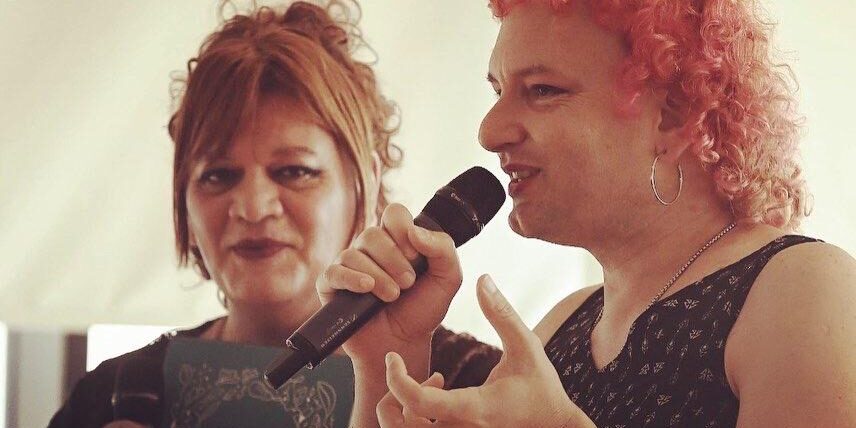
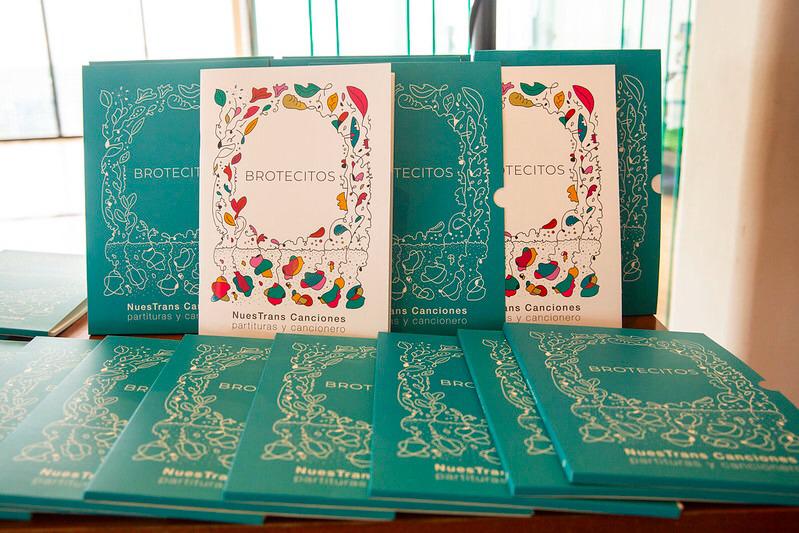
The songbook is the product of the Voz Propia workshop, led by Susy Shock and Javiera, where Susy led the lyric-writing workshop and Javiera led the music composition workshop. Twenty artists from across the country participated in the workshop, initially creating a performance filmed during the pandemic at the CCK's whale-shaped stage, now available on YouTube . The National Institute of Music (Inamu) quickly expressed interest in publishing a printed version. The result is "Brotecitos: NuesTrans Canciones" (Little Sprouts: Our Trans Songs), which contains ten songs primarily aimed at children, a prologue written by Marlene Wayar, and chronicles by I Acevedo.
Susy Shock spoke with Presentes about the importance of gathering knowledge that is “dispersed and invisible, belonging to a community living in a chaotic situation, brutally excluded from the entire system.” This existence outside the system often means, Susy explained, having to resort to prostitution as the only way out. “And where is our knowledge?” she asked. “Where is the possibility of accessing beauty, for example? Art is part of a political movement to reposition ourselves and to rethink ourselves in our own voices without anyone controlling us,” she added.
Paradigm shift
The songbook in physical format has already been distributed to more than 300 public and private libraries throughout the country, while the digital format is freely accessible through the Inamu website . It undoubtedly represents a historic milestone in Argentine culture. The final product of this project is not only a beautiful and much-needed gift for children (and adults, of course) across the country, but also a just and urgent recognition for the trans, travesti, and non-binary artist community who, in addition to being able to share their work, received legal advice from Inamu to register it.
“The decision to publish compositions by people with identities that dissent from the system, and to do so as part of the same collection that published Spinetta and Cocomarola, points to a paradigm shift,” Javiera told Presentes. In that sense, she emphasized that historically, the music industry has chosen to reward and reproduce everything that has already proven successful. That's why she described this project as revolutionary, because “it doesn't aim to highlight personalities, but rather the possibility of reinventing and re-evaluating oneself, which is so closely linked to art.”
To enlighten new generations
“I am 52 years old and I grew up looking at women, but I am not a woman. I always had to mediate the binary to discover everything that corresponded to me and what could belong to me,” says Susy Shock.
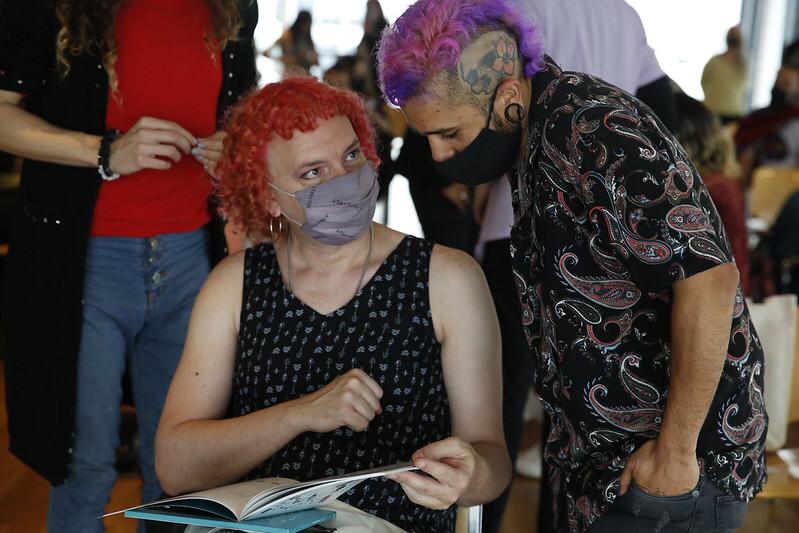
Herein lies the importance of this songbook: the possibility for transvestite, transgender, and non-binary people to create content not only to express themselves in their own voices, but also for those voices to resonate with any child who might be feeling something similar. In Susy's words, it's important so that it "enlightens those generations who otherwise find themselves terribly alone."
In this regard, Roma Roldán, an artist from Greater Buenos Aires who contributed two songs to the album, emphasized the importance of “these small but immense stories being shared with people who have similar experiences and also with those who haven't. That they can be moved by them and understand a little from within what we go through, and I say from within because art has a particular way of affecting people.”
In Javiera's words, "Brotecitos" is also "for those who want to affirm the gender assigned at birth, but from a more conscious place and therefore more responsible for the privileges that come with being in line with the majority of individuals in the system."
For the artists, participating in this project was also very exciting. “The work we did for four months was very hard,” Lorena Carapachay , from Salta, told Presentes. “For me, it was very challenging to learn to write like this. The verses I used to write were always folk songs, or ones I heard from a neighbor. Nowadays, I can say that I'm someone who can compose my own verses.”
For the children, the girls, the boys
Producing a songbook aimed primarily at children not only has the enormous impact of accompanying them as they grow up. It also means we are dealing with a trans-travesti-non-binary work. “ This focuses not so much on the victimhood, a harsh and difficult experience in a society that doesn't recognize you or that directly attacks you, but a little more on the hope of being, the joy, the happiness that can be associated with growing up in a world that does see and feel you,” says Javiera.
Roma Roldán, for her part, highlighted how much it moved her to imagine “music teachers, children, artists of any style singing and performing some of these songs without anyone's gaze inhibiting them or without it being something surprising. May this songbook be an impetus to continue leaving places of comfort and familiar discourses.”
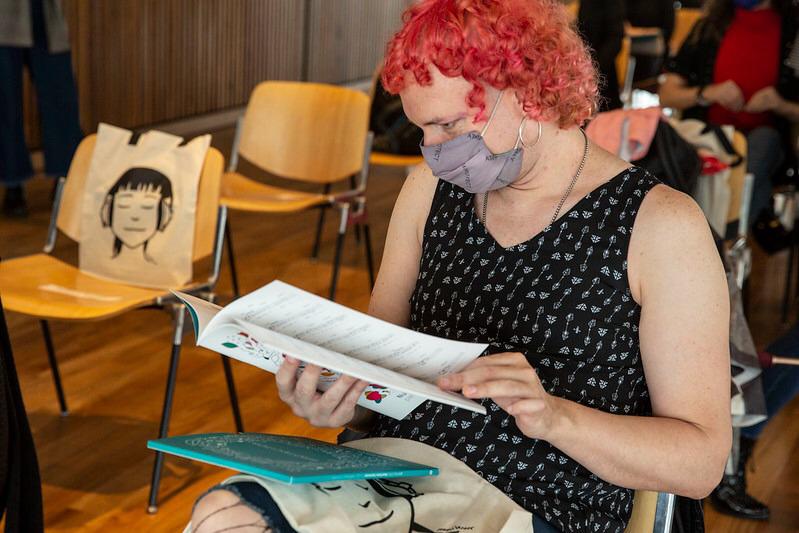
In this sense, Susy Shock defined this songbook as “an invitation for heterosexuality to also begin to see itself as co-responsible for many forms of violence. It’s an invitation to look inward, to consider whether part of that disciplining isn’t condemning them all the time. When we fight, we fight for all forms of upbringing, not just dissident ones. It’s very difficult to be a boy or a girl as it’s often portrayed. “Brotecitos” is for them too.”
We are present
We are committed to journalism that delves into the territories and conducts thorough investigations, combined with new technologies and narrative formats. We want the protagonists, their stories, and their struggles to be present.
SUPPORT US

FOLLOW US
Related notes


We are present
This and other stories are not usually on the media agenda. Together we can bring them to light.