

Lady Drag: subversive art against authoritarianism in El Salvador
She has become a symbol of the protests against Nayib Bukele's government. Despite intimidation from the ruling party, Lady Drag intends to continue using her drag queen persona to highlight the shortcomings of the president and Congress.


Share

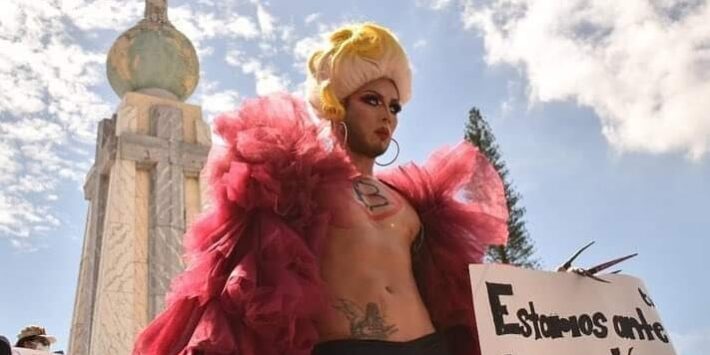
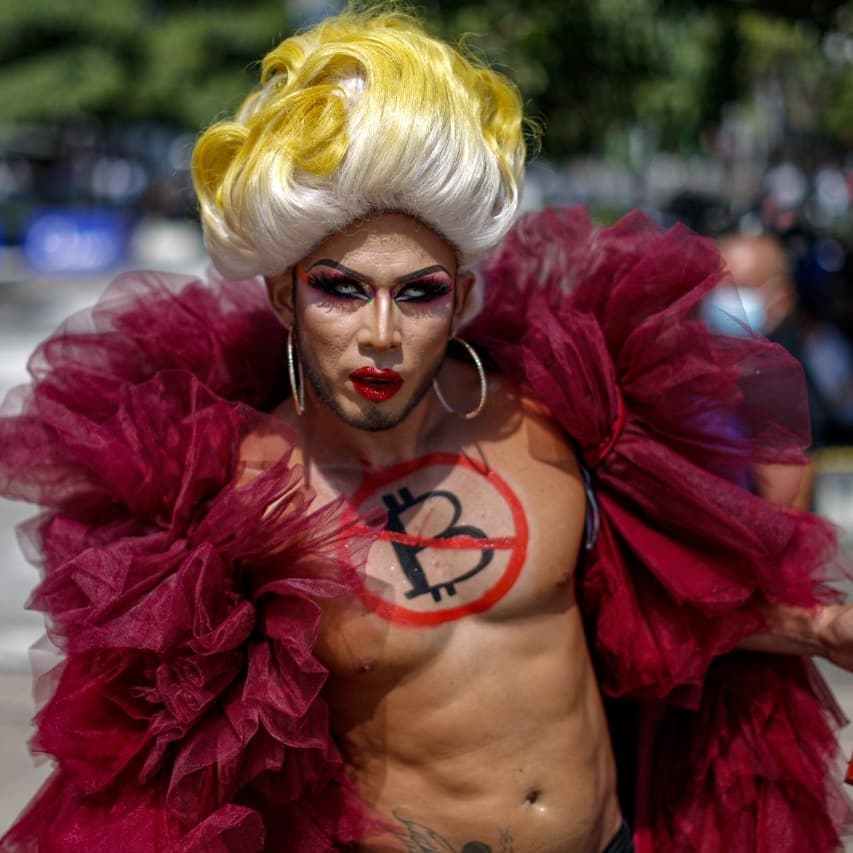
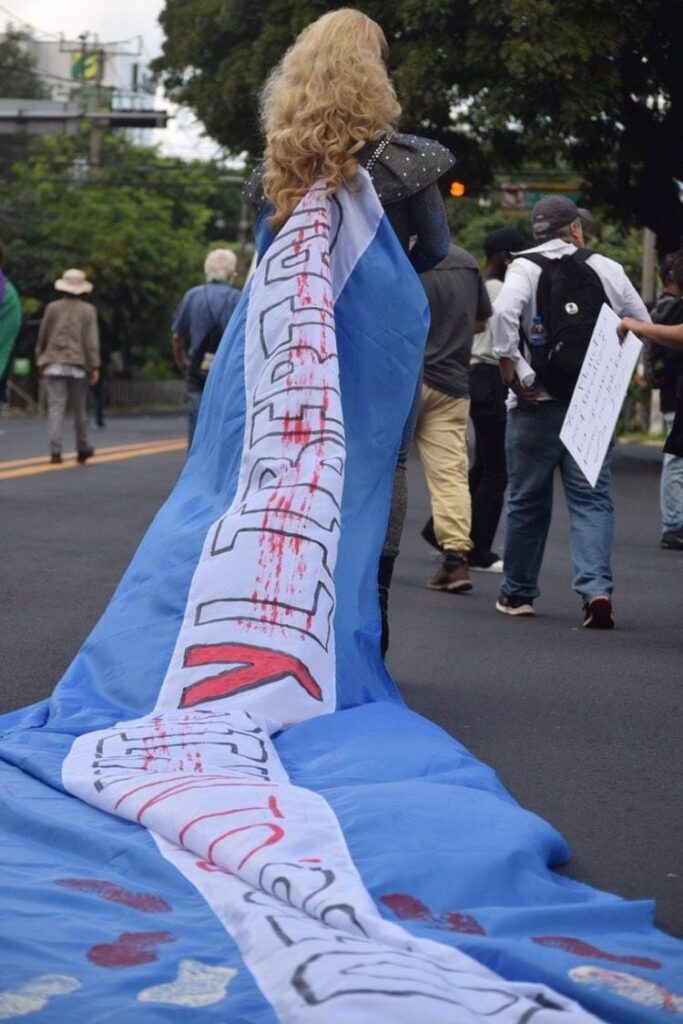
Nayib Bukele 's government . From tattooing a crossed-out "B" on her chest to express her rejection of Bitcoin as legal tender in El Salvador, to marching through the streets of the Salvadoran capital for the 200th anniversary of the country's independence, wearing a seven-meter-long blue and white flag as a cape.
“I insist, and I continue to call on these cowardly new generations, who want to solve everything with a post, making publications on social media, on Facebook, on Twitter, on Instagram. We're not going to achieve anything that way; we need to take to the streets,” he urged the population on camera on September 7th. It was in downtown San Salvador, the capital city.
Lady Drag wore large platform shoes, a voluminous wig, a pink cape, a fan, the letter B crossed out on her chest, and a sign that read: "We are facing a cowardly generation."
The day everyone met Lady Drag, Bitcoin began circulating as legal tender in the Central American country. Hundreds of Salvadorans took to the streets to protest this decision, which had been made in Congress without a thorough study of its viability.
Lady Drag, who until then was a figure who usually frequented spaces other than the street, broke her silence. She stood before a nation to demonstrate that the figure of the drag queen is also an instrument of social protest.
Political crisis
El Salvador is experiencing a political crisis. After Bukele won the presidency in February 2019, his party, Nuevas Ideas, also won a majority of seats in the Legislative Assembly in May of this year.
The pro-government members of parliament have agreed, since May, to a series of arbitrary measures. Among them: shelving, without justification, proposed laws developed by civil society, such as the Gender Identity Law; and their first decision as officials was the dismissal of the Constitutional Court.
They also approved a decree to force the retirement of judges over 60 years of age or who had served for 30 years, and the Executive branch is drafting a constitutional reform that would allow presidential reelection. In addition to all this, Bitcoin has been approved as legal tender.
The march on September 7th was the first of three marches against the Bukele government. The marches on September 15th and October 17th brought together thousands of Salvadorans.
But who is Lady Drag?
Lady Drag is a character created by actor and dancer Marvin Pleitez. In 2005, while studying theater at the University of El Salvador, the only public university, and having fallen out with contemporary dance, he also frequented nightclubs and was a fan of drag shows. That's how he began to like the idea of being a drag queen, he tells Agencia Presentes.
One day, a group of friends convinced her to participate in a beauty pageant that didn't require a very feminine persona at Scape, an LGBTQ+ nightclub in San Salvador. The pageant was won by Lady Evance Versace Garuch, a character Pleitez created and who was the predecessor to Lady Drag.
“It was about deconstructing the image of that beauty queen, with crowns, bows, and ball gowns,” the artist recalls. This also marked the beginning of several shows in which he incorporated humor with social commentary.
However, in 2009, before traveling to Cuba to specialize in stage direction at the Higher Institute of Performing Arts, one of his theater teachers questioned him about whether he wanted to be remembered as an actor or as a transvestite. Because of this transphobic criticism, he decided to abandon his character.
Discrimination against LGBTIQ+ people in El Salvador, which is not regulated by law, occurs every day, and the workplace is no exception.
By 2011, Pleitez had returned to El Salvador and auditioned for Los Torres, a series broadcast on Channel 33 and independently produced. He was selected to play a straight guy and appeared in a few episodes, but was fired because of his sexual orientation.
On the day of his dismissal, he recounts, the production team waited for him in an office with his termination letter and also showed him photographs of his character on Scape. Pleitez reported the case to agencies such as the Ministry of Labor and the Attorney General's Office for the Defense of Human Rights. He succeeded in getting Los Torres pulled from the channel and preventing it from having a second season, as had been planned.
A controversial figure
Lady Drag was born in 2019 and has become controversial. Pleitez says her shows maintain a social critique. In May of this year, at Living, another nightclub for sexual minorities in the Salvadoran capital, she was hired for a show dedicated to lesbians and, on stage, she transformed into Nayib Bukele: she wore black pants and a black jacket, and a cap, alluding to the outfit the president wears when making field visits, and put on a clown nose. Meanwhile, in the background, Mónica Naranjo's "Usted," a song that criticizes those in power, played.
Pleitez admits that she once sympathized with Bukele, but today she feels a responsibility to criticize him because the decisions he is making “affect the poor.” However, in a conservative country like El Salvador, those who challenge power from within the LGBTQ+ community also face violent rhetoric.
Minutes after the September 7 march, the mayor of the capital, Mario Durán, following the official narrative of criminalizing the protests, posted photographs on Twitter to complain that the protesters had dirty and stained the streets, and among the photos of the mayor's office staff sweeping, the official posted a photograph of Lady Drag, which had nothing to do with the message.
A historic march with drag queen presence
Pleitez is aware that few Salvadoran drag queens are taking a stand against the current government's actions. For the September 15th march, the day El Salvador celebrated its 200th anniversary of independence, Lady Drag dressed in black and carried the Salvadoran flag with red stains. She invited other colleagues, but none were willing to attend. She even notes that some of her colleagues and members of the LGBTQ+ community have limited themselves to criticizing her character based on the two marches she has attended.
This march was much larger than the one on September 7th. Nothing similar had happened in the last 14 years, organized against the current government. Last Sunday there was also another massive demonstration that included the participation of the LGBTQ+ community, feminists, the drag queen movement, judges, students, and other social sectors dissatisfied with the work of Bukele and his representatives.
The October 17th mobilization was besieged by police and military. In some parts of the country, police stopped buses carrying protesters heading to the capital and confiscated the drivers' keys.
Based on the social organization that began in El Salvador, the pro-government deputies approved a decree on Wednesday that prohibits mass gatherings and gives the power to imprison and fine thousands of dollars anyone who organizes marches.
Cases like that of Lady Drag can have domino effects on other people, says Néstor Urquilla, LGBTIQ+ activist and member of the Association of Organized Afro-descendants.
“I think it’s part of the awakening that humanity, that the LGBTI population, is experiencing,” Urquilla adds, noting that since 1930 (when the military dictatorship began), Salvadorans have had an established anti-communist mindset, and sexual dissidence is no exception.
"A tool for alerting"
Two other drag queens, Alexa Evangelista and Adodoll, also participated in the September 15th march. Both had already performed in other venues, but that day they gained greater visibility, says Adonay Herrera, actor and activist who created Adodoll.
Alexa wore camouflage and carried a sign that read “Recruited, but not defeated,” a stark critique of the government's recruitment drive for young people into the Armed Forces. Adodoll wore black and carried yellow tape used at crime scenes and a sign that read “The dick is hard.”
According to Herrera, in the last three years in El Salvador the figure of the drag queen has incorporated more political components into its shows, and he anticipates that more queer artists will join the movement, especially in a country that is used to silence.
“Drag, in itself, is a tool to make a call to action, to raise awareness. Politically, it works for that purpose because it is subversive, resilient, and outside of heteronormativity. It is very complex,” she says.
From this subversive perspective, Lady Drag warns: “I’m going to point the finger, regardless of whether my insurance or my life is at stake, because right now the situation in this country is super critical, but as a drag queen movement in El Salvador, I think we’re just getting started.”
On October 17, she emerged again as a symbol of resistance and dissent in the Central American country.
We are present
We are committed to journalism that delves into the territories and conducts thorough investigations, combined with new technologies and narrative formats. We want the protagonists, their stories, and their struggles to be present.
SUPPORT US

FOLLOW US
Related notes



We are present
This and other stories are not usually on the media agenda. Together we can bring them to light.