

Peruvian Judiciary recognizes co-maternity after 5 years of struggle by Jenny and Darling
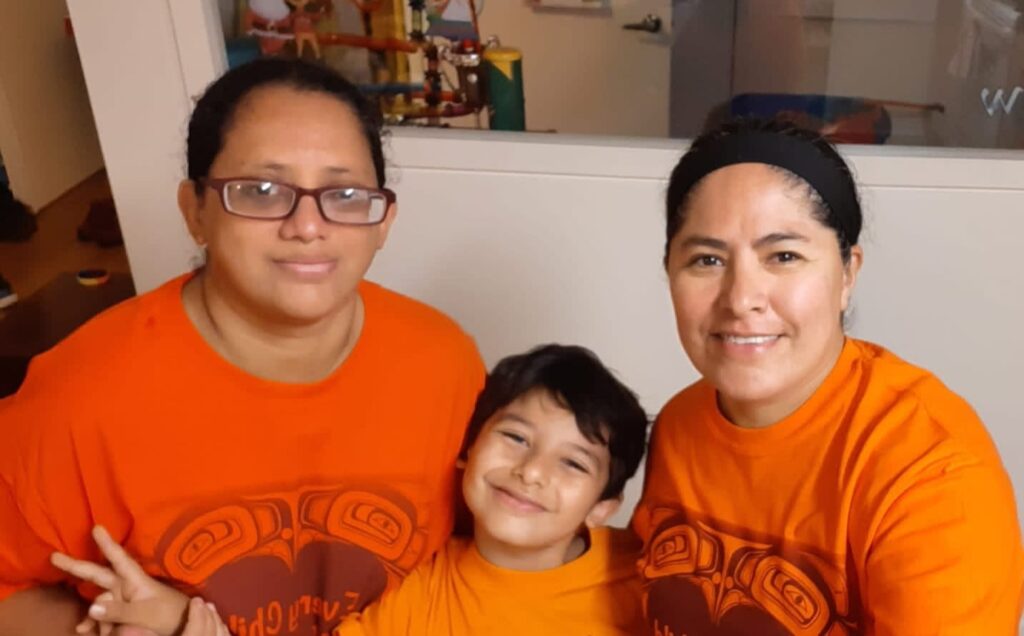
Jenny Trujillo Cueva and Darling Delfín Ponce began the fight in 2016 to have the National Registry of Identification and Civil Status (Reniec) recognize co-maternity on their son's ID card.



Share

On October 13, within the framework of Lesbian Rebellion Day, the Peruvian Judiciary decided to rule in favor of the amparo lawsuit filed by two lesbian mothers so that their surnames would appear on their son's identity document.
Jenny Trujillo Cueva and Darling Delfín Ponce began the fight in 2016 to get the National Registry of Identification and Civil Status (Reniec) to recognize their son's co-maternity on his ID card and include their surnames when issuing this document.
In February 2012, the couple symbolically married in Lima, at an event organized by the Peruvian LGBTI Network, which has held this event every February 14th for the past 16 years to celebrate Valentine's Day: “Love doesn't discriminate.” That same year, Darling and Jenny legally married in Mexico, and in August 2014, their son, Dakarai, was born. A year later, they decided to return to Peru. In Mexico, they are automatically considered Dakarai's mothers by virtue of their marriage, and this is recorded on his birth certificate. In Peru, they had been denied this possibility time and again.
Finally, the Second Constitutional Court of First Instance of the Superior Court of Justice of Lima, presided over by Judge Jonathan Valencia, ruled in their favor, partially the lawsuit filed by the two mothers and ordering the registration of their surnames, thus recognizing their parent-child relationship with their son. Unfortunately, the ruling declared inadmissible other rights that had been violated, such as the right not to be discriminated against based on sexual orientation and the right to be mothers.
The resolution orders Reniec to register both mothers in the minor's DNI and urges it to always take into account the best interests of the child when issuing administrative acts that may generate defenselessness and harm to children and adolescents, in accordance with the protection provided by national and supranational human rights standards ratified by Peru.
Violated rights of lesbian mothers and their children
The lawsuit filed by Jenny and Darling outlines a series of rights being violated by denying the child an identity document with both of his mothers' surnames. These rights include the child's right to identity; his legal personhood; the right not to be separated from his mothers; the right to family protection; and the right to be free from discrimination based on his mothers' sexual orientation. Regarding Jenny Trujillo, the lawsuit also cites the right to motherhood, as part of her rights to the free development of her personality and to privacy; and the right not to be discriminated against based on her sexual orientation.
Legal considerations for protecting Jenny and Darling's family
The judge's final decision was based on the following legal considerations, which can be taken into account for other lawsuits filed by LGBTI families:
1- Articles 2 and 4 of the Political Constitution of Peru, which specify that equality before the law is a fundamental right of the person and that the State especially protects the child, the family and promotes marriage, respectively.
2- The Constitutional Court's Judgment 02132-2008-PA-TC, which declared that the principle of protection of the best interests of the child is a special duty of protection of the minor, provided for constitutionally; the American Convention on Human Rights, articles 11 and 17, and the Convention on the Rights of the Child, article 16, which guarantee the right of the child to family life.
3- Likewise, the Peruvian Constitution establishes that the family is the fundamental nucleus of society; however, it “has not defined the concept of family, much less limited it to a specific modality. On the contrary, it has been understood that the concept of family should be interpreted in a broad sense.”
4-The Atala Riffo and daughters vs. Chile case, in which the Inter-American Court of Human Rights stated that: "a closed concept of family is not determined, much less is only a 'traditional' model of the same protected," because there is no specific model of family.
We are present
We are committed to journalism that delves into the territories and conducts thorough investigations, combined with new technologies and narrative formats. We want the protagonists, their stories, and their struggles to be present.
SUPPORT US

FOLLOW US
Related notes

We are present
This and other stories are not usually on the media agenda. Together we can bring them to light.