

This is how the first non-binary vote in Argentina was experienced
This September 12th, Argentina is holding its Open, Simultaneous, and Mandatory Primary Elections (PASO). For the first time, non-binary people with a rectified National Identity Document (DNI) that respects their gender identity will be able to vote.


Share

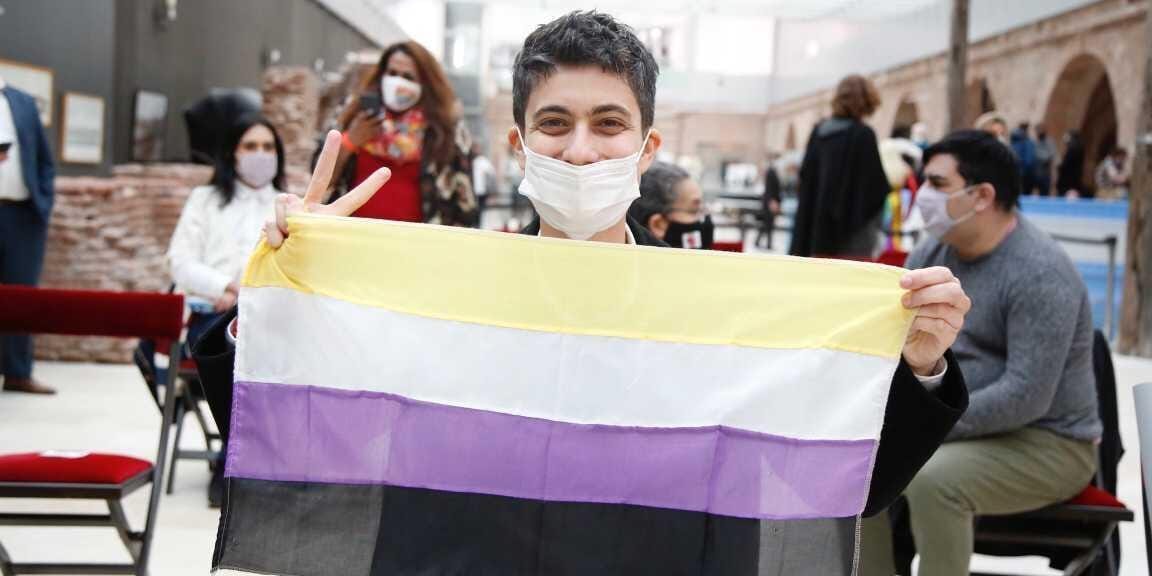
Opening photo: SaSa Testa by Carla Policella.
This Sunday, September 12, there are Open, Simultaneous and Mandatory Primary Elections (PASO) in Argentina, and it will be the first time that non-binary people with a rectified National Identity Document (DNI) will be able to vote, respecting their gender identity.
“Going to vote with my new ID is amazing. Looking up my name on the electoral register with my ID is incredibly gratifying. This time, going to vote feels like the first time, with so many expectations,” Shanick Lucián Sosa Battisti, a non-binary activist from Ushuaia (Tierra del Fuego), told Presentes. Shanick was among the first three people in the country to receive their corrected ID on the day it was announced that Argentina would be eliminating the male-female gender binary on identity documents.
On July 21, when President Alberto Fernández issued Decree 476/21—which establishes the option to mark an “x” in the “sex” field of the national identity card and passport —the deadline for updating the electoral register had already passed. However, the National Electoral Court (JNE) informed Presentes that “measures were taken nonetheless to implement it to the greatest extent possible.”
Initially, online voter registration query was modified by incorporating the gender category "Unspecified", in addition to "Male" and "Female".
After two exhausting years, the celebration of the non-binary ID card
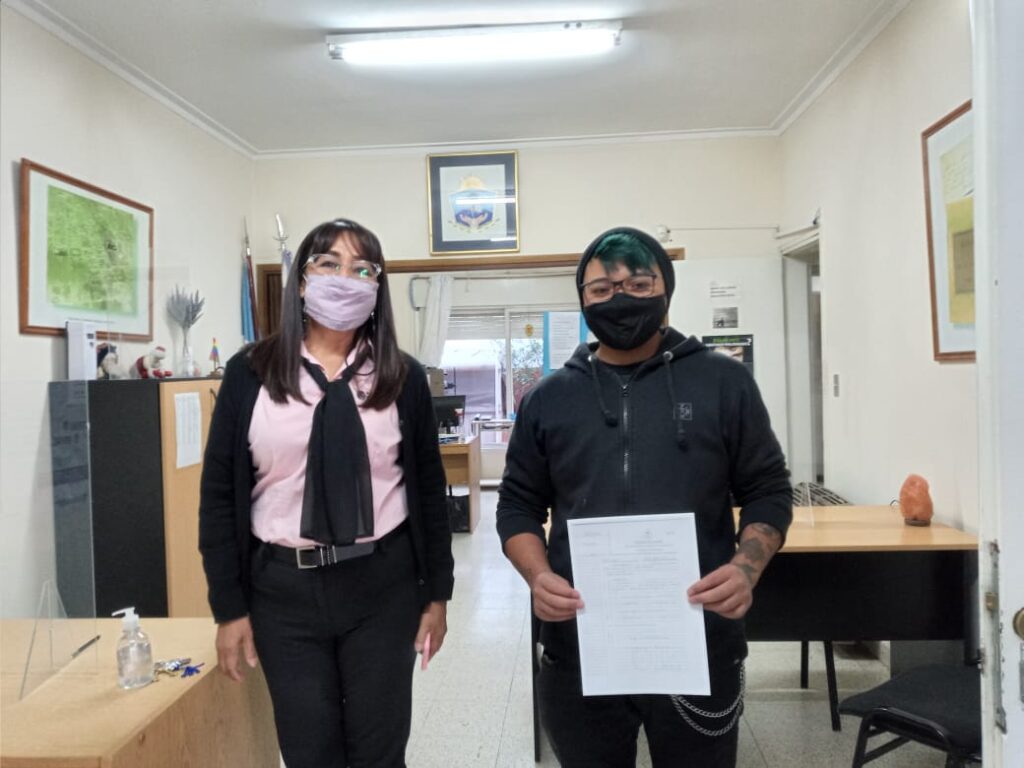
Regarding this, Dann Castro, an LGBTIQ+ activist, sex worker, and tattoo artist, told this publication that although he has already received his corrected ID card with the "X," in the voter registry he still appears under the female gender, even though with his self-identified name. "Even though we have the corrected name, a binary gender is assumed, as well as the pronouns," said Dann, who was the first visible non-binary person to process the new ID card in the province of Neuquén.
Dann belongs to the self-organized group Disidencias Autoconvocades Newken: Cuerpos Autónomames en Defensa del Territorio (Newken Self-Convened Dissidents: Autonomous Bodies in Defense of the Territory). She began the process to rectify her birth certificate on January 9, 2019. Two years later, on May 10 of this year, she received it. A week ago, on August 31, she also obtained her national identity document (DNI).
“These last two years have been exhausting: going to institutions, enrolling in high school, and having to clarify my gender identity and pronouns. I felt invalidated, abandoned,” she expressed.
However, he also said that receiving it was "super exciting" for him. "I celebrated with friends. I used it the same day: I went shopping with my debit card and the card had a different name on it, but the cashier didn't notice, although for me it was a huge deal."
“The identity on the register is not mine”
From San Luis, Ama told Presentes that “the identity currently on the electoral register is not hers” and described how she is experiencing this day. “Election day is a day my 8-year-old daughter looks forward to so she can accompany me to school. But often her enthusiasm is accompanied by confusion when she hears a name at the table that doesn't represent me. She doesn't ask anymore because she knows the answer, so she just gets indignant while she squeezes my hand and I tell her: 'The day they call my name, it will come.'”
Ama has had her birth certificate rectified, and her identity is correctly reflected in her university degree and her Electronic Provincial Identity Card (CIPE), the first non-binary identity document issued by the province of San Luis in 2020. There, under "Sex," it is listed as "NB" (non-binary). She is not currently processing a change to her National Identity Document (DNI) because for the past three years she has requested that it reflect the same identity as her provincial document.
Tegan, a human rights activist with Todes con DNI (Everyone with a National Identity Document), of mixed race, and a resident of Casilda (Santa Fe), will also be going to the polls without the rectified document, but with the birth certificate that indicates their non-binary gender. “My expectation for this Sunday is that the gender identity law will be upheld at the school where I'm supposed to vote. Daily life without an identity document is a constant source of different types of violence, including institutional violence. I hope this will be the exception,” they said.
What measures are in place for non-binary voting?
Another measure taken by the JNE to comply with the decree was to require the National Registry of Persons (Renaper) to report on the procedures underway for the rectification of DNIs with the “x”.
“These procedures were communicated by the National Electoral Chamber to the judges of each respective district so that they could consider the rectification (in the period of additions and deletions) of the identity data of these people in the register,” the Chamber reported.
They also detailed that the printed register does not report the gender of the people, but it does show the first name, and that in many of the new ID cards changes in the name were observed.
“In almost all of the cases reported by Renaper, the judges actually incorporated the correction into the printed register and the web query,” they indicated.
120 days for the administration to adapt
Regarding this, SaSa Testa, a Master in Gender Studies and Policies and a native of the city of Buenos Aires, told Presentes that although she has high expectations for Sunday, she recognizes that "the public administration still has 120 days from the regulation of the decree to adapt all the databases of names ."
And she emphasized: “ I recognize that this decree is a fundamental step forward for the recognition of non-binary identities and the human right to identity .”
Gender identity must be respected beyond what is stated on the national identity document.
Furthermore, the activists highlighted the importance of election workers addressing different identities with dignity, guaranteed by the Gender Identity Law (No. 26,743).
This Sunday, many people who have not yet received their corrected ID card or have not started the process to do so may have a name registered on their ID card that is different from the self-perceived name or even different from the one that appears on the census register.
In light of this, it is worth noting that Law 26.743 establishes in its article 12 that “ the gender identity adopted by individuals, especially girls, boys and adolescents, who use a first name different from the one recorded in their national identity document, must be respected . At their sole request, the adopted first name must be used for summons, registration, files, calls and any other procedure or service, both in the public and private sectors.”
“Let’s normalize asking questions”
The National Electoral Chamber also reported that “ in case of any discrepancy in the information provided, the presiding officer must verify that it is the same person by checking the ID number or any other information, and must allow the vote without any objection.” In this regard, Dann addressed those responsible for election tasks and society in general. “I would like to tell you to use that space to ask for each person's pronouns, without assuming they are cis, trans, binary, or non-binary. Let's normalize asking .” To which Shanick added that she eagerly awaits “respect and empathy” on that day: “We are human and we do something as simple as cis people: go vote,” she concluded.
We are present
We are committed to journalism that delves into the territories and conducts thorough investigations, combined with new technologies and narrative formats. We want the protagonists, their stories, and their struggles to be present.
SUPPORT US

FOLLOW US
Related notes



We are present
This and other stories are not usually on the media agenda. Together we can bring them to light.