

Threats against trans activist Yren Rotela: demands for guarantees from Paraguay
Paraguayan trans activist Yren Rotela has reported receiving death threats. Organizations are demanding an investigation and are requesting guarantees for her safety.


Share

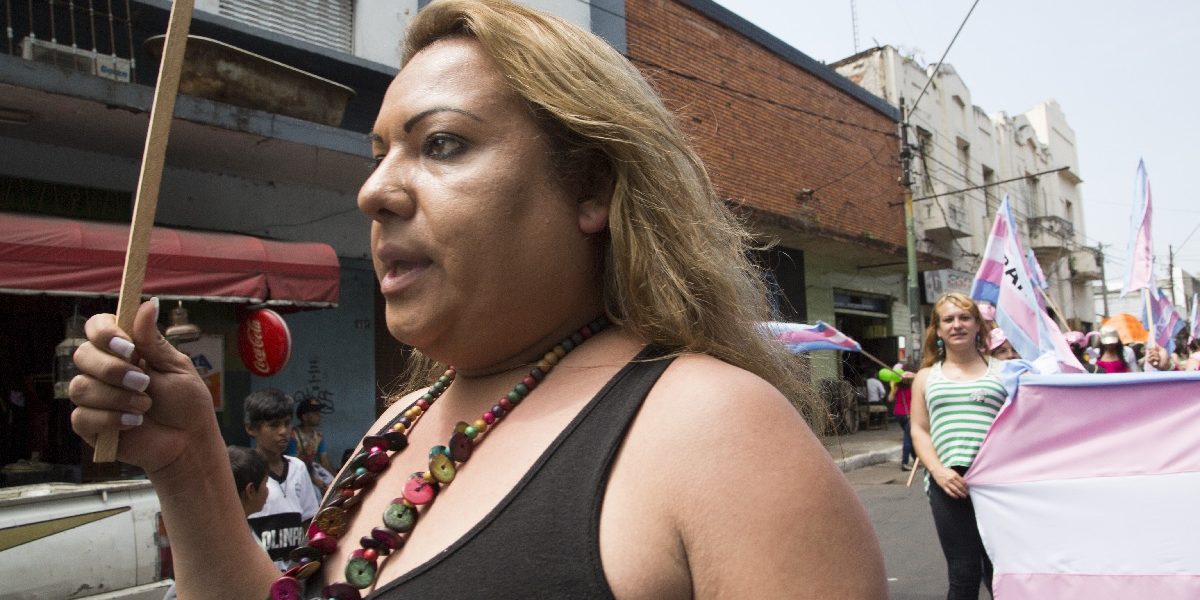
Paraguayan trans activist Yren Rotela reported receiving death threats via telephone on Sunday, August 29, around midnight. “You’re worthless, you’re going to die,” was one of the phrases she received from an unidentified person.
The complaint was filed at Police Station 20 in Central City of J. Augusto Saldívar. Several organizations contacted Rotela, as did the Human Rights Directorate of the Public Prosecutor's Office.
“I went to sleep, got up to get a drink of water, and saw that my cell phone was ringing. I answered it, and a deep voice spoke to me, like one of those people who use a voice changer. He called me by my last name, Rotela, and said, 'You're absolutely worthless. You're going to die, you fucking faggot,'” the human rights defender recounted, adding that after she told the person she was going to file a complaint, he replied that her “days are numbered.”
Previously, Rotela had been inquiring about the death of a fellow trans woman, and she believes the call may be related to this. “I’ve been looking into the murder of a trans woman, Soledad Fernández, in Pedro Juan Caballero—a very dangerous area. She was killed with nine gunshots, and so far there’s no answer as to who did it,” she told Presentes.
Yren is 40 years old and has been a human rights activist for 24 years. “Since then, what I’ve done is try to leave the country a little better than the one I inherited,” the founder of Casa Diversa , Paraguay’s first shelter for LGBT* victims of violence, told Presentes.
They demand guarantees from the State for Yren and activism
The Latin American and Caribbean Network of Trans People (Red Lactrans) condemned the threats and harassment against the leader, and asked the State for " guarantees so that Yren and all activists in Paraguay can continue fighting for human rights ."
This isn't the first time Yren has received threats and harassment. In 2007, there was an attempt on her life: eight shots were fired, three of which struck her. “I always denounced the bribes and the abuses. And I think it was the police. Also, in 2015, a uniformed officer pointed his gun at my head and pulled the trigger, but it seems the safety was on. I always say it has to do with my denunciations, with my work as a human rights defender, because I don't have a problem with anyone.”
Maricarmen Sequera, co-director of TEDIC, an organization that promotes digital rights, explained that this case involves “cyber violence .” Paraguayan law defines cyber violence as “the act of disseminating or publishing messages, photographs, audio, videos, or other material that affects the dignity or privacy of women through current information and communication technologies.”
What can be done in Paraguay in the face of these types of threats?
Sequera adds that beyond this classification, "the penal code contains the legal figures of extortion or harassment for which a person can file a complaint with the police or the prosecutor's office closest to their neighborhood."
“On the one hand,” Sequera says, “criminal charges can be filed. On the other hand, Law 5777/16, which addresses all forms of violence against women, can also be invoked.” She cautions that in Yren’s case, under a government as conservative as Paraguay’s, this legal recourse is unlikely to be available, even though Yren identifies as a woman.
She also clarifies: “while this case can be resolved in technological and/or legal terms, the trans community experiences this type of violence all the time .”
Unprotected human rights defenders in Paraguay
Rotela knows this well and describes the scenario: “The context isn't very easy for human rights defenders; it's somewhat hostile in the sense that you don't have security either. Sometimes the authorities themselves transmit a discourse of hate, transphobia, and violence, so what can you expect? Society perceives us as a threat to families. Human rights defenders are very unprotected in that sense.”
“In Latin America, access to justice is a problem when we're talking about violence or crimes that affect people, and specifically vulnerable groups (LGBT, Indigenous communities, peasant communities),” Sequera summarizes. She adds: “Violence is structural. In the absence of a state that doesn't guarantee rights, Yren and all women find themselves in a situation of isolation, deprived of the constitutional guarantees that everyone should have .”
"Digital violence is real"
Yren, like other activists, also experienced online violence. Fernanda Carlés, project coordinator at TEDIC, mentions some recommendations the organization makes for people to keep in mind when using the internet. “Neither the platforms nor the State offer good guarantees for these types of situations, which is why we work extensively on prevention and safety to avoid sharing more information online than one should,” she explained.
First, it's important to "try to maintain a separation between your public and private profiles," although "it's often complicated because, as an activist, you usually have a public profile." Second, she emphasizes the importance of recording and documenting.
“Sometimes digital attacks or violence aren’t as real as if they happened in the physical world, but the truth is that what happens in both spaces is connected . So we recommend documenting these kinds of things, mainly to have evidence in case it gets to the point where you need to file a complaint,” she explained.
In cases of online threats, harassment, or bullying, there are two ways to report it. “The first is to report it to the platforms themselves, which usually results in the content being taken down or the account of the perpetrator being abusive being blocked. However, this mechanism often doesn't respond to the issue in a timely manner. The second option is to file a report with the prosecutor's office. For this type of report, documentation is crucial: taking screenshots, for example.” Sequera emphasizes that “we shouldn't just focus on punishment and victimhood, but also on prevention and support . Reparation shouldn't only involve finding the aggressor and making them pay for their actions, but also ensuring that the State takes responsibility and provides care through education and respect for all people living in this territory .”
We are present
We are committed to journalism that delves into the territories and conducts thorough investigations, combined with new technologies and narrative formats. We want the protagonists, their stories, and their struggles to be present.
SUPPORT US

FOLLOW US
Related notes
We are present
This and other stories are not usually on the media agenda. Together we can bring them to light.