

What is known about the pork agreement between Argentina and China?
Activists warn of an environmental catastrophe and a breeding ground for future pandemics.


Share

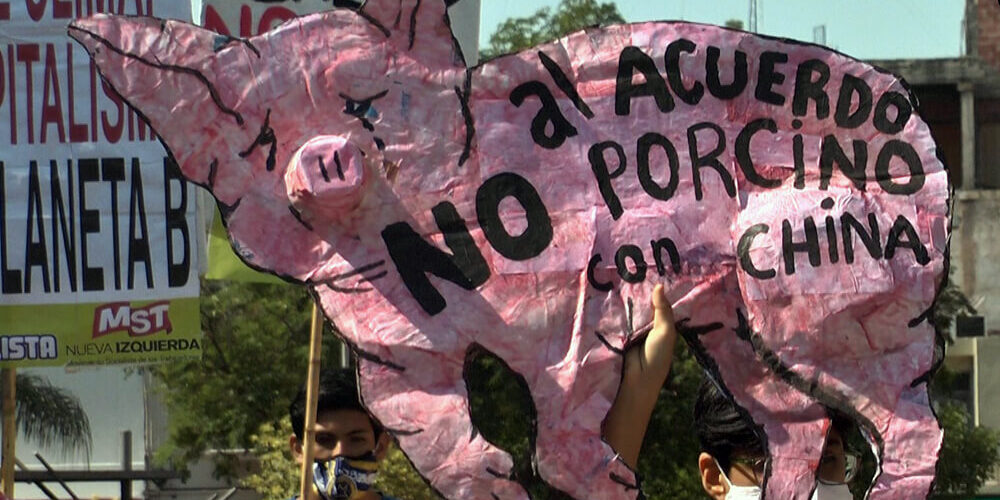
This Wednesday, August 25th, marks one year since the first nationwide mobilization against the pork agreement between Argentina and China, and since then, little to nothing has been revealed about it. For this reason, coupled with the constant back and forth, official statements, lack of clarity, and firm opposition to the project that seeks to exponentially increase pork production in Argentina for export to China, there will be actions across the country today to say: #NoToThePorkAgreementWithChina.
In Buenos Aires, the gathering will take place at 2 PM at the Chinese Embassy, located at Crisólogo Larralde 5349, across from Parque Sarmiento, on the border between the Saavedra and Villa Urquiza neighborhoods. The event will also be replicated in various parts of the country.
“The lack of response is a response,” Malena Blanco, co-founder of the activist organization Voicot, told Presentes, referring to the scant or nonexistent information available about the agreement. She continued: “That’s why, faced with their tacit response, we are rising up. The time to fight is now.”
Lack of information
On Monday, July 6, 2020, the Argentine Foreign Ministry reported through a press release about a conversation between Foreign Minister Felipe Solá and the Minister of Commerce of the People's Republic of China, Zhong Shan, in which the progress of a project "already discussed between the Argentine government and the Ministry of Agriculture of China, on pork production through joint investment between Chinese and Argentine companies" was assured.
He added: “Argentina could produce 9 million tons of high-quality pork, giving China absolute supply security for many years. The China Association for Industrial Promotion and the Argentine Association of Pork Producers have already reached an agreement on this project.”
This news was shared by various activists and journalists who questioned the agreement, and the official information was quickly edited . Instead of “9 million tons,” it now reads “900,000 tons over four years,” and the text adds the clarification “monitoring best practices and incorporating cutting-edge technology to reduce environmental impact.” Journalist Tais Gadea Lara highlighted this in the following tweet .
The questioning and concerns about the agreement continued, and despite the mandatory social isolation measures, they culminated in a nationwide protest on April 25, 2020, with a broad turnout. The demonstration had repercussions: five days later, the Foreign Ministry announced that the agreement was being postponed until November to incorporate into the Memorandum of Understanding with China “an article ensuring respect for environmental protection laws, natural resources, and biosecurity.”
However, November passed, and several more months. “There is no publicly available statement explaining what the agreement entails and what they are trying to sign,” Soledad Barruti, a journalist and writer specializing in food and the food industry, told Presentes.
“First they said it would be signed in November, then they said it wouldn’t be signed, and then (Jorge) Capitanich jumped in to say that he had already taken the first step of this agreement, which was to establish three model farms in Chaco. When requests for access to public information are made, they result in a tweet from the Foreign Ministry saying that this agreement will not be signed and that it doesn’t exist. The situation is so absurd, so bizarre, that it’s completely unbelievable,” he added.
The agreement between the governor of the province of Chaco, Jorge Capitanich, "involves projects totaling $130 million to produce approximately 10,000 sows. Through financing mechanisms from the People's Republic of China, and with an export contract, each of the production projects would, if completed, generate between 300 and 400 jobs," they reported in a statement .
"A violent and perverse event"
In October of that year, the "projects" materialized with the signing of an agreement in which Governor Jorge Capitanich signed a cooperation agreement with the Chinese-Argentine company Feng Tian Food. This agreement enables the establishment of three integrated pig production complexes in the province, destined for export. Each of the three facilities would generate 360 jobs and an annual demand of 32,300 tons of soybeans and 87,400 tons of corn for pig feed, based on an investment of US$129 million.
In addition, the official explained at the time: “Each complex will consist of five farms with 2,400 sows each; an export-oriented meatpacking plant; a biodiesel plant; a biodigester with energy generation; and a feed mill.”
“Confining hundreds of thousands of genetically identical animals in disastrous conditions causes them to get sick, requiring medication, besides being a violent and perverse event,” Barruti stated, and continued: “Besides that, it is a danger: these animals express different diseases - all with pandemic potential - which is why China wants to outsource its production to protect itself.”
This leads one to wonder: what was the reason for seeking to establish mega pig farms in Argentina? Since 2019, China has been experiencing the consequences of an animal epidemic caused by African swine fever (ASF), which reduced its pig population by a third and is estimated to have resulted in the loss of 100 million animals, dropping from an annual production of 54 million tons to 38 million tons. The result was an exponential increase in pork prices and, consequently, a move to imports to meet domestic demand.
"A breeding ground for new pandemics"
Regarding this, Flavia Broffoni, a political scientist, activist, and co-founder of Extinction Rebellion Argentina, told Presentes that “according to all international socio-environmental health organizations, (an agreement of this nature) is a breeding ground for new pandemics. The generation of new antimicrobial resistances, bacteria, and also viruses that cause zoonotic jumps—that is, diseases from non-human animals to us, human animals—occurs primarily in animal industrialization models like these.”
The debate surrounding the pork agreement with China was reignited by an article in the newspaper El Cronista , titled “Argentina and China close the deal to build pig farms and increase exports.” The article provided details about the agreement, stating that the objective “is to build some 25 plants and export 900,000 tons of pork annually.” The news generated widespread attention, particularly on social media, and was picked up by Ámbito Financiero . This time, the official response was swift. “The Argentine Foreign Ministry clarifies that this information is absolutely false and baseless,” the ministry stated, again via a tweet accompanied by a screenshot of the aforementioned article.
The president's response
“There’s a lot of contradictory information out there. A tweet isn’t an official response from the government. For them to do that after months of requests from activists and independent movements asking what they were going to do with these farms, what their plans were, how the treatments would be, how many animals there would be… nothing, zero response. Not even about whether the contract would be signed. The information we have is that the farms are going to be built,” Malena Blanco explained.
Presentes contacted the Argentine Foreign Ministry about this issue, and the inquiry was forwarded to the Ministry of Productive Development. They responded: “There is nothing about that. Not for the installation of 25 farms, nor anything of the sort.”
On the other hand, President Alberto Fernández commented on the agreement two weeks ago in an interview on the Filo.news ." He emphasized that the discussion isn't about whether or not the agreement will be implemented, but rather about "how pork will be produced in Argentina."
“We cannot produce pigs in a way that pollutes the environment. There are ways to produce pigs, and any type of animal, because the problem also occurs with cattle production, while taking care of the environment,” the president said, clarifying that if the agreement moves forward, it will be “with environmental preservation.”
Environmental impacts and animal and human lives
As for the reasons put forward by those who oppose the agreement, they are varied . Flavia Broffoni pointed out: “Beyond the components associated with cruelty and irrationality that, for some of us, industrializing animals for consumption and export represents, there are also the environmental impacts of these production units in terms of water consumption, effluents, and the use of agrochemicals in the agricultural supply chain. Each of these sheds requires 17,000 hectares of genetically modified corn and soy to feed the animals, and 1.5 million liters of water per day. These are production units with very specific characteristics in territories that lack the conditions to support them.”
Regarding this, Soledad Barruti added that “obviously entire areas of our country are becoming unlivable because you can't live with hundreds of thousands of neighbors' animals confined like that. So, basically, they are sacrificing a number of territories, towns, and places—which are obviously always poor, rural, and indigenous—for the sake of a business that hasn't even explained how it would benefit us. But if we follow the general trend of agribusiness, the benefit will be nonexistent because our country is saturated with agribusiness, and 50% of the population is poor.”
“If we aren’t listened to, if what’s coming isn’t heeded, if the IPCC isn’t listened to, if people don’t read about pig farms and all the harm they can cause—from contaminating groundwater and the air, to deforestation and the expansion of the agricultural frontier—we’re in trouble. As a civilization, we have to start changing course. We have to do it for something as basic as our survival,” Malena Blanco concluded.
We are present
We are committed to journalism that delves into the territories and conducts thorough investigations, combined with new technologies and narrative formats. We want the protagonists, their stories, and their struggles to be present.
SUPPORT US

FOLLOW US
Related notes



We are present
This and other stories are not usually on the media agenda. Together we can bring them to light.
1 Comment