

Garifuna people resist murder, criminalization, and forced disappearances
So far in 2021, at least four human rights defenders have been arbitrarily detained, and nearly 30 people have arrest warrants for claiming their right to ancestral territories.


Share

Behind the tourist reviews that present the beaches of the Honduran Caribbean as paradisiacal, and the reality shows that show its islands as virgin and uninhabited places , there are stories of dispossession and violence against the Garifuna people, who resist from their attachment to their culture, their identity and their territory.
The Garifuna Afro-descendant people , present in several Central American Caribbean countries, arrived in Honduras in the 18th century and maintain their own language, traditions and culture, whose survival is directly related to their remaining in their ancestral territories.
Despite this, throughout their history they have suffered dispossession and forced displacement from their lands, first due to the presence of multinational companies dedicated to the export of fruit, which were already established in the 20th century, and later with the rise of tourism and the establishment of monocultures to generate palm oil, a product of which Honduras is the eighth largest exporter in the world .
The long history of persecution, repression, assassinations, and disappearances against Garifuna leaders, as well as Indigenous people, environmentalists, and other human rights defenders, has intensified since the 2009 coup, making Honduras the most dangerous country in the world for defending land, water, and natural resources, according to Global Witness Aurelia Arzú , deputy coordinator of the Honduran Black Fraternal Organization (OFRANEH) , which fights for the rights of the Garifuna people in Honduras, in a telephone interview
Arzú cites as examples of the persecution against this people the murder of the leader of the Garifuna community of Punta Piedra, Antonio Bernárdez, in June 2020, the arbitrary detention and criminalization of four Garifuna land defenders between March and July 2021, and the forced disappearance, more than a year ago, of four young people from the community of Triunfo de la Cruz.
Four criminalized human rights defenders
Between March 3 and July 10, 2021, four Garifuna human rights defenders were arbitrarily detained: Jeny Boden Ruiz, Silvia Bonilla, and sisters Jenifer and Marianela Mejía Solórzano , according to data from the Inter-American Commission on Human Rights (IACHR) and the Office of the United Nations High Commissioner for Human Rights in Honduras (OHCHR), which have rejected the “criminalization of Garifuna human rights defenders”.
The four defenders belong to the Garifuna community of Cristales and Río Negro, which has been denouncing for years the occupation of parts of its ancestral territories by hotels and tourist resorts, and the impact of cruise ship terminal activity. Many of these businesses are owned by foreign investors, such as Canadian Randy Jorgensen , founder of a pornography platform and known as “the King of Porn” in his country.
The four women human rights defenders who have been criminalized have been accused of crimes including property damage, threats, theft, and land grabbing, in proceedings that both the IACHR and the OHCHR describe as “misuse of the criminal justice system as a form of harassment” against women human rights defenders. They also warn that this criminalization “promotes a collective stigma” and sends an intimidating message. “It is unacceptable that they violate us, imprison us, and accuse us of stealing our own lands, which are rightfully ours,” says Arzú. The defender points out that Silvia Bonilla, 73, was arrested while on public transportation, handcuffed, and held overnight before being taken to the city of Trujillo. “It is a complete disrespect to her age, and they didn’t even ask about her health,” emphasizes the OFRANEH representative.
Both Bonilla and Jeny Boden underwent a court hearing and were acquitted due to lack of evidence against them, while the Mejía Solórzano sisters are subject to alternative measures to pretrial detention, awaiting trial, and could face a ten-year prison sentence. In addition to them, approximately thirty other people have arrest warrants issued against them in connection with the same legal case.
“The timing of the sisters’ arrest is worrying, as it took place one day before the hearing to monitor compliance with the 2015 judgment in favor of the Garifuna communities issued by the Inter-American Court of Human Rights,” Mary Lawlor, in a statement . The Special Rapporteur is referring to the judgments issued by the Inter-American Court in favor of the Garifuna communities of Triunfo de la Cruz and Punta Piedra, in which it recognized the violation of their rights and demanded that the Honduran State grant title to, demarcate, and delimit the traditional territories of the Garifuna communities.
The hearing to review compliance with these measures was held on March 4, 2021, and the Inter-American Court found that the Honduran State has not met the deadlines set for reparations to the communities and the demarcation of their territories, and that its efforts to comply with the judgments have been “slow” and “insufficient.” The Court also urged the Honduran government to guarantee the protection of the right to life of the Garifuna communities, following the enforced disappearance of four young people from the Triunfo de la Cruz community in July 2020.
Four young people missing
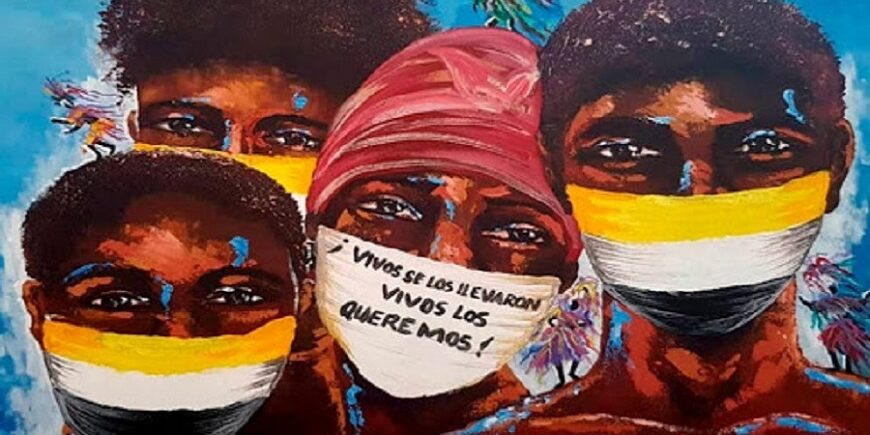
On July 18, 2020, at approximately 5:30 a.m., a group of armed men wearing vests from the Directorate of Police Investigations (DPI) forcibly entered the homes of four members of the Garifuna community of Triunfo de la Cruz and detained Milton Joel Martínez Álvarez , Suami Aparicio Mejía García, Gerardo Misael Trochez Calix , and Alberth Sneider Centeno. They have been missing ever since.
Sneider Centeno is a community representative from Triunfo de la Cruz, a member of OFRANEH, and had played a leading role in monitoring the 2015 Inter-American Court of Human Rights ruling that mandated the demarcation of lands and reparations for his community. In September 2020, the Court itself ordered the State to investigate and locate the four missing human rights defenders, but a year later, there has been no progress in the investigations, nor have the perpetrators been identified. “It has been a year of suffering for the mothers of our comrades, their families, and the entire Garifuna community, a year without knowing where they are or what happened. The State remains silent, refusing to answer, ignoring what occurred. It is outrageous how they were able to enter the communities, even their homes, to kidnap them and violate their rights,” says Arzú.
Faced with the State's inaction, relatives of the disappeared and activists from OFRANEH have launched a Committee for the Investigation and Search of the Disappeared of Triunfo de la Cruz ( SUNLA , in its Garifuna acronym), but Honduran authorities refuse to allow it to participate in the investigation. “We demand that SUNLA be recognized, since the State has no intention of conducting a thorough investigation. We demand to know what happened to our disappeared comrades. We want to know where they are, why they are not here with us,” says Aurelia Arzú.
Erika Guevara Rosas Amnesty International's Americas Director , stated in a telephone interview that "the rejection of the SUNLA (National Union of Law Enforcement Officers) is a sign of the authorities' lack of commitment and will to find the four missing activists alive and to guarantee the rights to truth, justice, and reparations for their families." Guevara Rosas also noted that at the time of the disappearances, the Triunfo de la Cruz area was under mobility restrictions to contain the COVID-19 pandemic, meaning that only police officers were allowed to enter the territory.
Luxury hotels and land grabbing
Viewed on a map, Triunfo de la Cruz appears as a town nestled on the Honduran Caribbean coast. Along one side of the municipality, the coastline is dotted with tourist establishments, ranging from campsites to hotel complexes like the Indura Golf & Beach Resort , part of the luxury Hilton hotel chain. A night at this hotel can cost between $127 and $192 per person, almost half the minimum wage in Honduras, which is set at 10,022 lempiras (about $417).
In 2014, plans were drawn up to expand this hotel complex onto Garifuna territory, leading to attempts at the forced eviction of the Barra Vieja community and the criminalization of more than 60 of its residents, according to a report by the NGO Global Witness. The report details that the Honduran state deployed 80 soldiers and 60 police officers with heavy machinery to carry out the evictions and filed charges against residents through the National Port Authority. The government's interest in the development of the hotel complex is clear: it owns half of the company promoting the Indura Beach & Golf Resort.
“The State protects the economic interests of large tourism corporations in the Honduran Caribbean, to the detriment of the human rights of the Garifuna communities in the area,” states Erika Guevara Rosas. She adds that, although this dynamic of land dispossession is a “historical issue,” it has deepened since the 2009 coup d'état, as a result of the “institutional weakening” in the country, and has become even more critical during the administration of current President Juan Orlando Hernández, in office since 2014.
Arzú, for his part, criticizes the Honduran state for labeling members of the Garifuna communities as “brutes” and people who “refuse development,” in a racist and stigmatizing discourse. “It is not true that we refuse development and progress, but we have the right to be consulted about what is going to be done in our territories. We have cared for these lands for years and years and years; we have been here since before Honduras was a republic, and we have the right to be consulted ,” he affirms.
The memory of the defenders
If we return to the map, beyond the hotels and golf courses, on the edge of the municipality of Triunfo de la Cruz, a large green patch appears: Jeanette Kawas National Park. This expanse of mangroves, swamps, and rainforest is named after a Honduran environmental activist who denounced illegal logging in protected areas and opposed several business projects that damaged ecosystems. Kawas was murdered in her home in February 1995, days after participating in a protest against the granting of land titles in Punta Sal National Park. In 2009, the Inter-American Court of Human Rights condemned the Honduran state for its responsibility in her murder.
The Kawas case is sadly reminiscent of another, more recent and well-known case: that of Berta Cáceres , the Honduran environmental activist murdered in 2016 for her opposition to the Agua Zarca hydroelectric project , which threatened the rights of the Lenca indigenous people. In July 2021, a Honduran court convicted David Castillo , an executive of Desarrollos Energéticos SA (DESA), the company promoting the project, as the mastermind behind Berta Cáceres's murder. “If it weren't for international pressure, that sentence wouldn't have been handed down. It's a small step, but it doesn't satisfy us; we're not happy. We want more, because Berta Cáceres's true murderers are free,” says Aurelia Arzú. For Erika Guevara Rosas, the sentence against Castillo is “a very important step” in the search for justice for the crime, but she admits that “it is not enough” and that it is still necessary “to investigate the intellectual perpetrators at all levels” who were involved in the murder.
The precedents set by Jeannette Kawas and Berta Cáceres, and the current cases of persecution, murders, and forced disappearances, serve as a warning to Garifuna women human rights defenders in Honduras, who choose to continue their struggle despite everything. As OFRANEH defender and leader Miriam Miranda in an interview with Pikara Magazine : “I feel I must fight to leave future generations a better country. That is fundamental to the struggle. That is why I am not giving up and not leaving Honduras. It is a risky decision because I am in the crosshairs, but I will do everything possible to avoid what happened to Berta Cáceres.”

*This article was originally published in Pikara. To learn more about our partnership with this publication, click here .
We are present
We are committed to journalism that delves into the territories and conducts thorough investigations, combined with new technologies and narrative formats. We want the protagonists, their stories, and their struggles to be present.
SUPPORT US

FOLLOW US
Related notes



We are present
This and other stories are not usually on the media agenda. Together we can bring them to light.