

A first survey sheds light on what it's like to be intersex in Mexico
Intersexuality is a form of bodily diversity. Intersexuality is not a sexual orientation, a gender identity, or a "third gender."


Share

The Mexican organization Brújula Intersexual and the National Council to Prevent Discrimination (CONAPRED) conducted the first survey on intersex people in Mexico, which seeks to contribute to making visible the problems faced by this population with information that promotes the construction of public policies and reforms necessary to guarantee their human rights.
“For years, intersex activism has tried to raise awareness about all that is socially silenced and unknown, and what is ignored cannot be addressed. The Intersex Survey brings visibility to the complex reality of intersex people in our country. We believe this tool is a fundamental step towards a fairer and kinder world, less prejudiced and less violent towards intersex people,” commented Laura Inter , founder of Brújula Intersexual (Intersex Compass ).
Intersexuality Intersexuality is not a sexual orientation, a gender identity, or a "third gender." Intersex people are those born with variations in their sex characteristics that do not fit typical male or female definitions, and these variations do not in themselves represent a health problem; therefore, intersexuality is not a pathology.
Brujula Intersexual is the first intersex activist collective in Mexico. It emerged in 2013 and since then has worked to generate information about the right to autonomy and bodily integrity of intersex people and to build community with other Spanish-speaking intersex people.
The survey was conducted between November 8, 2019, and January 31, 2020. Brújula Intersexual participated in the design and presentation of the results of the first Intersex Survey in Mexico, in which 89 intersex people participated, mostly adults and young people (47% and 45%, respectively) from 24 of the country's 32 states.
Unnecessary surgeries without consent
According to the Intersex Survey, 39.8% of intersex people reported having had some surgery and 9.1% were not sure whether or not they had undergone any procedure, and almost half said it happened in their childhood: 22.4% in early childhood and 24.5% in childhood; 30.6% in adolescence and 22.4% between the ages of 18 and 30.
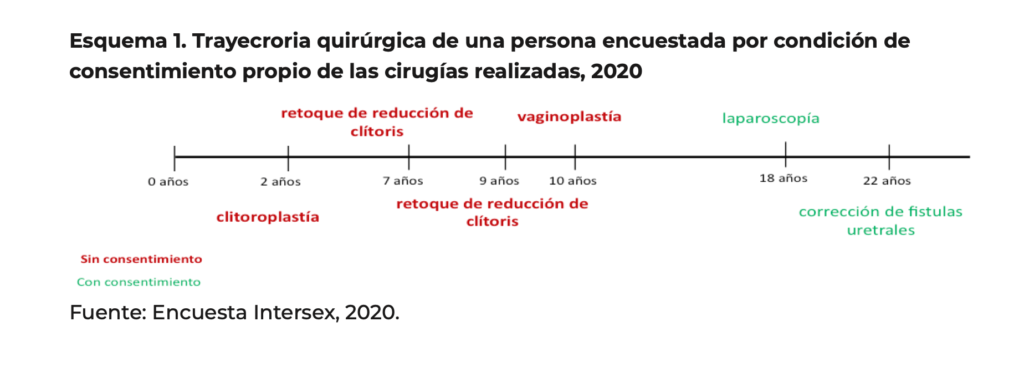
Laura Inter comments that among the main human rights violations experienced by intersex people is the performance of genital surgeries and other invasive and unnecessary medical procedures in childhood, without their own consent or adequate information.
“The medical protocol recommends genital surgery at early ages, basically for “cosmetic” reasons, so that the genitals have a more typically feminine or masculine appearance, and so that they can engage in heterosexual sexuality, that is, the practice of vaginal penetration, assuming that all people will want to engage in that sexual practice and will have a heterosexual orientation, and also overlooking the fact that there are many more practices in sexuality than just penetrating or being penetrated, and thus violating the most basic human rights such as the right to bodily integrity,” he explains.
In addition, slightly more than 6 out of 10 intersex people reported that the surgeries they underwent were without their consent, and only 5% informed their parents or guardians of the option to delay irreversible medical interventions until they were of legal age and understood the procedures and their consequences.
“The surgeries are extremely painful and carry many physical and psychological consequences such as partial or total loss of genital sensation, pain, infections, scarring, depression, anxiety, and traumas whose impact is similar to that produced by sexual abuse. There are even medical guidelines that mention that the surgery helps strengthen the “parental bond,” as if a mother or father were incapable of loving their daughter or son as they are,” says Laura Inter.
In the Intersex Survey, a 34-year-old woman reported having undergone 15 surgical procedures. “Doctors repeatedly referred to my body needing to be 'corrected' through surgery so that I could have sex with my husband when I got married,” she recounted.
“Without information you feel like a freak, a monster”
For Laura Inter, the importance of this survey also lies in the fact that intersex people have lived for many years without information about their own congenital variation.
“We have lived in ignorance, we do not know what happens to our bodies because of the concealment and secrecy in hospitals that frequently do not allow us to have access to our medical records, in addition to the fact that our families commonly do not talk to us about the subject, and sometimes they hide information from us.”
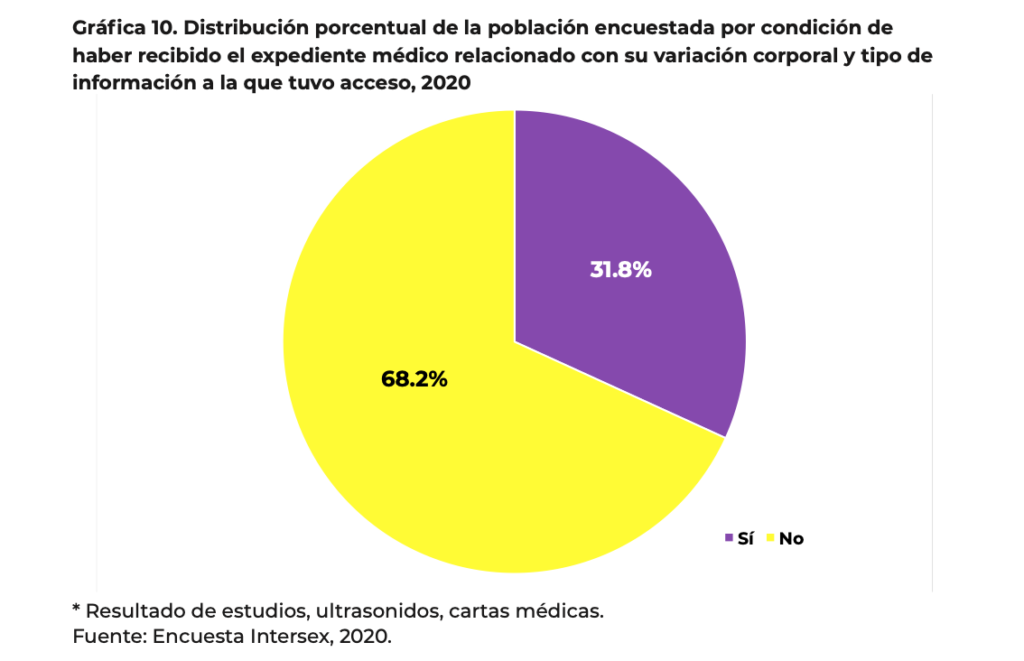
The Intersex Survey reveals that 68.2% of respondents have not had access to information about their congenital variation, and only 31.8% have had access to it through their medical record.
Laura Inter insists that “the fundamental problem for intersex people is not the assignment of a binary gender at birth. Every person—whether born with an intersex body or not—is assigned a gender at birth, and there is no guarantee that the person will identify with that gender. The problem, as intersex activist Morgan Carpenter says, is what is done medically to make our bodies conform to those norms.”
The survey also reveals that 44% of people currently live with a gender identity that does not correspond to the sex they were assigned at birth. The report explains that the problem lies in the fact that these individuals were subjected to invasive and unnecessary medical procedures intended to reinforce the sex assigned at birth, especially during childhood or adolescence—without their knowledge or consent—resulting in “irreparable and irreversible damage for the rest of their lives.”
Violence and discrimination in health settings
Intersex people face discrimination when attending health services; according to the data, 58% reported going to the doctor only when needed, and 42% stated they did not seek treatment in these spaces or did so with home or alternative remedies.
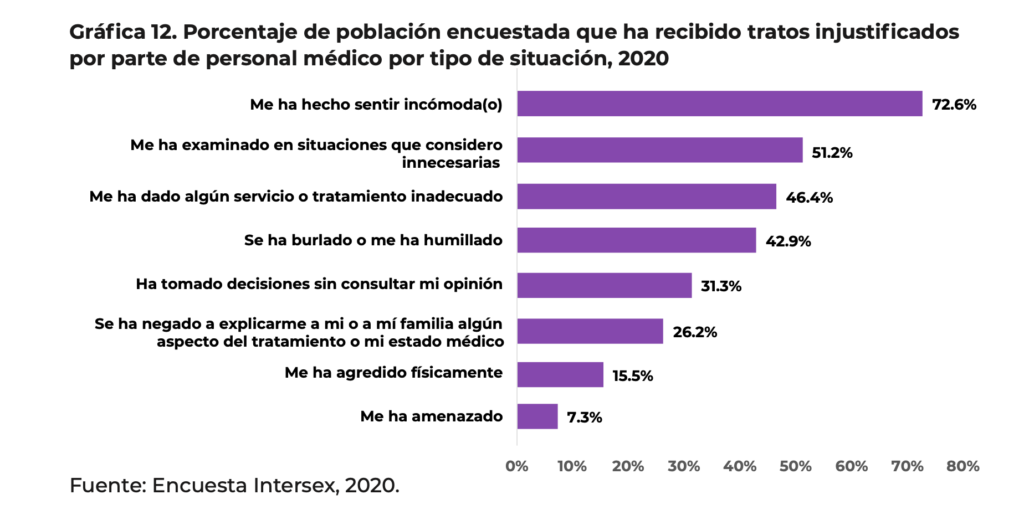
They also reported that medical personnel treated them in ways that violated their dignity. One in two intersex people said they had been examined in unnecessary situations, and three out of ten reported that decisions about their bodies had been made without their consent. They also reported experiencing ridicule, physical assaults, and threats.
School: a hostile place for intersex teenagers
The survey reveals that public spaces such as streets, public transportation, and restrooms, as well as schools, are environments where intersex people experience the most discrimination. However, it is in educational settings where intersex adolescents face the most violence.
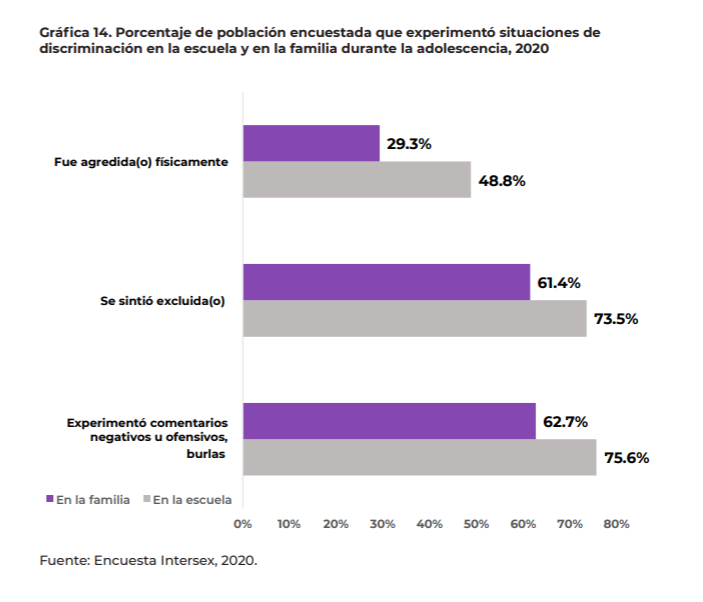
About the survey
During the First Latin American and Caribbean Conference of Intersex People in 2018, the San José Declaration of Costa Rica , calling on States to compile data to inform public policies that benefit intersex people and to understand their realities, with the aim of making their experiences and the challenges they face more visible. In this sense, the Intersex Survey is a powerful exercise in activism that opens the door to understanding, raising awareness of, and promoting the human rights of intersex people in Mexico.
And while the results are representative of the surveyed population but not of the entire Mexican intersex population, this is an important record of their needs and experiences in health services, their self-knowledge, their emotional well-being and the social prejudices they have faced.
Laura Inter adds: “In Mexico, we know a large number of intersex people, but we didn't know how many would respond, because answering a survey like this involves confronting painful situations from our past, and others we are experiencing in the present, and that is always difficult. Other factors also played a role, such as the lack of internet access in many parts of Mexico, and the fact that not all people born with variations in sex characteristics feel addressed by the term “intersexuality,” or even know it, and that may have prevented them from deciding to open and answer the survey. However, we promoted the survey within groups of specific intersex variations.”
During the presentation of the results of the Intersex Survey, the Undersecretary of Human Rights, Population and Migration of the Ministry of the Interior, Alejandro Encinas Rodríguez, stated, “The Intersex Survey is valuable because it tells us what the outstanding issues are and exactly where they are located, and that is why today I want to assume the commitment of this government to counteract the violence, discrimination and exclusion of intersex people.”
She announced that achieving this requires promoting initiatives such as limiting unnecessary surgeries and medical procedures; reviewing official health regulations to propose reforms against any provision that violates the human rights of intersex people; and ensuring compliance with the guidelines for guaranteeing access to healthcare free from discrimination for LGBTI people . She also stated that anti-discrimination measures will be promoted to combat bullying in schools and promote inclusion in the workplace.
For Laura Inter, this is very important because "it is the first time that the Mexican government has recognized the violence experienced by people born with variations in their sexual characteristics, and we will be monitoring the actions taken in future projects."
We are present
We are committed to journalism that delves into the territories and conducts thorough investigations, combined with new technologies and narrative formats. We want the protagonists, their stories, and their struggles to be present.
SUPPORT US

FOLLOW US
Related notes
We are present
This and other stories are not usually on the media agenda. Together we can bring them to light.