

Flag-waving protest for trans memory sweeps across Argentina
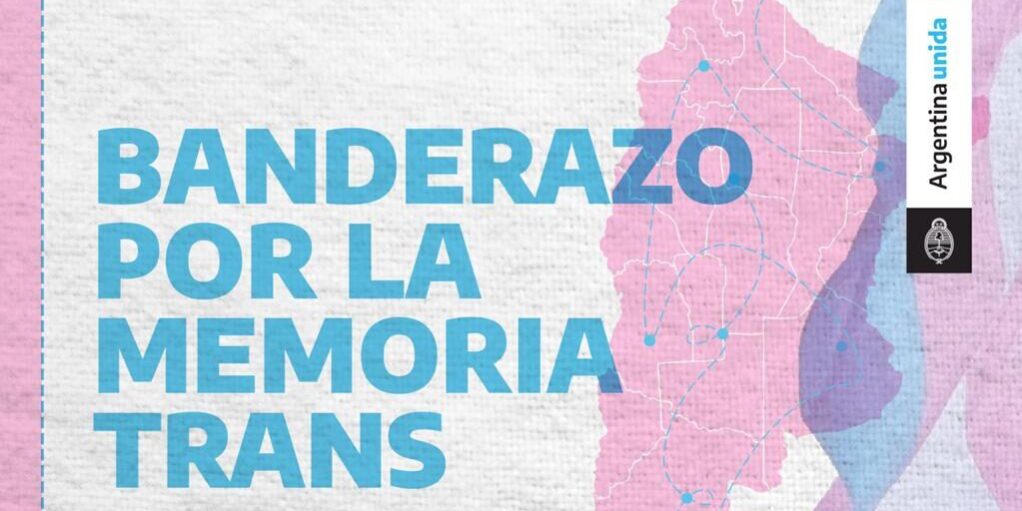
In an initiative promoted by the Trans Memory Archive, an immense pink, white and light blue flag will travel the country to reach the Memory and Human Rights Space (former ESMA) in the city of Buenos Aires on November 20, International Trans Day of Remembrance.

Share

This Friday, July 23, a Trans Memory Flag Parade will tour Argentina. This federal initiative, promoted by the Trans Memory Archive with the support of the Ministry of Women, Gender and Diversity, demands historical reparations for the trans community. The first stop will be the Government House in Santa Fe, and then the flag will travel to different locations throughout Argentina. “It is a collective action to remember our dead,” said María Belén Correa, founder of the Archive.
A trans flag - pink, white and light blue - 15 meters long and 7.5 meters wide will travel through the provinces to reach its final destination at the Memory and Human Rights Space (former ESMA) in the city of Buenos Aires on November 20, International Trans Day of Remembrance.
“The Trans Memory Flag Rally is a nationwide action that invites us to unite to remember and honor our murdered, disappeared, or deceased comrades. We write their names on the flag, and with that simple gesture, we refuse to forget them. To remember means: To relive them in our hearts,” stated the Trans Memory Archive.
The tour continues on July 24 at the National Flag Memorial in Rosario (Santa Fe). On both occasions, the Flag Rally for Trans Memory will take place at 4 p.m. “As Carlos Jáuregui said, every historical act must be within a historical context. That is why the tour was chosen to begin in the province of Santa Fe, given that the national flag was created in Rosario,” Correa explained.
The idea of the flag-waving protest originated in Spain, where María Belén Correa first saw it. In Argentina, the flag was made by the Empoderamiento Travesti Trans textile cooperative, which operates out of the Hotel Gondolín in Buenos Aires, and it has some modifications compared to the Spanish version. This one is larger and has a protective black net-like mechanism with 32 handles spaced one meter apart for added strength.
How can you collaborate with this activity? “If you are someone who likes the work of the movement, you can help us by documenting the action, taking photos and videos in each province where the flag is passing through. And if you are a trans person, you can attend so that we can carry it and remember each one of our own,” Correa said.
The initiative has the support of the Ministry of Women, Gender and Diversity, which will cover the postage costs to transport the flag from province to province, as well as the labor and materials.
“While we celebrate the trans job quota, the demand of this demonstration is for a comprehensive law, historical reparations, recognition and redress, remembering those who risked their lives,” she concluded.
The flag transfer is scheduled week by week as follows:
July: Santa Fe, Entre Ríos and Corrientes.
August: Misiones, Chaco and Formosa, Santiago del Estero, Tucumán, Salta, September.
Jujuy: Catamarca, La Rioja, San Juan.
October: Córdoba, San Luis, Mendoza, La Pampa, Neuquén.
November: Chubut and Rio Negro, Santa Cruz and Tierra del Fuego, Federal Capital
August: Misiones, Chaco and Formosa, Santiago del Estero, Tucumán, Salta
September: Jujuy, Catamarca, La Rioja, San Juan
October: Córdoba, San Luis, Mendoza and La Pampa, Neuquén
November: Chubut and Rio Negro, Santa Cruz and Tierra del Fuego. Federal Capital
We are present
We are committed to journalism that delves into the territories and conducts thorough investigations, combined with new technologies and narrative formats. We want the protagonists, their stories, and their struggles to be present.
SUPPORT US

FOLLOW US
Related notes
We are present
This and other stories are not usually on the media agenda. Together we can bring them to light.