

Many ways to say friend
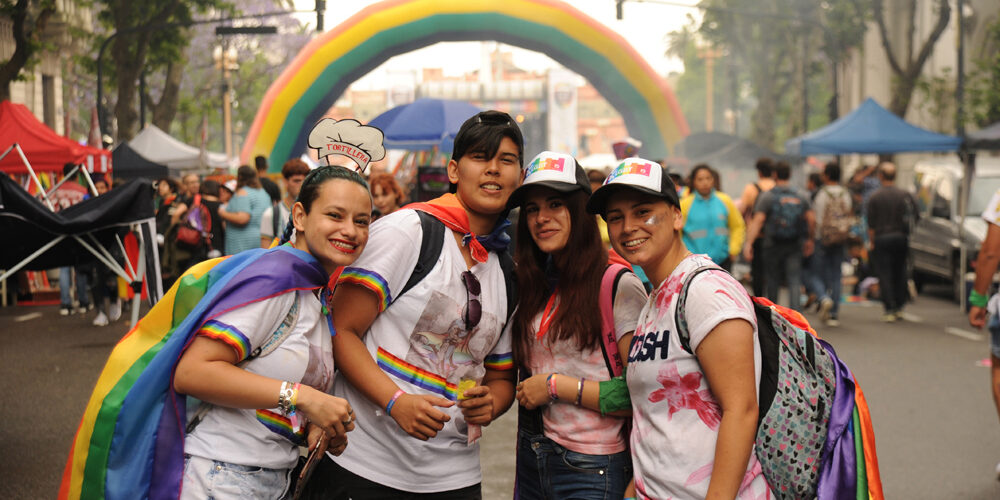
We talked with Violeta Alegre, Bruno Silva, and Alejandra Devenuta about friendship and LGBT people, chosen families, and the groups we work with.


Share

Why celebrate friendship—a bond that is often more important than family ties and provides support in countless situations—only once a year? Furthermore, why do some people tend to consider it a secondary bond compared to blood relatives or romantic partners? What place do we give to friendships in our lives? Is it also a space where violence exists?
We talked about friendships and LGBTIQ+ people with teacher and transvestite activist, Violeta Ríos Alegre; researcher and psychologist, Bruno Gabriel Silva D'Angiola; and sexual, gender, affective activist and psychologist, Alejandra Devenuta.
While everyone experiences relationships differently, there are certain commonalities among the LGBT+ community. Many individuals within the community are ostracized by their families, excluded from state institutions, and/or suffer various forms of violence. “ For many LGBT+ people, friendship groups are the first people who acknowledge their identity and existence . Finding someone who sees me as an equal and recognizes me gives immense value to that connection. It's a space where you can be yourself and be recognized,” explains Silva D'Angiola, a specialist in gender, diversity, and territories.
Alejandra Devenuta adds that “faced with violence, the expulsions we sometimes experience from childhood from family and partners, friendships are often those affective networks that are more a matter of choice. We may also choose our partners, but there is a mandate, like a project we have to aspire to, especially those of us who have been socialized as women.”
Networks of friendship and care
Sometimes, lived experiences of violence also generate feelings of empathy among people in the community and strengthen the creation of a care network. “I see it in the women who are sex workers. For example: the care they take on the street, how they look out for each other, how they create that specific care with clients, the codes, a common language that other people don't understand. It's a worldview completely different from the cisheterosexual world. With a specific humor too, which is often acidic, something harsh for other people, but which also saves us,” observes Violeta Ríos Alegre.
People who have experienced hostile environments and difficulties accepting themselves or being recognized and valued by their families may find it harder to trust others. “In many cases, some of the aftereffects can be difficulties forming social relationships. This can include significant inhibition, shyness, or even fear or rejection of social settings. Whatever the reason, some people reach adolescence or adulthood without many friends, without much desire to socialize, or with difficulty doing so. The concept of having many friends is often idealized. But I also think it's important to have at least one person with whom they feel they can talk, build trust, or feel heard,” says Silva D'Angiola.
Like any bond, friendship is also shaped by the context in which it develops. “Sometimes we believe that certain identities, or certain people with non-hegemonic identities or orientations, are outside of logics that actually affect us all: patriarchy, romantic love, affective capitalism, and other factors as well,” says Bruno. In this sense, jealousy, possessiveness, judgmental mechanisms, intrusiveness, and even unequal power dynamics often arise among friends. For Violeta Alegre, it's a “lesson that affects us all.”
"We come from a deprivation of affection"
Furthermore, specifically regarding how she addresses the LGBT community, she explains: “ We come from a world that has been completely deprived of affection, a world that practically leaves you out of the emotional landscape . Sometimes you find someone with whom you can share loving experiences—as difficult as that is for us—and you might become incredibly obsessed or experience it much more intensely. You want them to be yours. It's about not wanting to lose what makes you feel good. It's a matter of needing that affection, and it's logical that you need it; who doesn't? Often, you lack the self-awareness, self-esteem, or emotional intelligence to cope with it differently.”
Even in friendships, especially in very insular groups, violence is tolerated for fear of losing that space. “We all have friends with whom we’ve experienced violence. And yet we maintain the friendship out of fear of what will happen if I stop being their friend, because I feel sorry for them after so many years of friendship, because I try to justify their behavior,” says Bruno.
However, friendships are also spaces where the mandates of possession and hierarchy are not as strong as in other relationships. Violeta points out that “there are no known hate crimes among friends.” Along these lines, Ale Devenuta reflects on the power of friendships “in being able to build relationships that actively try to escape contracts of exclusivity and possession, even knowing that we will be affected by them, that we cannot erase a historical context, a way of being raised. That is why I think of friendships as places of escape and of more horizontal construction.”
What place do we give to friendships?
What place do we give to friendships? “The interesting thing is to actively question, in our concrete daily actions, how much space our friends occupy in our lives. With whom do we manage, or with whom do we think about managing, cohabitation, sharing our finances, sharing our care. In that sense, it's very clear at a social and structural level how we often end up prioritizing family and romantic partners. I think it's good to reclaim friendships, not necessarily with the goal of destroying hierarchies, but perhaps the strategic aim is to re-establish them,” Devenuta reflects.
She adds: “In this sense (not everyone and not always), but there is something about queer communities that has historically questioned this place of friendships , where they end up. And not only our friends but also our fellow activists, for example.” For Violeta, addressing these issues becomes crucial at this time: “We urgently need to build other ways of relating to each other.”
We are present
We are committed to journalism that delves into the territories and conducts thorough investigations, combined with new technologies and narrative formats. We want the protagonists, their stories, and their struggles to be present.
SUPPORT US

FOLLOW US
Related notes


We are present
This and other stories are not usually on the media agenda. Together we can bring them to light.