

For the first time, a case of discrimination against a gay couple in Peru reaches the Inter-American Court of Human Rights
After 17 years, the discriminatory violence suffered by Crissthian Olivera at the hands of the Peruvian State reached the Inter-American Court of Human Rights.


Share

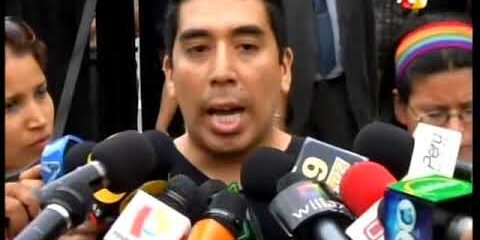
Crissthian Olivera has had to wait almost 17 years for the Inter-American Court of Human Rights to review his case since he suffered discriminatory violence along with his then-partner while shopping at a supermarket in the San Miguel district of Lima.
“ The arrival of my case at the Inter-American Court of Human Rights gives me back the hope of finally achieving the justice that was denied me in my country. It is the possibility of healing the wounds caused by institutionalized and normalized homophobia ,” Olivera stated upon learning of this development.
The incident occurred on August 11, 2004, when the couple was in the supermarket cafeteria. They were displaying affection like any other couple, but a complaint from another customer, who stated that two men were "committing homosexual acts" and that this made him uncomfortable because he was with his minor children, prompted the cafeteria staff to reprimand the couple and ask them to leave.
A week later, they returned to the supermarket with a heterosexual couple who displayed the same affectionate behavior, but the staff only reprimanded them. Olivera reported the discrimination to the consumer protection agency, the National Institute for the Defense of Competition and the Protection of Intellectual Property (Indecopi), on October 1, but his request was rejected on August 31, 2005. Olivera appealed, obtaining a final unfavorable decision on April 11, 2011.
The unsuccessful search for justice in the Peruvian judicial system led Olivera to turn to the Inter-American Commission on Human Rights with the support of the feminist organization Demus .
In Court
On November 29 2011 , Demus filed Petition P-1718-11 with the Inter-American Commission on Human Rights, alleging violations of Olivera's rights. Ten years later, on June 4, 2021 , the IACHR presented the case to the Court, establishing the State's international responsibility for violating Crissthian Olivera's rights to equality and non-discrimination, privacy, due process, and judicial protection, as a consequence of discriminatory acts based on his sexual orientation.
Presentes spoke with Sayda Lucas, coordinator of the landmark litigation in the case and co-director of Demus, who stated that “ they hope to obtain a favorable ruling that includes reparations for Crissthian and establishes the State's responsibility for the violation of his rights to equality and non-discrimination, privacy, judicial guarantees, and judicial protection. We hope the Court will rule on the validity of public displays of affection by LGBTQ+ individuals .” She added that “ currently, although the case is before the Inter-American Court of Human Rights, it is still in the first stage (preliminary examination stage); we are waiting for the Court to admit the case .”
The IACHR, in its merits report on this case, indicates the recommendations to the Peruvian State, such as comprehensive reparation, the adoption of measures aimed at preventing the repetition of the events of this case, such as implementing public policies to promote the rights of LGBT people in society and their social acceptance, training for justice operators, adopting measures that require, promote and guide companies to comply with the inter-American standards on non-discrimination in their consumer relations, and measures necessary to promote the ratification of the Inter-American Convention against all forms of Discrimination and Intolerance.
This is the first case of its kind to reach the Court and will allow for the establishment of standards regarding the burden of proof in cases of homophobic and gender expression discrimination. A favorable ruling is expected within two years.
We are present
We are committed to journalism that delves into the territories and conducts thorough investigations, combined with new technologies and narrative formats. We want the protagonists, their stories, and their struggles to be present.
SUPPORT US

FOLLOW US
Related notes


We are present
This and other stories are not usually on the media agenda. Together we can bring them to light.