

The Buenos Aires justice system once again turns its back on a gay couple attacked in Palermo
For the second time, the case investigating the hate crime suffered by a gay couple in Palermo (City of Buenos Aires) in September 2020 was shelved.



Share

The Buenos Aires justice system has once again turned its back on Pablo Cavaignac and Cristian Jacobsen: for the second time, it has shelved the case investigating the hate crime suffered by the couple in the streets of Palermo in the City of Buenos Aires in September 2020. After more than three months since the first dismissal , the Criminal, Misdemeanor and Minor Offenses Prosecutor's Office No. 22 (Discrimination), headed by Paola de Minicis, decided to shelve the investigation again due to a lack of evidence.
“The investigation of crimes committed in public places or in private places with public access, motivated by hatred of gender or sexual orientation, gender identity or its expression, has not shown significant progress in recent years in terms of punishment; many of them have been archived for lack of evidence or for other procedural reasons,” Emiliano Montini, director of Legal Affairs at INADI, explained to Presentes .
According to Montini, Argentina does not have an acceptable track record in the investigation and prosecution of this type of conduct.
The attack in a Buenos Aires neighborhood
This is what Pablo and Yaco experienced during these months as they sought justice and found none. On September 30, 2020, they had gone out for a beer in Palermo, and on their way back, they kissed on a street corner. At that moment, a group of people began to beat them. Yaco suffered injuries to both knees, his right elbow, the palm of his left hand, and severe pain in his shoulder and ear. Days later, they received homophobic messages on social media and reported attacks at their doorstep. With this measure, the investigation into these events is, for the second time, shelved.
“The case was initially dismissed due to the complaint regarding the homophobic attack, the online harassment, and the damage to our home. We requested a review by the Appeals Prosecutor's Office, and they overturned the dismissal. We also requested that the online harassment and the police actions continue to be investigated,” Pablo Cavaignac explained to Presentes regarding the initial dismissal.
“That’s what the prosecutor did. And now she’s shelving the case again in two months, saying that Facebook isn’t responding to her requests to find out who the users behind the online harassment are and that the police action didn’t constitute a crime,” he concluded, indignant.
In this second filing, Prosecutor De Minicis requested that the Urban Monitoring Area of the Autonomous City of Buenos Aires install cameras in the area. She also requested that the City's Undersecretariat of Human Rights train its citizens on diversity and sexual orientation perspectives, and extend this training to local security forces. She had already made both of these requests the first time the case was dismissed.
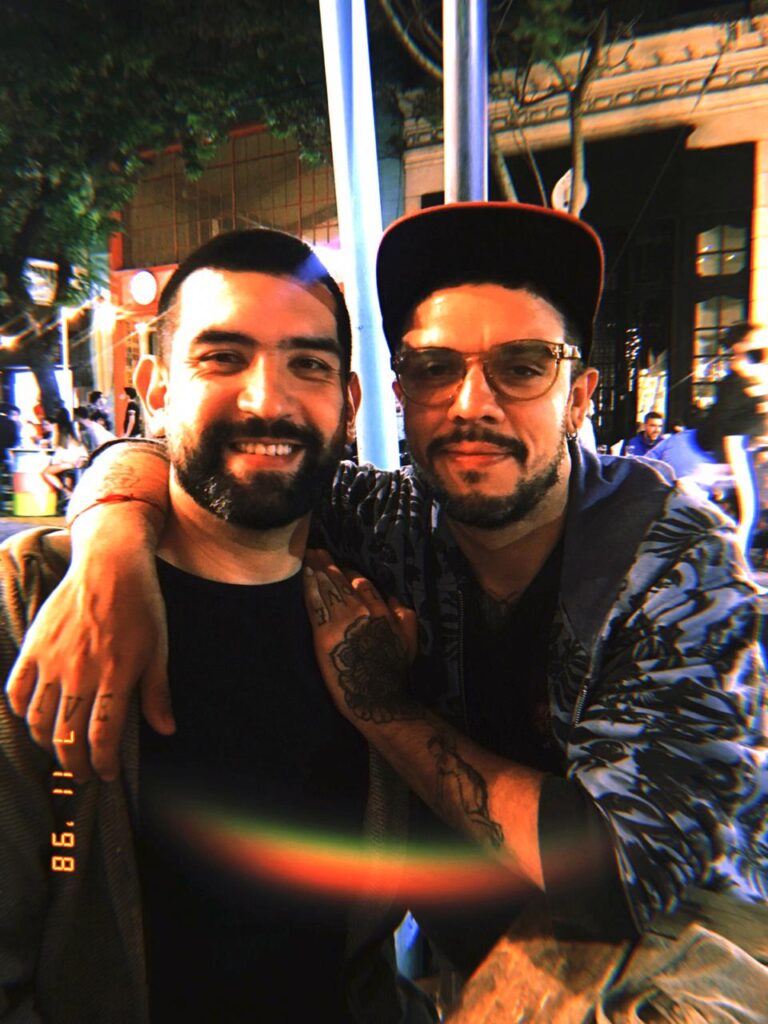
They say the prosecutor never met with them. They weren't even allowed to see the case file. "What's the message?" Pablo and Yaco ask. "They beat you up. They call you a faggot, the police do nothing, and the justice system doesn't punish anyone? Then we're surprised when things like Samuel's case happen in Spain.".
This refers to Samuel Luiz, a 24-year-old man who was brutally attacked and subjected to homophobic slurs. He died in the early hours of Saturday, July 3, outside a nightclub in A Coruña. His friend, Lina, told the media that the attack began with homophobic insults.
Facebook is not responding
After the initial dismissal of the case in March 2021, Pablo Cavaignac requested that Facebook be asked again for information about the users who had attacked them on social media. According to the new legal document, the prosecutor made the request but received no response.
He also requested an analysis of an Instagram profile, but, De Minicis wrote, “it has been concluded that no person could be linked to said profile.”.
However, after receiving this second file, Pablo Cavaignac asked to see the file and confirmed what he suspected: that profile had already been identified, the prosecutor had the data to call him to testify - including his document and the address of his home, the place where he studied and where he works - but she never did.
What's needed to move forward?
Emiliano Montini, director of Legal Affairs at INADI, says he is aware of these incidents and many others. Based on what he has seen over the years, he believes there is a lack of technical and procedural tools to move forward with these cases. One such tool is a comprehensive anti-discrimination law that amends Law 23.592 , among other regulations.
Until now, the law has not mentioned sexual orientation or gender identity in its text. It only refers to discrimination based on race, religion, nationality, ideology, political or union affiliation, sex, economic status, social condition, or physical characteristics. Organizations have been requesting this change 20 years
“At INADI , we are working on a comprehensive and innovative law with a strong focus on prevention and education , without neglecting the criminal penalties that the most serious offenses should receive,” he explained. His plan is to present it this year.
We are present
We are committed to journalism that delves into the territories and conducts thorough investigations, combined with new technologies and narrative formats. We want the protagonists, their stories, and their struggles to be present.
SUPPORT US

FOLLOW US
Related notes
We are present
This and other stories are not usually on the media agenda. Together we can bring them to light.