

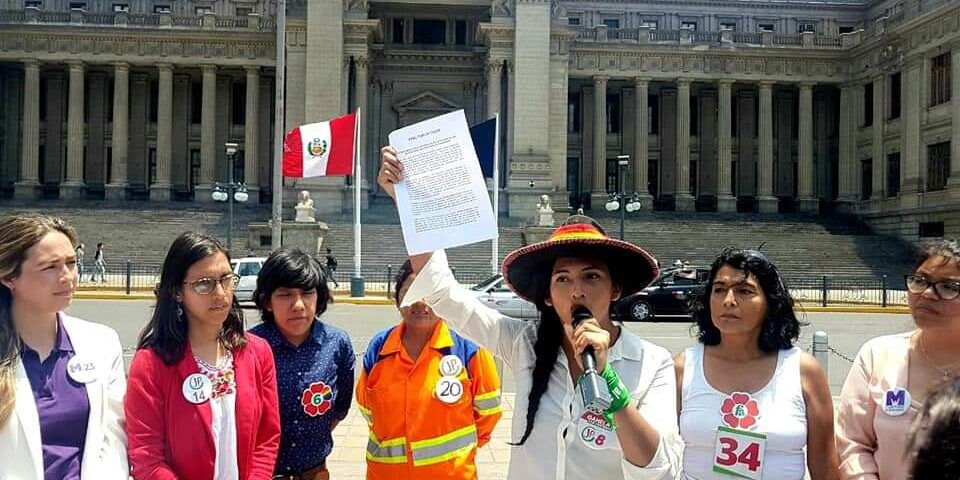
Trans activist and former candidate Gahela Cari was attacked in Lima while the Serenazgo (municipal security force) did nothing.
The Ombudsman's Office also issued a statement rejecting the "acts of transphobic violence committed against Gahela, which were allegedly witnessed by Serenazgo personnel from Cercado de Lima."


Share

Trans activist and former congressional candidate Gahela Tseneg Cari Contreras was attacked on the night of July 9th as she left her apartment in the early morning hours. According to her Twitter account, the young politician witnessed an act of violence against a woman by several men and intervened when Lima's Serenazgo (municipal security force) failed to protect the woman being assaulted, despite their presence. It was then that Gahela was also attacked by the men. According to her testimony, the police never arrived.
“How is it possible that some guys attack you, while the security guards watch them beat you, and the police still haven’t arrived to help? My crime? Being a trans woman, going out to take out the trash and asking a woman if she needs help. How much longer will the police and prosecutor’s office take?” Gahela wrote on her Twitter, where she also showed the injuries she suffered as a result of the beating.
In response, the mayor of Lima, Jorge Muñoz, stated that he " strongly rejected the act of aggression against a trans person that occurred in the early hours of the morning ," and added that an investigation had been launched to determine the responsibilities of the municipal staff who refused to help Gahela while she was being beaten.
Presentes contacted Gahela, who told us that what she has experienced is what most trans people in Peru experience, “ and it’s not fair to have to encounter transphobic people in the streets, but also to encounter a judicial system that remains homophobic, lesbophobic, and transphobic. It is necessary for the State and society to assume responsibility for guaranteeing us a life free from violence, and there will be no such life without a gender identity law that allows trans people to have a document with our information, without marriage equality, without laws that prevent corrective rapes, without quality education that reaches everyone, without a public health system that leaves no one behind. That is what I demand by making this act of transphobia visible .”
The activist received support from a team from the Emergency Care Service of the Ministry of Women and Vulnerable Populations, who accompanied her to the police station to file the corresponding complaint where she gave her statements.
The regulations are not being followed
In Peru, LGBTQ+ people are considered a vulnerable population and are therefore included in the National Human Rights Plan. Protocols for their care exist in the Manual of Human Rights Applied to Police Functions and in the Municipal Security Guard's Manual. Furthermore, Lima has had Ordinance No. 2160 since 2019, which promotes respect for equality and prevents, prohibits, and punishes all forms of discriminatory practices or acts in Metropolitan Lima. These legal tools were "forgotten" by the Lima Security Guard when they ignored the violence experienced by Gahela.
The Ombudsman's Office also issued a statement rejecting the " acts of transphobic violence committed against Gahela, which were allegedly witnessed by members of the Lima city security force ." The state agency responsible for ensuring respect for citizens' rights demanded a thorough investigation of the incident, adhering to the highest standards for the protection of the human rights of LGBTQ+ individuals.
The gender identity bill is about to be shelved
The Gender Identity Bill, which has waited more than five years to be debated in Congress, passed its first stage when it was approved in the Women's Commission in March of this year, but it stalled in the Constitution and Regulations Commission, which has so far not scheduled the legislative initiative as the end of the legislature and the arrival of a new government approach.
Lima councilman Manuel Siccha, who has been working with other activists to advocate for the passage of this law, told Presentes that “ everything seems to indicate that the gender identity law is going to be left hanging. We've even had two sessions with members of the Congressional Committee, where there was a clear consensus in favor of the proposal. However, the short timeframe and the negligence make us view any possibility with despair, knowing that the current legislature's term ends next week. This is yet another example of how our rights are treated as something that can be postponed, insignificant even in a bicentennial year .”
In Peru, trans people still cannot access a document that recognizes their gender identity, they are the population most affected by HIV/AIDS, their quality of life is diminished by structural poverty, they lack decent housing and access to health care with respect for their dignity, they are forced to perform risky work on the street, their life expectancy does not exceed 45 years, and they are part of the population affected by hate crimes, which occur in Peru with an average of 15 LGBTQ+ people murdered each year.
We are present
We are committed to journalism that delves into the territories and conducts thorough investigations, combined with new technologies and narrative formats. We want the protagonists, their stories, and their struggles to be present.
SUPPORT US

FOLLOW US
Related notes


We are present
This and other stories are not usually on the media agenda. Together we can bring them to light.