

Argentina has a Gender Equality Law in the media
The law establishes gender equity in representation from a sexual diversity perspective in state media staff.


Share

Early Friday morning, the Chamber of Deputies experienced a historic marathon of legislation on rights and gender. Following the preliminary approval of the Law Promoting Access to Formal Employment for Transvestite, Transsexual, and Transgender People, "Diana Sacayán – Lohana Berkins ," the Chamber also passed the Law on Gender Equity in the Media. This latter law approaches communication from a transfeminist perspective and aims to guarantee the representation of at least 1% trans and travesti people in all media personnel.
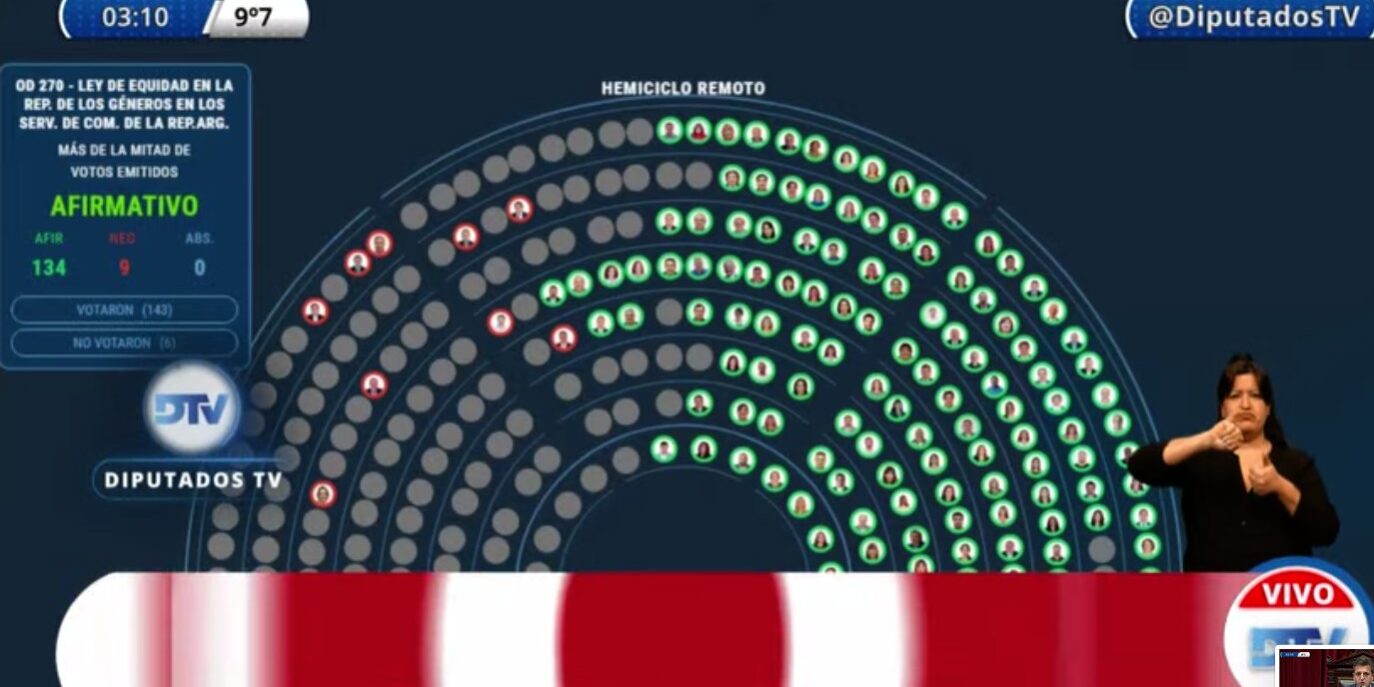
The initiative was approved at 3:30 with 134 affirmative votes contributed by the Frente de Todos, and the Federal and Federal Unity for Development inter-blocs, while a large percentage of deputies from Juntos por el Cambio stood up when the vote was about to take place, and the nine who remained in the chamber voted against it.
The project establishes that "equity in gender representation from a sexual diversity perspective must be applied to all permanent, temporary, transitional and/or contracted staff, regardless of the type of contract, including management and/or decision-making positions."
"Despite the pressure from media groups, the lobby to empty the session and the boycott of the transfeminist construction, we have achieved a new victory!", tweeted Mónica Macha, national deputy for the Frente de Todos and one of the promoters of the law, at the time of the approval of the project.
The project was presented by Senator Norma Durango of Frente de Todos, and incorporates a proposal from the Argentine Journalists collective and contributions from other feminist communicators networks such as LATFEM, who participated in a series of federal forums organized in 2020 by Macha.
What the law says
The law promoting gender parity applies to state-run media services. As for privately operated media outlets, they will be given preference in the allocation of government advertising if they present a certificate of gender equity. The aim is to reward media outlets that comply with the law's recommendations.
This point was the one that generated the greatest differences throughout the debate and the vote on the article that details it received 126 affirmative votes, 78 negative votes and 2 abstentions.
Thus, the regulation establishes a system that will "issue a certificate of gender equity for those providers that incorporate this principle into their structures and action plans." To access the registry and obtain the certificate, private media outlets must prepare an annual report demonstrating progress in gender equity from a sexual diversity perspective.
Another key point of the project is that it requires that "a representation of transvestite, transsexual, transgender and intersex people must be guaranteed in a proportion of no less than one percent (1%) of its total staff."
In the event of non-compliance with these obligations by those responsible for state-managed communication services, there will be sanctions, warnings and reprimands, and these "do not exclude those that may correspond by virtue of the status of public official of the offender."
"If only a few people speak, or the same people, or everyone from the same place or background, it's impossible to generate transformations and processes of autonomy. Regarding gender inequality, this is clear, compelling, and serious: women, lesbians, transvestites, and trans people have a much lower participation in the media," Mónica Macha argued in her case for the law's approval.
"In general, women and gender minorities are assigned marginal issues on the public agenda; in media boards, men occupy 75% of the positions, meaning we are absent from the media," the congresswoman continued, emphasizing: "The fair participation of women, lesbians, transvestites and trans people also implies a discussion about the roles, moments and spaces they occupy."
An intersectional perspective
The law promotes personnel selection processes based on equity, labor inclusion policies with a gender perspective, training in gender and communication, actions to support the distribution of care tasks, provision of breastfeeding rooms and daycare, promotion of inclusive language and creation of protocols for the prevention of workplace and gender violence.
Furthermore, the standard has an intersectional perspective that Macha made clear. "The participation of national universities gave the discussion a federal character and incorporated the perspectives of brown identities, Indigenous experiences, and community communication processes," she stated.
"We already know what happens when the public word is arrogated to the sectors of power: an unequal society is formed, with euphemisms to justify violence, with omissions, with arguments of class, gender and race against our life trajectories, our desires and our projects," she said towards the end of her speech in the chamber.
"That's why we need to guarantee fair and representative participation. Otherwise, we will always be defined by the violence of sexism and the discursive structures of patriarchy," she concluded.
We are present
We are committed to journalism that delves into the territories and conducts thorough investigations, combined with new technologies and narrative formats. We want the protagonists, their stories, and their struggles to be present.
SUPPORT US

FOLLOW US
Related notes


We are present
This and other stories are not usually on the media agenda. Together we can bring them to light.