

"Feminism has more resources than most political cultures to address animal rights."
Rosi Braidotti, philosopher and cartographer of ideas, does not consider herself an animal rights activist but an ally. She analyzes the possibility of an anthropocentric shift and the resistance to multiple forms of discrimination and patriarchal oppression, including human supremacism.


Share


By CATIA FARIA / Pikara Magazine *. Photos: CCCB
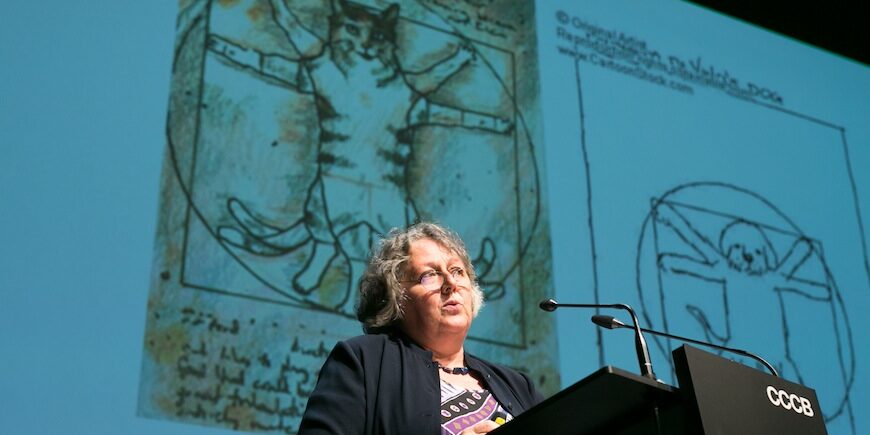
Rosi Braidotti is Professor of Philosophy and Director of the Centre for the Humanities at Utrecht University. She is considered a pioneer in feminist studies in Europe, having founded the Netherlands Research Centre for Women's Studies. Braidotti is situated within the tradition of continental philosophy, investigating the constitution of contemporary subjectivity and the concept of difference. This has led her to consider how ideas of gender difference can affect the meaning of other divisions, such as human and animal. In her latest works, * The Posthuman* (Gedisa, 2015) and * Towards an Affirmative Politics: Ethical Itineraries* (Gedisa, 2018), Braidotti explores how an affirmative feminist ethics and politics will lead us to a necessary anthropocentric shift that dismantles the idea of human supremacy over other species. Rosa Braidotti visited the Centre for Contemporary Culture of Barcelona (CCCB) to talk about how “Becoming Animal” is the response of resistance and political transformation to the multiple instances of discrimination and oppression that persist in the world today.
You gave a talk as part of a lecture series at the CCCB about the need to reconsider our relationship with animals. Given that human beings are, for all intents and purposes, animals (humans), what do you mean by “becoming animals”?
When I speak of “becoming animals,” I mean reconsidering what used to be a relationship based on oppression. We are equally “other” in the eyes of the dominant subject, and we need to transform ourselves into something much more affirmative. For me, affirmation consists of accepting vulnerability and remaking it. Vulnerability is not a problem to be solved; it is not a defining characteristic of humans. The defining characteristic of humans is the freedom to act upon the sources of our understanding. So too is our capacity to understand the sources of our oppression. That is what makes us ethical subjects. Understanding that animals were, in some way, historical allies of women and LGBT people situated as naturalized inferiors and, consequently, discriminated against.
Furthermore, animals are trapped in a highly complex set of operations within science, experimentation, and, of course, the food industry. Changing this instrumental and exploitative relationship, from the specificity of our respective positions, is one level of becoming animal. Moreover, animals are superior to human beings in one respect: they know their territory intimately. They are embedded within it. Human beings tend to be detached. Thus, becoming animal means becoming more ecologically connected to a territory, aware of its resources and limitations, and taking responsibility for that territory, which is simultaneously environmental, social, and emotional. Becoming animal means understanding that without air and water, no transcendental consciousness can exist that can become operational. Therefore, it means becoming embodied, within an immanent relationship. That is the other level of becoming animal.
Your work is particularly well-known within feminist studies, where animal rights don't usually receive much attention. Could you explain why you think we're in the midst of a post-anthropocentric turn and why this should matter to feminists?
Feminists, almost single-handedly, have invented the post-anthropocentric turn, along with the political vegetarian and animal rights movements. If you look at early feminist texts, women feel like non-subjects, which made them feel closer to other non-subjects, whether colonized peoples, non-whites, animals, or extraterrestrials (if you look at feminist science fiction). There has always been a very strong historical alliance with men's "others." And you can see this kind of affinity in literature, even more so than in philosophy.
I think that right now the post-anthropocentric turn has become very urgent due to the combined impact of the Anthropocene and advances in the life sciences and technologies. In the life sciences, from Dolly the sheep onward, we have found that animals have entered the production cycle of contemporary capitalism. Capital today is the knowledge of the cause of the genetic information of all living systems. Cognitive capitalism, research capitalism, platform capitalism: there are different ways to refer to this particular moment. It is a real transformation of what counts as capital. We are producing knowledge systems and capitalizing on them. Thus, the status of animals and other non-humans is a feminist issue because it concerns the return of otherness to men, so to speak. Feminism has more resources than most political cultures to address this issue, insofar as we have a long history of affinity with the oppressed, who are not given the same status and rights as men.
In your work you say that “posthuman” is not a concept, but a tool for examining the question of “what does it mean to be human?” But why are we still asking ourselves that question? Isn’t the need to redefine the human still a reaction to the progressive eradication of human supremacism? Why not simply eliminate “human” as a category with moral and political relevance?
I believe that the posthuman is a critical stance toward a dominant notion of posthumanism that is being operationalized at all levels, including university research and certainly in policymaking in the business world. And the dominant view is, in fact, “transhumanism,” that is, “human enhancement.” Today’s humans are insufficient; our brains are slower than computer networks. Our genetic system contains flaws. Our neural system has significant limitations when compared to those of dolphins and bats, not to mention supercomputers.
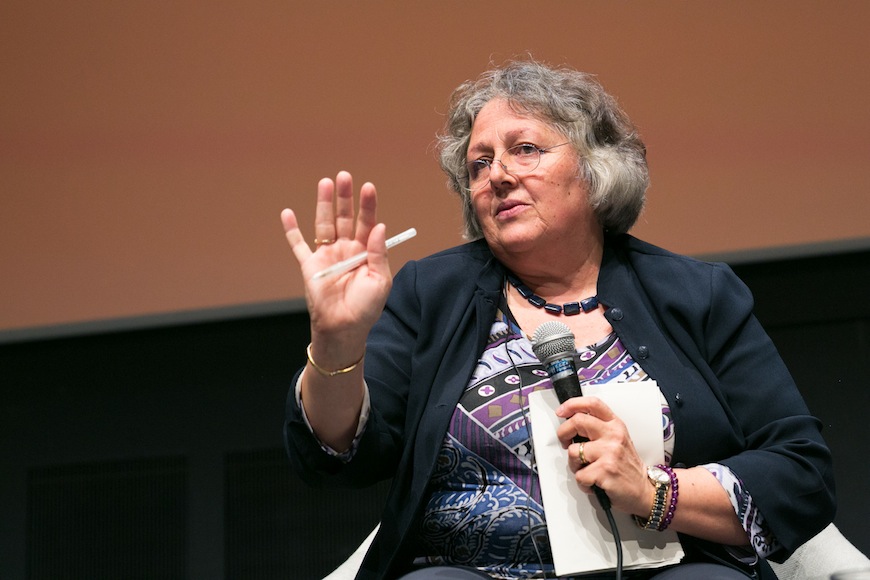
This is the form science is taking; the fourth great industrial age is based on the life sciences, and since the deciphering of the human genome, it has completely controlled our understanding of where we are headed. This has some paradoxical consequences. One of them, which may be frightening but is potentially very affirmative, is that our science and technology are capable of reconstructing extinct species—we have phenomena of rewildhood, for example—and of creating new life forms through synthetic biology. We are not only exploiting nature. This is a very novel situation and may frighten us, but it can also be part of the solution. For example, artificial meat. This could be the solution to a major problem. And yet, it hasn't exactly been met with great enthusiasm because people really miss the animal aspect. We still want to eat the animal. There is a whole cosmology behind this, a whole religious system where humans have interacted deeply on a carnal level.
It's important to say that these developments are ongoing. That's why I say that the posthuman is also a navigational tool. It sheds light on these ongoing developments and allows us to see what different options are emerging, what positions are developing. For example, this dominant Silicon Valley system model, which would be analytically post-anthropocentric—that is, it lets computing and networks do the thinking—continues to reinstate humanist values in terms of norms. This model is an aberration. Because it takes this incredible surge of technologies and links them back to a narrow notion of liberal individualism—white children and their machines. There's a deep element of racism; it has to do with white supremacy.
But why is Silicon Valley providing us with the model for the kind of posthumans we are going to become? For me, posthumanism must converge with post-anthropocentrism. The patriarchal rule of Man must be questioned, as must the supremacy of the Anthropos species. It is a complete process of total opposites.
That's why, again, I think this is a feminist issue, because we've always had our prototype of how to redefine what it means to be human. Let's consider one of the earliest, and also one of my favorites: Allyson Jaggar's 1980s feminist text "Feminism and Human Nature," in which she examines the implications of different schools of feminism and poses the question of their visions of human nature. We've always had a vision of what human nature should be. We've disagreed about it, from radical feminists to the SCUM Manifesto; Donna Haraway and Hillary Clinton's liberal model, Emma Watson and the socialists who still think capitalism will eventually collapse. But despite all these differences, we've always had prototypes of what it means to be human, so I think it's our issue, and we shouldn't now leave it in the hands of the white guys in Silicon Valley and their own manifesto. We must make our voices heard, for diversity, solidarity, and non-profit.
Speaking of ethical disagreements, I'd like to bring up one of your many disagreements with Judith Butler. In this case, it concerns your own definitions of ethics. You say that for Butler, ethics is the acceptance of the other's vulnerability and loyalty to them. You disagree with this definition, stating that for you, "ethics is the transformation of the negative into the positive." However, I don't see a clear incompatibility between these definitions. Could you please explain this disagreement and specify how each approach would lead to different ethical outcomes?
People always exaggerate the differences between feminists. I start from Spinoza's notion of joy. Joy is not optimism, which is the ideology of advanced capitalism. It is working with pain to gain a keen understanding of what we are up against . In the tradition of Levinas and Derrida in which Butler works, vulnerability is in a sense untouchable, a defining trait that you must respect and honor. I see that there is truth in that, but I cannot stop there.
For me, that's a recipe for paralysis and inaction. But it's very noble. For Spinoza, vulnerability is the capacity to be exposed to multiple relationships, and that's our defining trait as living entities. This exposure to different degrees of being is the material we work with. It allows us to form alliances with animals and with different groups to gain a sharper understanding of what we're up against. But an immune system is collectively built by discussing problems, breaking down the barriers that stand against our understanding. The fact that we have the same kinds of genes as higher primates makes me feel less alone. It makes me feel like I'm in a joyful kinship system. But for many people, this is a crisis: "Oh my God! I'm not that special!" And you know what? We're not. But then again, as feminists, our egos have been reduced a priori , so I don't think this is a major crisis.
I think if we could recall the resources that feminist political culture has in this regard, we would see that we have been dealing with this for a long time. So we should return to this tradition and make good use of it. Affirmation is not a psychological issue: it is a matter of power and empowerment. We are in a toxic environment, but we need to engage with it. Ethics is the antidote, which consists of assimilating the world, swallowing the poison, and thus building your resilience by cultivating the collective practice of joy. This is my world, it's the only one I have, now let's see what we can do about it.
One of the central methodological concepts in your work is that of “nomadic subjectivity.” How would this concept function in a non-anthropocentric politics of location?
Nomadism has always been linked to transversality, to embodied and embedded entities, and it is connected to territories and communities. What has become more acute in my understanding of nomadic subjects over time is that these groups include large numbers of non-humans. What has changed is a broader awareness of the Anthropocene, that “we” are all in this together in this crisis. It is embodied and embedded because it is about “us,” not “them,” but we are not identical . We differ even though we are part of the same problem (climate change, the new economy, etc.). The idea that you are outside the problems you face, that you are transcendent because you deny them, because you confront them, is a very bad trick, and I don't believe in it. In the politics of immanence, we are part of what we are trying to change, and therefore we need to do it differently: not waiting for dialectical confrontation to provide a synthesis, but working together to create the conditions for subversion and the boundaries of what we can do as a community . For example, should we make robots pay taxes? Should we resist enhancement, or on the contrary, should we perhaps have DIY ? Preciado is absolutely right on this point. At the heart of all this lies the notion of the commons: we must do this as a community, accepting our different locations as well as our shared concerns.
Despite your rejection of anthropocentrism, you don't consider yourself an animal rights activist, but rather "a philosopher and cartographer of ideas." How do you justify this apparent contradiction with your advocacy of a synergy between political and academic engagement?
I come from another political movement in which I'm still active: antifascism. The animal rights movement has a tradition of political action that includes direct action and other things I'm not directly connected to, though I am involved across the board. That doesn't mean I take a passive, spectator role. I'm not just mapping the situation, but also providing alternatives. For me, the ethical and political praxis that comes from an ethics of affirmation requires proper understanding. If we don't understand our own conditions of oppression, we're left out. This is very difficult because it involves shedding the illusory fantasies the system throws at us. And in the future, between the resurgence of religious fundamentalism on the one hand, and populism and fascism on the other, and Silicon Valley enhancement projects everywhere, we're surrounded by fantasies . Now, working on a proper understanding of these issues is a form of activism that doesn't get funding. The old political families are fragmented and each in its own corner. I don't see myself as an animal rights activist, but rather as an ally. Proper understanding and knowledge are changing public opinion around us. It would be hypocritical of me to say it's my political family, although I do see potential alliances. Then there are the internal differences between the more liberal and more extreme versions of animal rights. It's very analogous to what's happening in feminism. I'm hopeful that we will be allies. That is, in fact, the idea. And there is much to be done.
This article was originally published in Pikara Magazine . To learn more about our partnership, click here .
We are present
We are committed to journalism that delves into the territories and conducts thorough investigations, combined with new technologies and narrative formats. We want the protagonists, their stories, and their struggles to be present.
SUPPORT US

FOLLOW US
Related notes
Without feminism there is no future: Women and diverse groups united their ongoing struggles on March 8th
Antifascist and Antiracist Pride March against the Milei government: "No life is disposable"
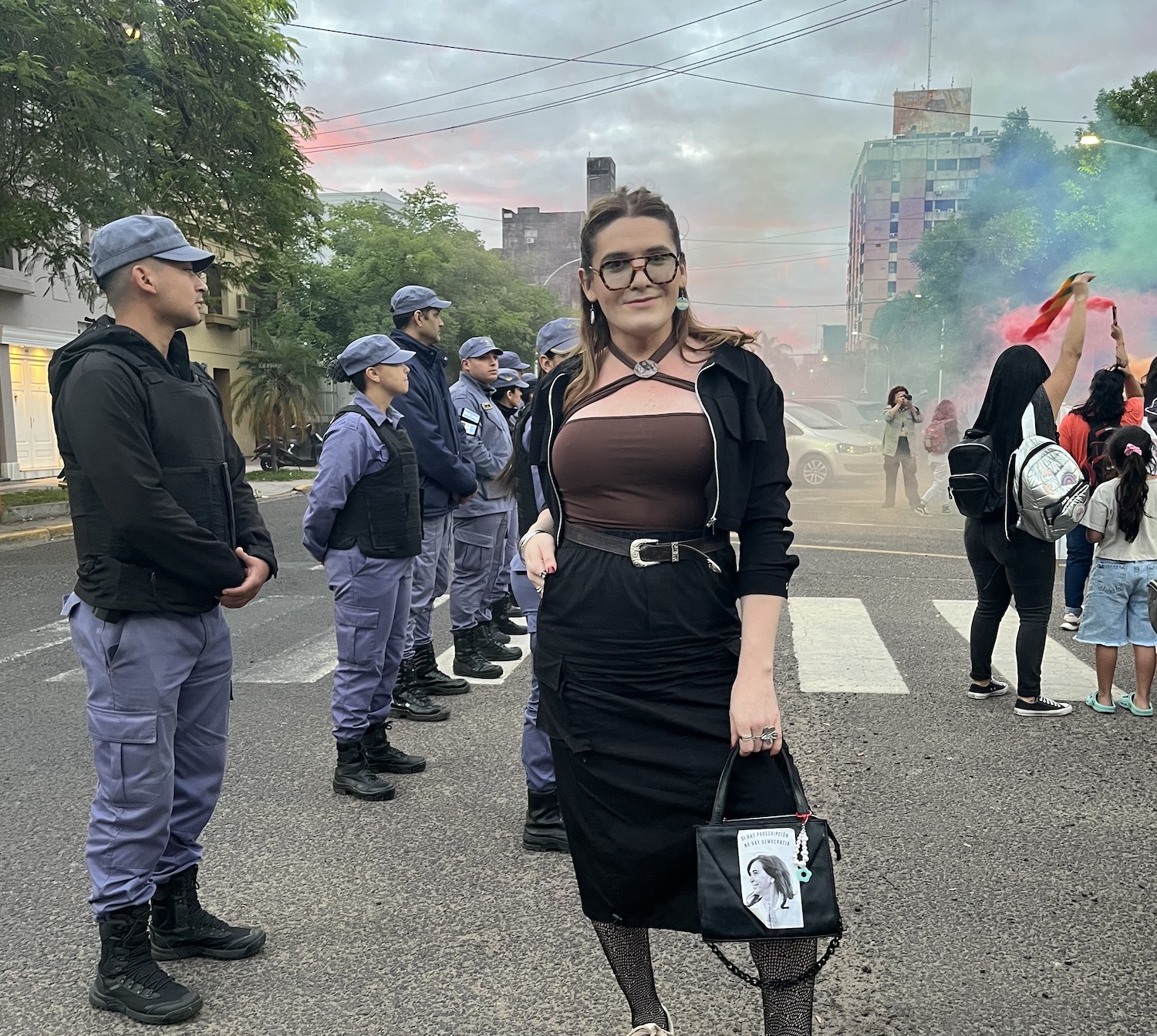
Julieta Gómez, trans communicator: "Uniting our struggles so that there are no other cases like Loan and Patricia"
We are present
This and other stories are not usually on the media agenda. Together we can bring them to light.